
Places and landscapes
The great arena of Qor-Zaï
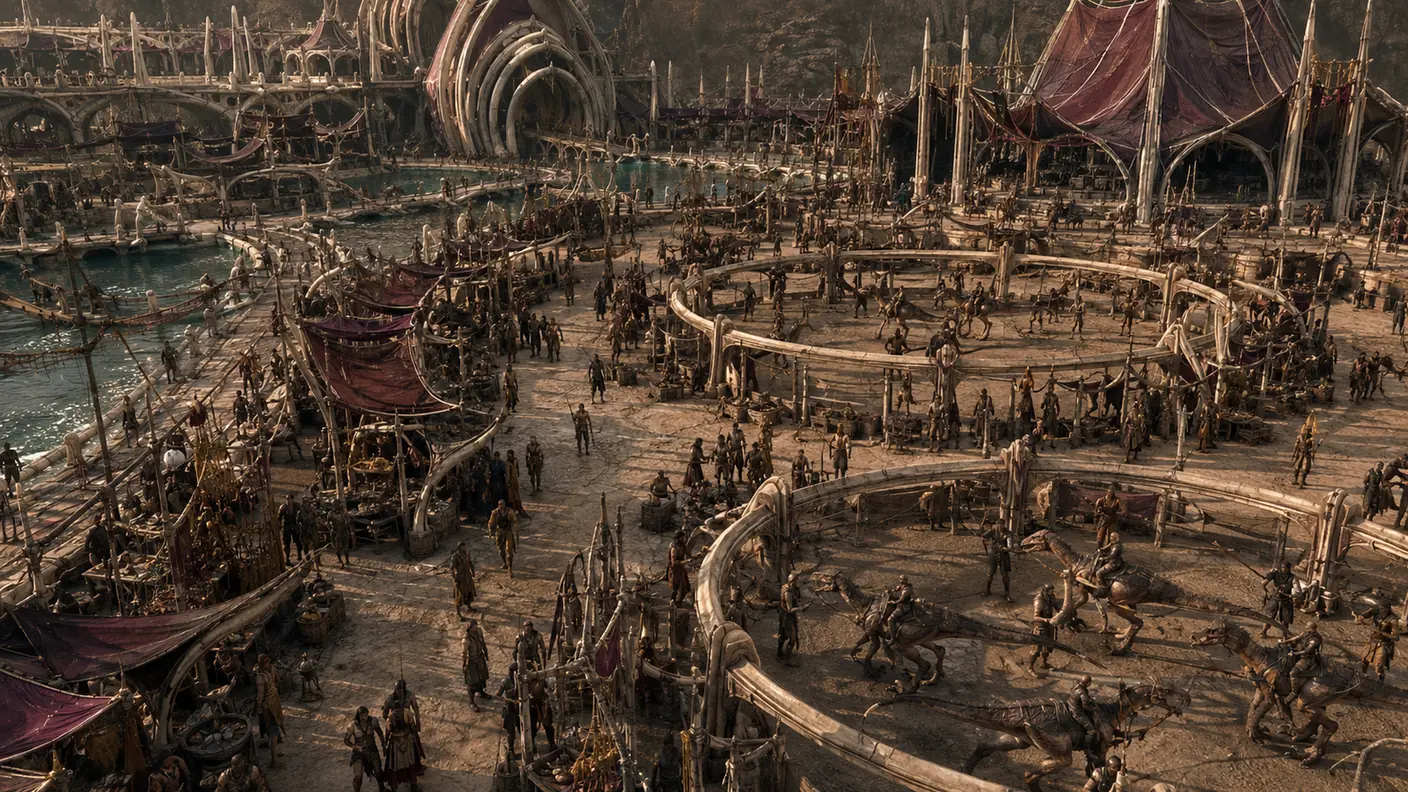
Qor-Zaï has a great arena of earth and bone, surrounded by small training yards. Restraint gates, sacrificial barriers, veterinary pits and carcass winches keep the public, the beasts and their masters apart.
Three separate exits
Qor-Zaï’s great arena is unique: the city is not a series of civic arenas. Its tiers are of earth and bone. Restraint gates and sacrificial barriers protect the spectators; water, veterinary pits and carcass winches serve the animals, living and dead. The public, the beasts and the masters each have their own exits.
A great predator requires an organisation that goes far beyond its appearance in combat. Its meals, its rest, its jaws and its teeth determine its availability, and specialised surgeons take part in this upkeep.
The training yards
Around the arena, small yards serve for training and as pack grounds. Their spiral plan exercises and distributes the animals without directing the whole city. Outer feeding troughs, resting niches, stakes, clan scents and pigments equip them. Pack masters know their shortcuts, and a straight emergency exit always makes it possible to break a panic. Hatcheries use the same form.
What is shown there
The great arena serves first of all to show what beasts and those who lead them are worth. New raptor lineages are presented there before the keepers of lineages and the buyers; riders from clans claiming a rank are tested on courses of turns, jumps and restarts; pack trainers show that they can launch, halt and recall dozens of beasts by the sound of flutes alone.
Regulated fights between shock carnivores, carnotaurs above all, bred for the charge, are also held there. They rarely go to the death: a valuable beast is not wasted, and the fight stops when one of the masters raises his staff. No man faces a beast there for show; the Arkhans leave that kind of game to other peoples.
The masters of the arena
The arena belongs to no clan. The Crown of Bone entrusts its running to the masters of the Great Arena, who hold it by concession and answer to the treasury for it. They maintain the stands and the gates, rent out the training yards, employ the tenders, the winch hands and the barrier guards, and keep a dozen shock carnotaurs in residence for fight days.
Seats are paid for, in Dracos or in kind, and their price depends on the programme: a lineage presentation draws connoisseurs, a great fight fills the stands to the top. The arena masters are also middlemen: many mounts change hands in their yards, and a beast that has shone on the arena’s earth sells for more at Sand Port.
A crowd in tiers
The stands of earth and bone are divided by clan, each recognisable by the pigments painted on the posts of its section. Children crowd at the very top, where one sees best and can flee fastest. Between the rows move sellers of grilled eggs, strips of dried meat and water by the ladle, and bettors knotting the stakes on their cords, as at the Great Race.
Foreigners are seen there too: Volonian merchants come to judge beasts before buying them, envoys waiting for an audience, a few curious visitors from Korath. The crowd roars during the fights and falls silent at once when a barrier gives way, because everyone then knows which exit to run for. That sudden silence is, people say, the most frightening sound in the arena.
Healing after the game
A wounded beast does not leave the arena by the same gate as the others. It goes down into the veterinary pits, where it can be held without being shut in, fasted, wedged and sewn up. Jaw surgeons and claw tenders learn their trade there on valuable animals, under their masters’ eyes, and many of Arkhan’s great practitioners made their first sutures beneath these stands.
The carcass winches serve on the days when care comes too late. A dead beast is hoisted, taken out through the masters’ exit and led to the flaying yards, where its bones, teeth, tendons and hide enter the ordinary supply chains. Nothing is lost, and certification follows the material all the way to the workshop.