
People
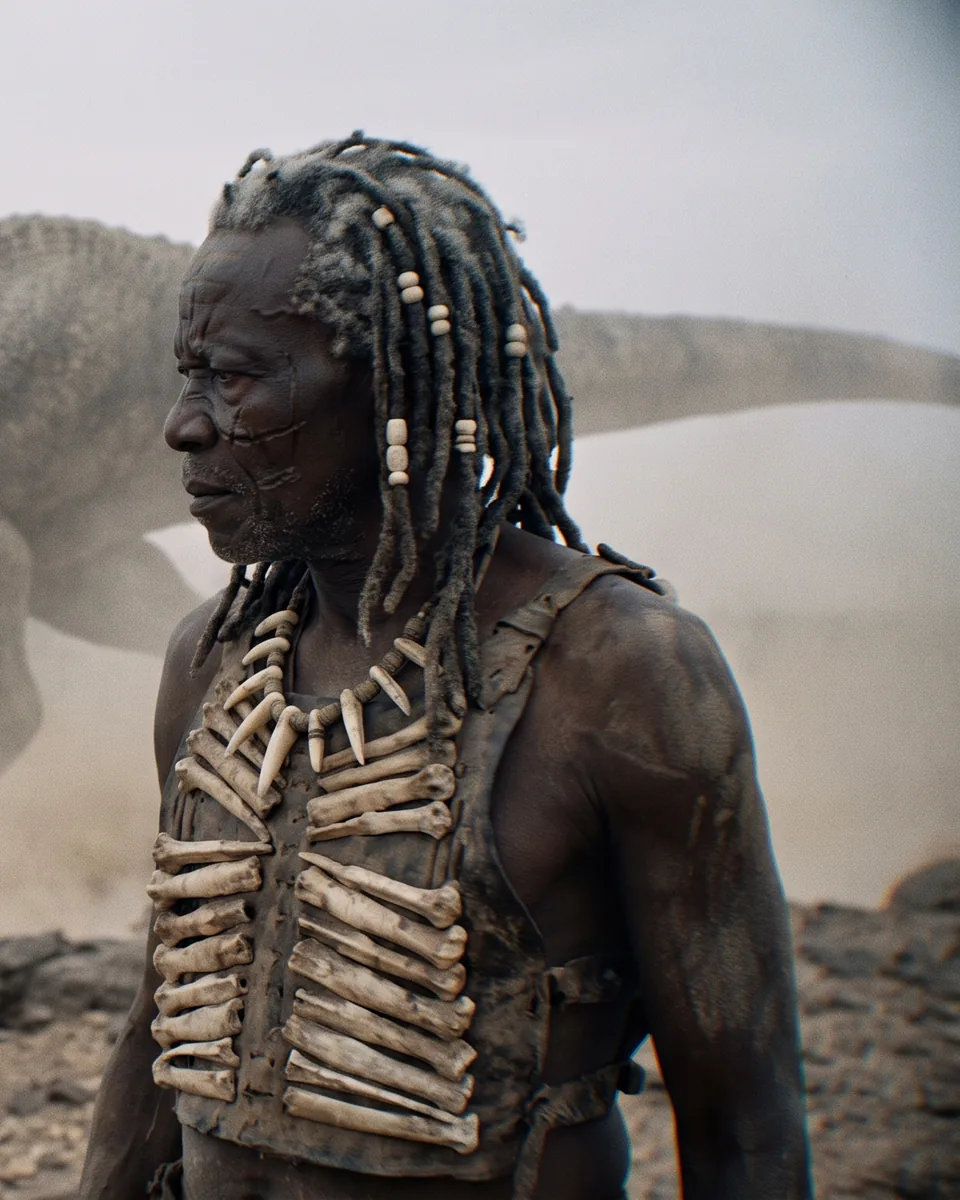
Orgaï
Arkhan’s supreme khan: a power of convergence, trails and living command.
Counting the trails
Orgaï stands at the head of the Great Horde. The great banners retain their forces and traditions; bringing them together requires understanding their interests as well as their direction of travel. Federation is part of his authority, without reducing him to a mere arbitrator without command.
A power that must travel
The Great Moult exchanges the active and governing populations of Arkhan’s cities. Qor Zaï remains fixed, but the supreme khan undertakes the Tour of the Seven Trails. The Guardians of the Empty Saddle watch his seat during this journey: the leader’s movement is part of political continuity.
Commanding from a living animal
Orgaï commands from an Apex, among a guard of great theropods and riders. The mount imposes scale, pace and constraints on the staff: power is not exercised only behind a table. The movement of orders must follow that of humans and animals.
Ce que réunir les bannières exige
This extended reading is currently available in French.
Orgaï est le Khan suprême d’Arkhan. La grandeur du titre ne transforme pas les grandes bannières en unités interchangeables. Chaque groupe arrive avec des forces, des traditions, des intérêts et des vivants dont les besoins doivent continuer d’être satisfaits. Fédérer exige de comprendre ces différences et de leur donner une direction commune.
Réunir des hommes ne suffit pas si leurs itinéraires, leurs réserves ou leurs montures ne peuvent soutenir le même mouvement. Le chef doit faire tenir un ensemble qui conserve une part de son autonomie. Cette capacité ne le réduit pas à un arbitre : le commandement existe, mais sa réalisation dépend du passage entre une volonté centrale et les ressources concrètes des pistes.
Qor Zaï demeure la capitale fixe. La Grande Mue ne déplace pas géographiquement la cité ; elle oblige cependant le Khan suprême à accomplir le Tour des Sept Pistes. Il assiste aux transmissions, confirme les autorités et arbitre au contact des villes et des populations. Les Gardiens de la Selle Vide veillent le siège pendant ce déplacement. Le départ n’est donc pas une interruption de la souveraineté. Il en est une manifestation : le chef doit rester capable de rencontrer ce qui dépend de lui.
L’adversaire de Marjory
This extended reading is currently available in French.
Aux Trois Ondes, Orgaï commande face à Marjory. Les deux figures appartiennent dès lors à une mémoire militaire qui dépasse leur seule civilisation. Leurs forces ne portent pas la même organisation, mais toutes doivent faire agir des masses humaines et de grands vivants dans un terrain qui impose ses limites.
La bataille forme un passé public, non une intimité entre eux : nul ne sait s’ils se sont parlé ni même rencontrés. Ses conséquences, elles, sont connues : l’ampleur de la mobilisation, les pertes animales et la place de chacun au commandement. Orgaï possède ainsi une histoire bien antérieure aux événements présents.
Le chef des pistes n’est pas seulement une silhouette montée sur un prédateur. Il a déjà affronté un autre système de puissance et porté les responsabilités d’une guerre de grande échelle. Son autorité se comprend dans cette capacité à réunir et à faire agir des forces, mais aussi dans les besoins qui demeurent après l’affrontement. Le mouvement ne supprime pas les coûts ; il change la manière dont le pouvoir doit les porter.
Before the title: the officer of the Three Waves
Orgaï has not always reigned. At the Three Waves, many years before he rose to the supreme office, he was between twenty-nine and thirty-four and only the second or third military chief of Arkhan. A descendant of great clans, at ease with the elite, a former officer of the north-west and the Red Lands, he held local command of a hundred and fifteen thousand fighters under the Supreme Khan of the day, Zarsalaï. His mission was to slow and divert the Urnok army, cut its supplies and help lock down three cities. He was already riding Morg-Khaï, then still young.
The battle was a tactical victory for Urnok, but it made his name. Orgaï launched four diagonal waves of Apex with distinct functions — to ask the question, to test the correction, to offer an apparently complete reading, to strike the depth the first three had prepared — and had his infantry open corridors into which noasaurids poured. He surprised Marjory twice, something that had never happened to her before. Twenty-two great Apex were lost, but he turned palisades, artillery and surviving Apex into delaying lines and brought most of his army home.
The man who closes his eyes
The Supreme Khan is an old man today, and he plays on his age. In council he often closes his eyes; everyone thinks he is dozing, then he restates every promise in the order in which it was made. His voice is slow, made of images of trails and seasons, broken by long pauses; he rarely explains the middle of his reasoning. His words keep returning to the same things: wait, walk, meat, water, old, again. He makes very few gestures.
His objects are those of a man of memory: knotted cords, fires, bones, silences. His public reputation wavers between three readings, an old man perhaps outdated, perhaps asleep, perhaps sacred, and he takes care not to settle the matter, since his chief way of lying is to let people believe he is sleeping, forgetting or out of his depth. Under pressure he turns to ritual, listens, goes still and delays until the others have revealed what they want. His form of tenderness is to give a name, a rank or some patience to someone the others would have used up.
A generation of fragmented khans
Orgaï was born into a generation of divided khans, in which clan freedom was sacred and continuity almost impossible. He saw enough local victories produce collective defeats to distrust them. His training combines trail warfare, oral arbitration, the memory of promises, the logistics of the Horde and a deliberate use of myth: he knows what a story can set marching.
His wound is to have watched too many khans confuse freedom with self-destruction; his desire, to build a unity that outlives the need for his own person. His shame, which he never shows, lies in his age, his slowed body and the fear that the young khans now obey only his legend. When he gives way, he takes up the voice of the old absolute khan and humiliates people in public. He loves talented people by placing them in a story larger than themselves, which can be an honour or a prison.
The voice, the memory and the mount
Orgaï’s power passes through a few people and one beast. Nzaru the Long-Shadow, from the Marcheurs du Vent, is his voice and his eyes: he says what Orgaï has already decided and draws the maps the Supreme Khan needs. Keshan Sept-Pistes, an old man and his operational right hand, arbitrates between the khans and holds the memory of trails, water and relays; he repeats the terms of an agreement word for word and has knotted his seven cords even into the harness of his old Vrii, Nœud. Morg-Khaï, the tyrant of Qor-Zaï that has carried him since his youth, reminds everyone that the Supreme Khan commands from an Apex.
In a council of Orgaï’s the roles are shared out like this: Keshan recalls what was promised, Nzaru says what will be done, and Orgaï, eyes closed, lets the khans speak to the end. Those who have spent time with him say you know he has decided when he opens his eyes again, and that by then it is too late to argue.
Part of this article covers events of season 1. Turn spoilers on in the menu to read it.