

Creatures
Arkhan — Le vivant, des soins aux manœuvres
Observer les anatomies, entrer dans les enclos, suivre les équipes de soin puis les retrouver sur le terrain d’exercice : ces scènes rapprochent le bestiaire de la vie des civilisations.
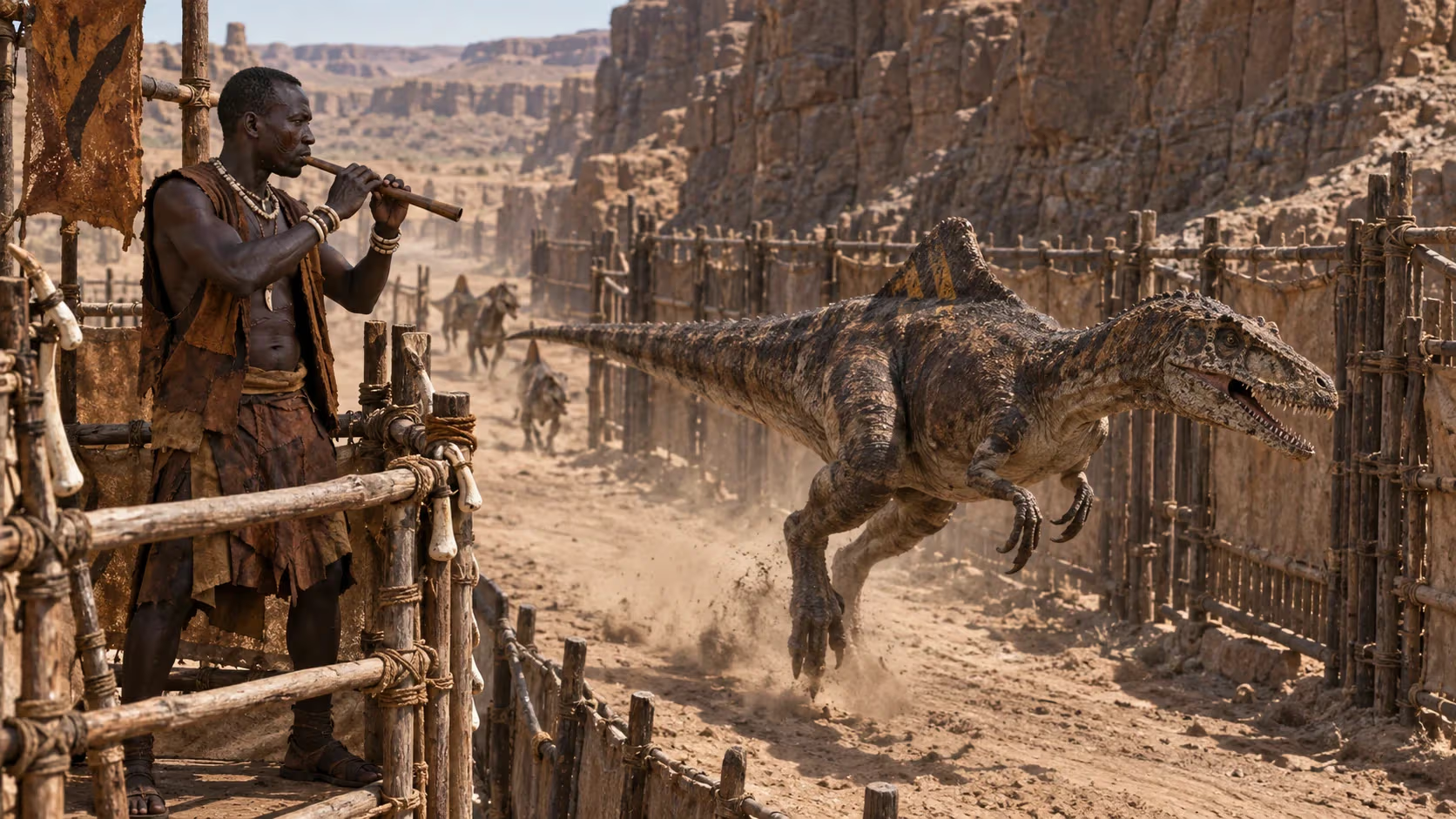
Enclos, soins et circulation
This extended reading is currently available in French.
Les raptors, les élevages et les métiers de maintenance inscrivent le vivant dans les déplacements d’Arkhan. Harnais, pièces d’os, tendons et équipements demandent un travail régulier. Veska Sarr représente un savoir de soin précis, tandis que Vashkar relie sa fonction à des matières et des usages. Préparer une bête ne consiste pas à lui ajouter une armure : il faut aussi maintenir la mobilité, observer les blessures et connaître les limites de ce qu’un équipement permet.
Observe gestures and materials · 2 images
La veille du canyon
Pistes de la Confédération · surveillance carnivore.
Le passage du mufle court
Enclos claniques · retour et inspection.
Le détail du vivant se découvre dans les gestes ordinaires : un harnais ajusté, un dégagement vérifié, un troupeau orienté.
L’animal au milieu des hommes
L’exercice donne à voir les distances entre formations, les signaux et les zones de rotation. Certains animaux travaillent avec une unité ; la faune sauvage croisée à l’exercice n’en est pas domestiquée pour autant.
Observe gestures and materials · 2 images
La frappe puis le décrochage
Pistes de la Confédération · raids, rupture et décrochage.
Le choc des enclos claniques
Enclos claniques · choc contrôlé et exploitation par l’infanterie.
Maintaining Arkhan’s living animals
The body before capability
A jaw, tooth, skin, tendon or joint creates material needs before any use. Care work begins by assessing a condition and preventing an injury from spreading. For Apex animals, the oral care practised by Veska Sarr offers a precise example.
Maintaining Arkhan’s living animals
Equipping the outside does not heal the inside
Arkhan’s composites combine bone, leather, tendon, resins, textiles and reinforcement. Preparing them requires skills different from caring for a living body: select material, assemble it, test its hold and preserve mobility. Armour repair can support movement; it does not replace diagnosis or surgery.
Maintaining Arkhan’s living animals
The chain does not become a caste
Care, workshop, driving and command are distinct skills. Their coordination makes it possible to accompany animals, maintain equipment and organise movements.
Veska Sarr, Apex mouth surgeon
Treating a great predator’s mouth
Veska Sarr is an Apex mouth surgeon. Teeth, jaws, gums and infections determine what a very large carnivore can still do. Her practice belongs to living-animal maintenance: treat a body before pain, a fracture or an abscess becomes danger for the animal and the teams around it.
Veska Sarr, Apex mouth surgeon
Observe, secure, repair
Veska Sarr works in dental and oral surgery for Apex animals. Her team must be able to examine a large living being, prevent dangerous movement, assess an injury and then decide on care. Effectiveness comes from a care chain, not an isolated heroic gesture.
Veska Sarr, Apex mouth surgeon
Care is not equipment
The surgeon works on the living interior; the armourer works on exterior equipment. Animal medicine, armour manufacture and military command remain separate. Both trades can depend on the same material supply chains and mobilisation calendars without becoming one power or one person.
Material before symbol
Vashkar combines selected bone with leather, sinew, horn, resins, adhesives, metal and cushioning textiles. His judgement concerns fibres, thickness, fracture, fastening and weight. The social term bone smith does not mean that he heats a rib like iron.
A craftsman with workshops
His business provides moderate prosperity, staff, apprentices and stocks. He prioritises function and availability and dislikes shoddy work. He employs someone to handle the accounts he hates and can be late despite his thriving enterprise.
The human boundary
Human bone is absolutely excluded from craft, even when it comes from an enemy. Identifying a human piece stops the work chain. This boundary belongs to Arkhan’s material culture as much as the expertise that identifies a bone by touch.
Food also moves
Arkhan keeps open herds of common beasts and larger animals guided by flutes and mobile slaughter facilities. Drazka and the Sand Serpents carry a food chain within them. Food thus travels with a society of tracks.
Feeding rider and animal
People eat dried meat, roots, game and farmed flesh; animals receive carcasses and offal. Animal provisioning is not a copy of the human meal. A force preserves mobility only if both needs are met.
Material after food
After battle, a legal economy of animal recovery takes over. Leather, bone and sinew enter biocomposite workshops with an absolute separation of human remains. The living chain therefore does not stop at an animal’s use or eating flesh. It continues through sorting, treatment and craft.
Mobility that shapes society
Raptors are a major part of Arkhan’s fauna alongside carnosaurs and noasaurids. Their use accompanies a civilisation that places authority in trails, memory and reputation. An animal emblem is not equivalent to zoological exclusivity.
Two speeds in the town
A raptor district can distinguish a fast animal trail from a slow human path. Holds, cushioning hides, turning landings and sandy fall zones support movement. These facilities remain local; an entire capital does not become a jumping course.
Training with a way out
Pack areas and training yards combine feeding places, resting niches, scents and clan marks. Keepers know the shortcuts. A straight emergency exit and panic breaks remain necessary: managing a pack also requires planning for refusal and alarm.
A morning at the enclosure
A scene repeats itself every morning in every camp in Arkhan. Before sunrise the carers enter the enclosures, hands rubbed with resin and an oil lamp in hand, and make the round of the beasts. The raptors raise their heads one after another, sniff, unfold. A carer crouches in front of a mount that is favouring a leg, takes its foot, spreads the toes, pulls a splinter of stone from a pad; another runs a hand under a jaw to feel its warmth. An old female watches it all from her corner, and the young do not come near until she has got up.
At the entrance of the enclosure the saddlers wait with their pieces. A new strap is tried, a lashing redone, a saddle greased before it is set on. The riders come last, look at their beast for a long time before touching it, and mount only after feeling it relax under their hand. None of this is spectacular, and yet it is what lets the columns leave on time.
On the exercise ground
The exercise ground tells another story. On a stretch of packed sand at the edge of the camp, riders wheel their mounts in tight circles, halt at the whistle, set off again at the drum. Further on, a file of young raptors learns to keep in line behind an older beast; on a bank, two Vur-vaa climb and come down an earthen wall under the eye of a trainer who never shouts. Distances between the beasts are measured in paces, and the turning areas are marked with painted stakes.
There are many onlookers: children perched on the stockades, elders sitting in the shade commenting on every fall, merchants come to assess the beasts before a sale. A mount that refuses an obstacle is not beaten; it is brought back to the start of the course and the exercise begins again, as many times as necessary. Foreigners who watch these exercises are often surprised by the calm that reigns there, having imagined the Arkhan cavalry as a howling pack.