

Trades
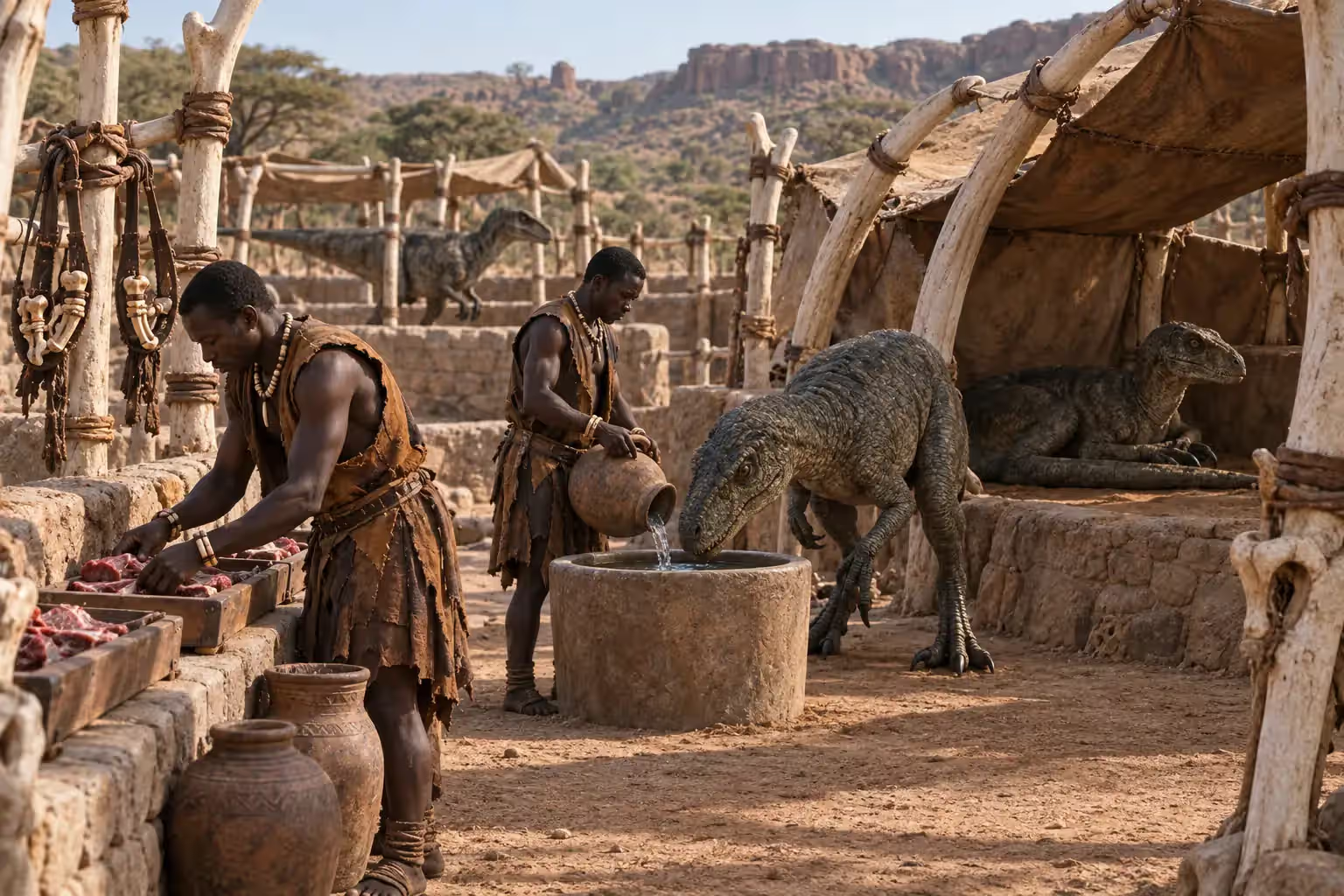
The pack-trainer
The pack-trainer carries tacit knowledge that Arkhan does not sell: it is not exported as property, and moves only through marriage, hostage-taking or adoption.
Knowledge that is not for sale
Arkhan’s mount-trainer conditions raptors and ornithomimids. Whoever knows how to hold a pack carries tacit, irreplaceable knowledge that the Confederation treats as a strategic good: the pack-trainer is not exportable as property. His knowledge goes abroad only through marriage, hostage-taking or adoption into a clan.
Some bands have made it their speciality: that of the Morsure-Douce tribe is training from hatching.
Not triggering the hunt
Arkhan excels at living alongside predators: there, people are taught how not to trigger the hunt. The school-camps that follow the migrations across the steppe, known as the Conservatory of Calm Packs, teach applied ethology — managing stress, preventing frenzy, reading group signals —, movement tactics and an operational language of shouted or sung codes, short enough to carry through wind and panic.
These schools award three titles: Pack-Keeper for ethology, Wind-Tracer for movement, Voice of Cadence for codes and command. Their main mounts are fast and frugal; heavy predators are reserved for rare units.
The pack at war
In war, the pack-leader commands the units of runners and raptors. The pack also feeds on plunder: under the Rule of Three, one third of the spoils feeds the pack, which literally means keeping the beasts fit for work.
Deux raptors courent le long d'un mur de fémurs géants vers des villageois aux mains levées ; un guerrier vu de dos tient une lame courbe.
From egg to pack
Training a pack begins before hatching. In the hatcheries, such as that of Itor on the lands of the Skull Riders, the trainer watches over the egg during the last days, then over the young from the moment it emerges, until the animal recognises no one but him: this is imprinting, and the bond it creates lasts the beast’s whole life. The Morsure-Douce tribe has made it their speciality, and its trainers sleep for weeks among the clutches.
The young raptors then learn to hunt together. Live prey is released for them, small farmed dinosaurs sold for the purpose, for a pack fed on dead meat does not know how to hunt. At the same time the trainer teaches them to come back to the voice, to stop at the signal and above all not to attack what the camp protects: children, pack beasts, tents. A youngster that does not answer the recall never joins the pack.
Voices, whistles and flutes
A pack is led by sound. Trainers schooled at the Conservatory of Calm Packs use short voice codes, which the beasts learn as the riders do; the Wind Walkers add three-note bone whistles, which carry from one ridge to another. Among the Sand Serpents, the bone flute split at the end plays not music but orders: two notes to turn, a held note to stop, a short trill to come back.
Smell counts as much as sound. Trainers rub their hands with calming resin before entering an enclosure, and use lures made from raptor glands to draw a pack where they want it. A trainer who smells of fear, rancid sweat or fresh blood does not go in: he waits, scrubs himself with sand and comes back later. The best, it is said, can be recognised by the fact that they smell of nothing.
Adopting a trainer
Since a pack trainer cannot be exported like property, those who want his knowledge must adopt him. A foreign power, or a clan short of trainers, can obtain that a trainer come and live among them for a season, by paying a dowry to his clan; the trainer then enters by adoption, by marriage or as a hostage, and leaves at the end of the agreement. He takes his beasts with him, or leaves them if the agreement provides for it.
This rule explains why the best trainers are also stakes in marriage. The trails readily marry their trainers to one another, and a renowned trainer never marries without his clan having its say. The Volonians, who buy raptors at Port de Sable, and the Empire of Urnok, which imports them under watch, know that a pack deprived of an Arkhan trainer becomes within a few seasons a danger to those who own it.