

Materials and resources
Animal bone: supporting, sorting, joining
Architecture and armour recover animal material within an absolute human boundary.
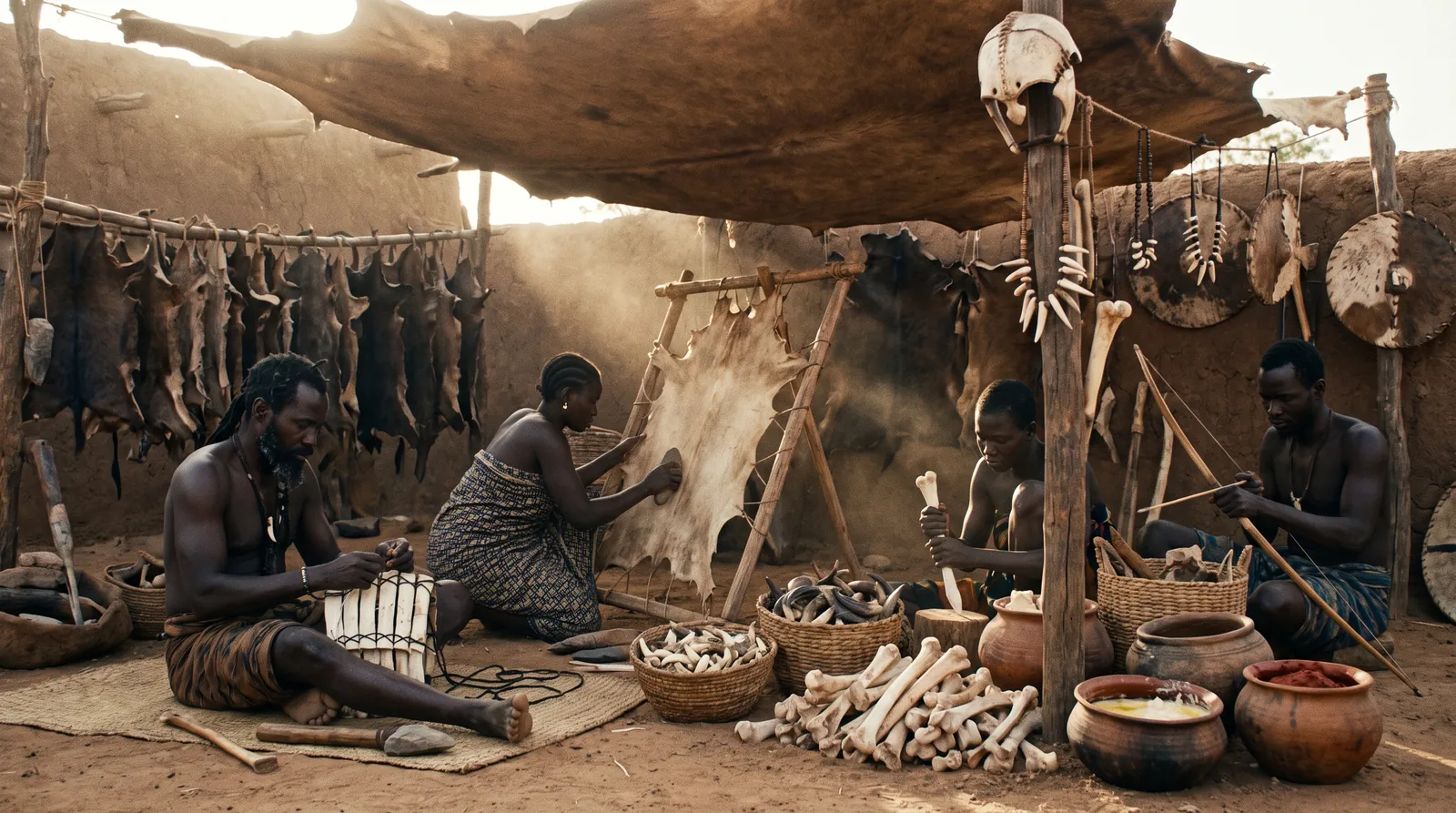
The boundary comes before the workshop
Human bone is forbidden in Arkhan crafts, weapons, armour and objects. The ban covers enemies, slaves and condemned people. After battle, human remains are separated from recovered animal materials. The bone chain therefore begins with a distinction that yields neither to a batch’s value nor to the brutality of its context.
Observe gestures and materials · 2 images
Un artisan compare de longues côtes d’animal à un cadre de bois pour choisir ses pièces de structure.
Le grain du ciment d’os
Le ciment d’os animal relie le travail de la matière à l’entretien des murs.
A part does not bear loads in every direction
Cortical bone serves compression, frames, beams, columns and armour parts. Poorly oriented, it gives way in bending, and it needs treatments and resins. These limits explain the importance of sorting and joining.
A chain for walls
Where bone comes from
Arkhan bone has four origins. Herds and slaughter yards provide common bones of small beasts every day. Hunting and carcasses provide larger bones, and dead very-great beasts, pieces that are awaited for years. The gleaners collect, on the steppe and in the Sea of Bones, the bones of beasts long dead. The quarries of the white cliffs, finally, yield petrified bone, turned to stone, which is extracted with a pick like a block.
Each origin has its market. Common bone goes to the kilns and small workshops, very-great bone to builders, armourers and thrones, petrified bone to sculptors and boundary stones. All of it passes through the mortuary teams’ sorting before entering a workshop, and the most valuable through the Bone Tribunal, which certifies its origin.
The Longs-Os gauge
The most common piece in Arkhan is the calibrated long bone. In the kilns and workshops of the Longs-Os, long bones are sawn, scraped, straightened with heat when needed and brought to the measure of a gauge that everyone knows. This standard piece is used for everything: lance shafts, the hoops of trail tents, the frames of transport cages, stretchers, enclosure bars. It is carried in bundles and counted by the piece.
Because it is the same everywhere, it also serves as a currency of labour: skinners, bearers and gleaners are paid in calibrated bones, which they resell or use. From it the Longs-Os also make the dry bridges, prefabricated spans of bone ribs that the Horde carries to cross dry riverbeds and ravines, and that are assembled in a morning.
Stone bone
Petrified bone comes from fossil giants that wind and erosion lay bare on the white cliffs and in the old basin of the Sea of Bones. It is made into boundary stones, slabs, thresholds, travelling altar stones and the bone belts that crown certain city walls. In a few deposits the marrow of the bones has turned into milky opal with fiery glints: it is the chief gem of the bone workshops, which the sculptors of the White Coasts work into ornaments and figurines.
The Volonians buy petrified-bone sculptures at the same price as bronzes, and khans readily give them to their allies. Stone bone is neither burned nor ground: it goes into neither lime nor cement, and the workshops treat it as a precious stone rather than as ordinary material.
Powder, meal and glue
What does not become a beam becomes powder. Burned and pounded bone gives bone powder, which serves as filler for Ancestor cement, as a soil improver in the oasis gardens and as an abrasive for polishers. Ground with their marrow, fresh bones give a meal that is mixed into the ration of raptor broods and young carnosaurs, so that they grow strong bones.
Offcuts, finally, are boiled at length to draw bone glue from them, weaker than N’Goro’s glues but available everywhere, which serves for ordinary joints, lances and chests. An Arkhan bone workshop is recognised by three mingled smells, that of the saw, that of the kiln and that of the cauldron.