
Places and landscapes
The Marche de Keryth
An outer march of Ishtir, made of traffic, watch, border farming and hospitality for travellers; during the Respiration, the region of martial games.
An outer march
The Marche de Keryth is an outer march of Ishtir. It combines traffic, watch, border farming and hospitality for travellers. A march gate has neither the materials nor the risks of a terrace road or a marsh dyke: borders, like water, require local rules.
Outposts and oases
The region is a land of desert outposts and guarded oases, home to fortresses, supply and the military interface with hostile zones. Its border tension faces Arkhan and Urnok.
Ishara de Keryth, who commands field lines, bears that name as a posting: Keryth names a place or a post, never a house that owns its units.
A name of the -yth layer
Keryth lacks the Q and Z signature of Ishtiri names. Its -yth suffix belongs to an old place-name layer of the marches, which it shares with only two towns, Kanyth and Seryth. All three names lie on marches facing Arkhan. The suffix stays rare: it is reserved for these places and never given to people.
The martial frontier
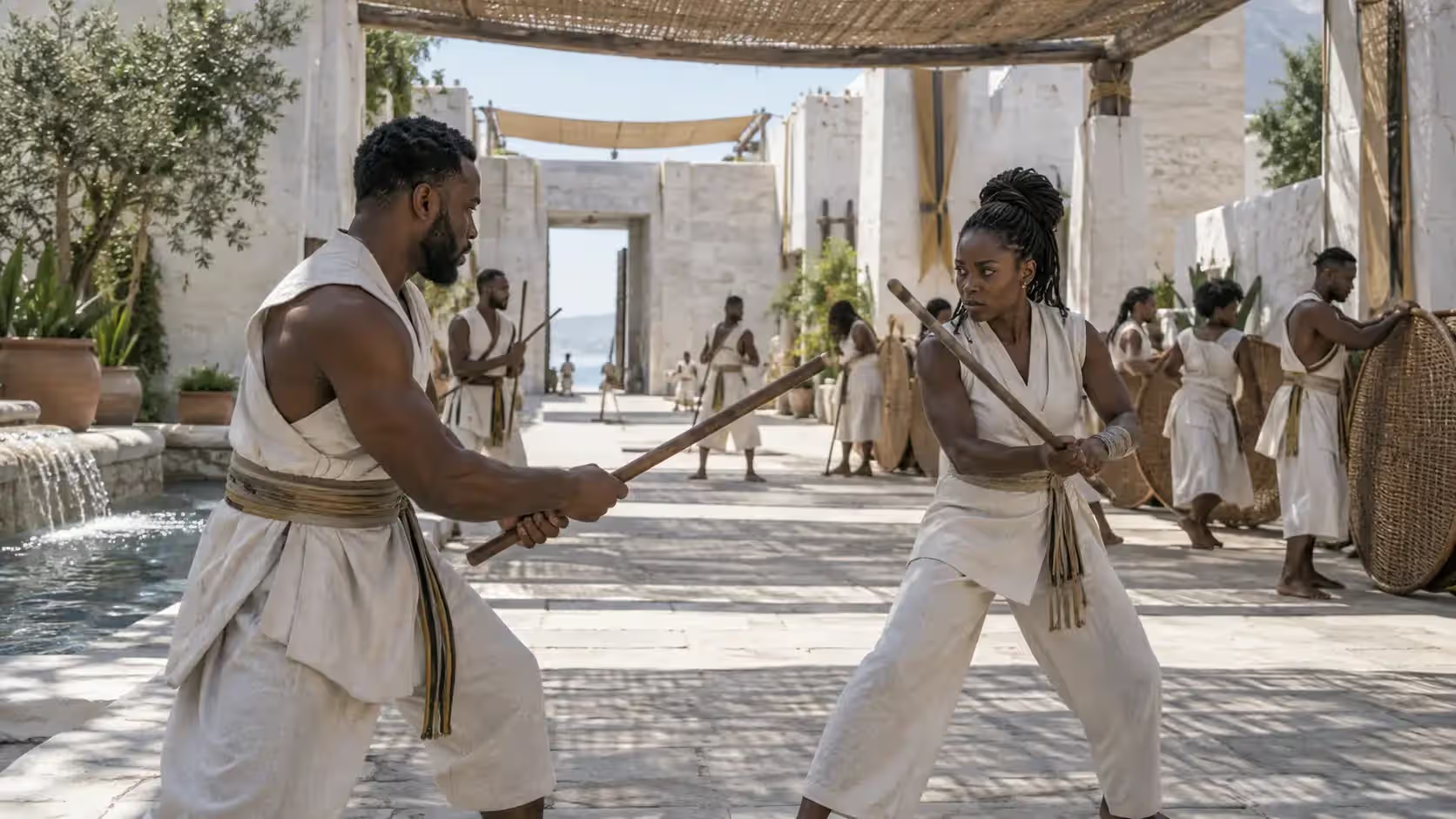
During the Respiration, the Marche de Keryth is the martial frontier: military games, athletic contests, races, controlled hunting and fairs.
Places and place names
Qer-Halun, the Oasis du Couchant, is one of the march’s named places; its name follows the Qer- system rather than the -yth layer.
Qer-Halun, the Oasis of the Setting Sun
The centre of the March is Qer-Halun, the Oasis of the Setting Sun: a dry steppe where two lakes feed an oasis of gardens, palm groves and irrigated fields. The town houses the Temple-fortress of the Golden Throne, seat of the Order of the Wardens, and the stables and stud farms where the Silver Horns train part of their ceratopsians. The rest of the March is made of forests, stony hills and a long coast.
It is the least populated region of Ishtir and the most military. A large share of its inhabitants serve at the gates, in the forts or at the stud farms, and the March does not feed its garrisons alone: fodder comes from the Plaines des Brontes, grain from the Terraces and the Coasts.
The Fields of Sky Iron
The March holds a wealth the whole country envies: iron fallen from the sky. Astronomers note the streaks of fire that cross the night and the direction in which they fade; a few days later, teams of Bronze prospectors, escorted by the Horns, set out into the desert. Each mass found is weighed and marked on the spot, then brought back on sledges.
This sky iron is not a metal like the others. Matter come from above, it is reserved for the Solar Forge of Hélios, in Qer-Aton, which makes charge lances, balance parts for the Weighing and medals from it. The prospectors speak of it with respect and superstition at once: no one picks up a stone from the sky without first greeting it.
The oasis of Sothir and the boundary stones
Further into the steppe, the oasis of Sothir yields the most famous dates in the country. It is held by the Order of the Wardens, which also guards the patrol roads and the boundary stones of the March: white stones set up along the tracks, limewashed every year, each with its own keeper. A moved boundary stone is a serious matter that goes all the way up to the judges of the Golden Ray.
The boundary stones have a history. The elders of the March tell of the First Wars of the Boundary Stones, then the War of the Hundred Stones, when the measurements of the neighbouring Empire clashed with Ishtir’s sacred lands: wars over passages, pilgrimages and pastures, whose stories are passed on at the Breathing fairs far more than in the registers.
Garrison life
The garrisons of the March are mostly Bronze, led by Silver officers. They serve in rotations: a season in a frontier fort, a season in the oasis, then a return to their home quarter. The forts are small, built around a cistern and a pen, and linked to one another by mirror signal towers.
The March’s animals are chosen for the frontier. Aru-Qerim styracosaurs hold the mobile guard and the flanks; the anti-raptor ceratops, horns lowered in a tight line, guard the roads against Arkhan’s fast cavalry; chasmosaurs of the Silver Horns form the lines in depth. Soldiers say the March teaches two things: to count water and never to turn your back on a dune.
Hospitality for those passing through
The March is not only a rampart. Its caravanserais receive pilgrims, convoys and authorised travellers, with water, a bunk and a meal owed to anyone admitted. A foreigner receives a sealed clay permit stating where he may go and for how long; he hands it back on leaving.
During the Breathing this hospitality changes scale. The military games, races, archery and throwing contests, controlled hunts and fairs draw thousands of visitors from all over Ishtir, who come to see the frontier ceratops and to measure their strength against that of the garrisons.