
Creatures
The Siirmuu
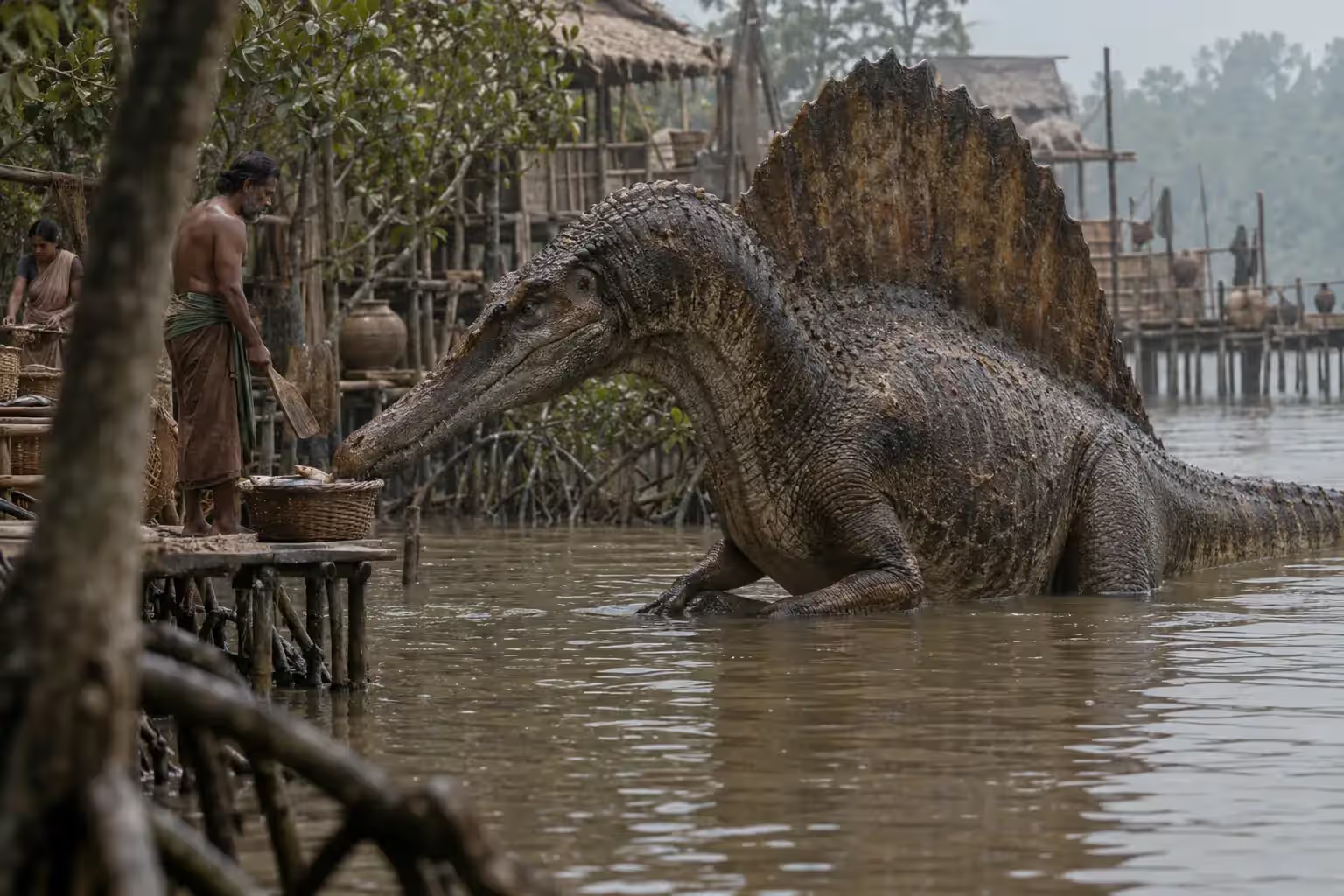
Great allied or domesticated Spinosaurus of the low waters.
A trade term, not a personal name
Siirmuu is the N’Goro term for great allied or domesticated Spinosaurus. It describes a category of work and relationship with living animals; it is not an obligatory personal name for an individual animal.
Defence, fishing and rescue
Great spinosaurids are the colossi of defence, fishing, estuaries, rescue and the Foam Marches. They belong to the low waters, where fishers, ports and amphibious networks encounter submerged roots and environmental hazards.
Un abri de soin au bord des eaux basses
Claies, écrans sanitaires et petit module flottant composent un abri vétérinaire. Le bassin garde une séparation avec les circulations ordinaires.
Preparing the environment
Keepers work with smell, territory, food, rhythm and preparations. Protocols can modulate stress, pain or sleep without ensuring total control. Doses vary with the body and exposure; the alliance requires ecological skill and continuing care.
Becoming Siirmuu
A spinosaur is not born Siirmuu; it becomes one. The word names a working relationship between a great spinosaurid and a human team, and that relationship begins on the day the animal agrees to come back, of its own accord, to the same quays, the same smells and the same people. Many Siirmuu were born near the quays and grew up among the teams; others are wild ones that took to following the fishing barges and that a trainer patiently tamed with the ration. None was ever captured: no ally is made of a beast taken in a net.
The Circle of Balances keeps the register of these relationships. A spinosaurid that becomes Siirmuu is entered in it with its team, its water and its name; one that returns to the wild, stops coming back to the quays and no longer answers its team, is struck off without reproach, and people simply say it has “gone back to its water”. The hundred and twenty great spinosaurids that N’Goro counts are those of the register; the wild ones, nobody counts.
A Siirmuu’s name
Each Siirmuu receives a name from its team, and that name follows the rules of human names. A young animal is first given a tender name, one meant to change, like a child; it receives a true name when it has survived its first fishing seasons and it is known that it will stay. These names speak of its character or its story. Mère-Boue, the old matriarch of the Sacred Lakes, owes hers to the crust of peat and shells that covers her; Seuil, Sûma’s mount, his to his refusal to cross unread water; Sûma-lui-parle, the ritual animal of the Basins, his to the woman who is said to speak to him.
A Siirmuu may change its name after a wound, the death of its trainer or a change of water, and the old name is not held to be false: like a person, it is what it has passed through. In the N’Goro language, the Siirmuu are classed with the tender living, alongside humans and alliances in progress, not with the creatures of chitin or with things: they are spoken of as one speaks of a relative. The Circle’s registers keep all their successive names.
The animal of the Great Ancestor
For many Ngoro, the Siirmuu is more than an ally. The cult of the Saurian Ancestors sees in the great spinosaur the figure of the Great Ancestor, the being who lives between water and air as humans live between the seasons, and the confraternities that serve it wear in their rites masks stretched with Siirmuu sail. This veneration has very concrete effects: the flesh of a spinosaurid is never eaten, a Siirmuu is never killed, and its skin and sail are taken only from an animal that has died a natural death, by the hands of its trainers.
The Mysticism of Sheddings and Thresholds, more widespread, speaks of no ancestor, but it respects in the Siirmuu the same thing it respects in an old woman: a body that has come through decades of floods and fevers. The two traditions agree on one point: a Siirmuu belongs to no one, not even to its team, and the Circle refuses to speak of one as property.
When a Siirmuu dies
The death of a Siirmuu is lived like that of a member of the family. When the animal stops feeding and drifts away from the quay, the team follows at a distance, without forcing it, and waits. After its death its trainers enter a Closing as for a human mourning: the team’s feasts are suspended, little is said, and no fishing is done with the other beasts for several days. Then what belongs to the trainers is taken: the sail, which will be stretched on drums and masks, the skin, and the teeth, which will become the points of rank harpoons and insignia.
The body is then given back to the marsh, in a water of return where no one will fish again, like the body of a human. The Circle strikes the animal from the register, noting all its names, and the trainer who stayed with it to the end wears a mourning cord at her wrist for a season. Sometimes a team does not outlive its beast: without a Siirmuu, its helpers scatter to other quays, and part of its knowledge is lost.
What a Siirmuu costs
A Siirmuu is costly to those who live with it. Each day it needs its ration of fish, salt and herbs, a maintained quay, recharged territory beacons, a team of a dozen or so people who do little else, and Sap-Keepers for its wounds. The loose hauling collar it agrees to wear, of hide and chitin, is worth on its own the price of some ten pirogues. No family can keep a great spinosaurid alone: Houses, lineages of fisher-trainers or whole villages take charge of one, and the Circle of Balances keeps the account.
The cost is repaid otherwise than in coin. A Siirmuu that drives the shoals towards the nets feeds a whole quay; it rescues the shipwrecked, keeps the great crocodilians away from the barges, opens channels and guards the estuary. The people of the Foam Marches say that a team does not own its Siirmuu but owes it its fish, and that a village without a Siirmuu can be recognised by its half-empty nets.