
Institutions
The Night of Doors
The last night of dismantling before the departure horn of a Great Shedding: whatever is still fixed to a building passes to the city.
The rule of the last horn
Preparing a Great Shedding distinguishes what walks, what is shed and what remains. The last horn sets a decisive limit: any object still attached to a building when it sounds becomes city property. A family therefore does not keep a door because it once bought it. It must detach it and take it away in time, or leave it to the next inhabitants.
A night of dismantling
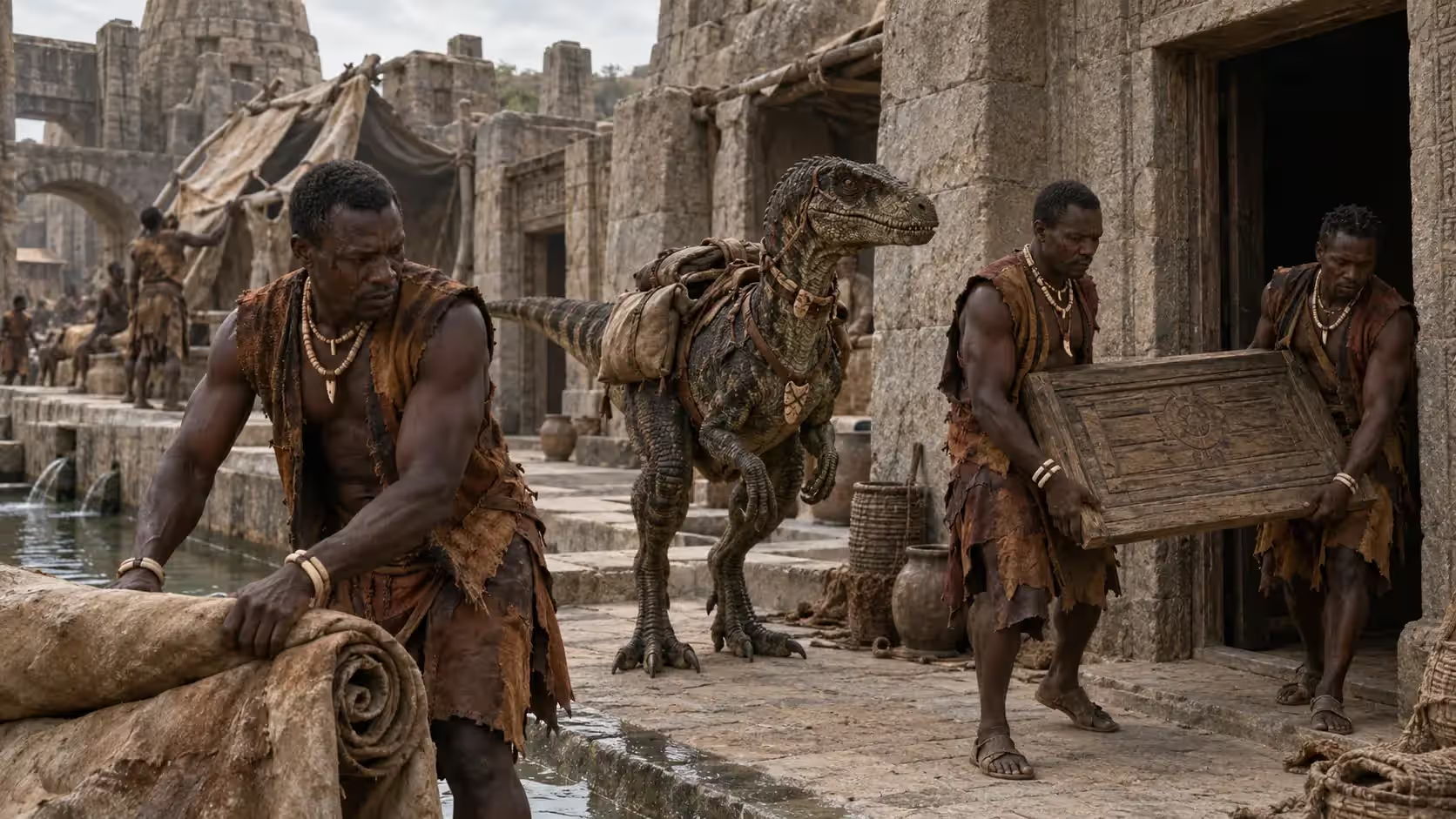
The Night of Doors is the last phase of dismantling before the departure horn. Families remove the doors they want to keep; nobles dismantle or saw off the portable parts of their terraces; judges inspect the hinges and fastenings that decide a possession’s status. What is truly detached must be made visible, so that ownership does not rest on word alone.
The same rule for everyone
The Night affects households as much as the powerful. Palace and family home may own precious things, but their value does not suspend the common deadline for handing back. Everyone must treat departure as a material operation: an old door kept from one Shedding to the next takes up arms and space in the column, and a piece of furniture is only useful in the next city if it survives the journey and can be set up again.
Doors that travel
Tales of the Shedding remember families who have carried the same monumental door through four Sheddings, and old people who, staying with the city, promise to keep a bed and sell it to the next people. The rule turns every departure into a public inventory of fastenings and possessions.
The dead of the door
If families fight for their doors, it is not only for the wood and the fittings. Among the Arkhans, the dead of a household remain persons: after excarnation their bones return to the dwelling, a femur holding the doorpost, a skull set on the lintel. People say that the dead carry the house. These bones have names; they are not pieces, and the ban on human bone in craftwork does not touch them, since a place is not a use.
The door is therefore often where a family keeps its ancestors. Detaching it means taking them along; forgetting it means leaving them to the next people, who have no tie to them. During the Night of Doors the funerary doorposts come before everything else, valuable furniture included. The recently dead travel with the column, “to see one last trail”.
How the judges judge
The judges of the Night are mostly Anchored, since they are the ones who will stay with what the city keeps; each district receives two or three of them, accompanied by witnesses from the departing people. Their rule is material. An object is detached when it no longer holds by itself: the hinge pin has been drawn, the door rests on its carrying frame or on the bare ground, the terrace beam has been sawn through its whole thickness. A piece still held by a single binding belongs to the city.
The judges mark with a stroke of bone chalk whatever they have seen to be free. A dispute is settled on the spot, before witnesses, before the horn; after the horn there is no appeal. So in the last hours one sees whole families hanging on a stubborn fitting while a judge waits, lamp raised, saying nothing.
A creaking city
The Night of Doors can be heard from afar. The whole city rings with saws, mallets, pins being wrenched out and hinges shrieking. The oil lamps stay lit until dawn, and the lanes fill with door leaves laid on frames, terraces cut into sections and lashed chests waiting for their pack beast.
One profession works on that night alone: the unhangers, carpenters and rope-workers who hire out their arms to the highest bidder. Their price doubles at sunset and triples past the middle of the night; they are paid in Dracos, in dried meat or in knotted promises. Children run after them with baskets of pins. Poor households, which close their doorway with a curtain of hide, roll up the curtain and go to sleep; in rich houses the night is always too short.
What the city keeps
When the last horn has sounded, the Anchored go round the houses and draw up, on cords, the inventory of what was left behind. A forgotten door passes with the house to the arriving people; a bed, a table, a chest too heavy to carry may be sold for the upkeep of the basins and walls, as the old men who keep a neighbour’s bed promise with a smile.
It happens that a family finds its own door again two Sheddings later, in the same city, and has to buy it back from those who received it. The saying shows no pity: “What you did not unhook, you never had.”