

Institutions
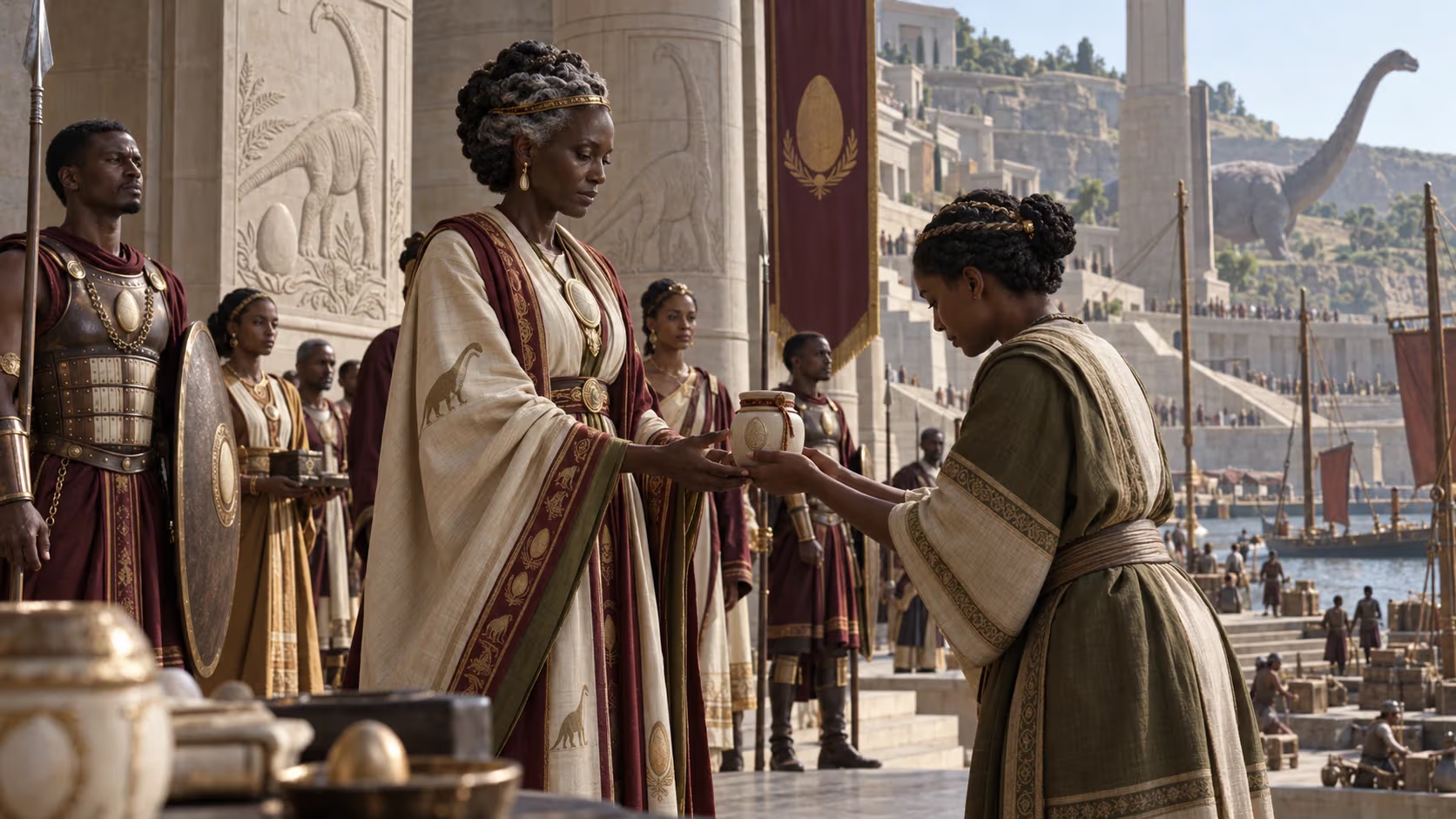
The Diet of Great Silos
Certification of reserves whose force lies in public confidence and ritual.
Certifying reserves
The Diet provides moral certification of reserves. Its function is ritual and symbolic rather than that of an executive ministry managing all grain on a daily basis. Its place in the Empire makes stocks publicly recognisable as a promise kept. It replaces neither the owners of reserves, their working teams nor other financial institutions.
The silo chiefs’ vote
The silo chiefs vote every twenty years. They elect a Grand Keeper. Term and selection belong to the institutional arrangement. They give the rite its own continuity, distinct from daily appointments to handling or transport services.
Many silos, many responsibilities
Certification can produce confidence or panic even when its function is symbolic. In Sarnor, reserves are distributed among many Lines: House Orlenox holds the duchy without owning all its grain. The Diet acts within this landscape of distributed responsibilities. Affirming the strength of reserves requires considering a network of stocks and trades rather than one ducal granary.
The Grand Keeper and the public word
The Grand Keeper is elected by the silo chiefs; the office is distinct from the ducal House Orlenox, which holds the duchy of Sarnor and some great silos without owning all its grain. The Diet expresses confidence in the state of stocks or declares them unworthy, with possible consequences for markets and for the fear of famine. Certifying reserves involves both the Diet and the Bank; Sarnor Trois-Saisons and the duchies are among the actors it engages.
Amon Sarn-Tarek
The Grand Keeper in office is Amon Sarn-Tarek, an elderly man. Institutional keeper of the silos, elected and distinct from House Orlenox, he can contradict Sarnor’s ducal house.
The Great Treasury of the Silos
The Diet guards the Great Treasury of the Silos, a treasure made of grain rather than gold. This treasury is not a building: it is the sum of the reserves declared by the forty-six imperial silos, spread between Sarnor, Calaron, Velmor and the marches. The Diet owns none of this grain. It says what it is worth, and its word gives the Treasury its public existence.
That word has a concrete use. Imperial silo shares, registered titles to a silo’s reserves, are exchanged for fodder at the rate the Diet certifies. The great houses, the Lines and some foreign merchants hold them. When the Diet raises or lowers a silo’s rating, the value of these shares follows, and with it part of the Empire’s credit.
The Silo of Sarnor
The Diet sits in Sarnor, in the largest of the cathedral granaries, known simply as the Silo of Sarnor. It must not be confused with the Gué-Long, the silo of House Orlenox, nor with the silos of the Upper Ford held by the Karnil Line: the Silo of Sarnor keeps the Diet’s own reserve, silage of the best grade that is opened only in a declared dearth.
Its certification hall occupies the foot of the tower. The walls carry, in painted bands, the levels of every imperial silo, scraped off and repainted at each certification. A great bronze gauge, a replica of those in the vats, stands in the middle of the room. It is there that the silo chiefs vote every twenty years, and that the Grand Warden reads out the state of the reserves each autumn.
An election by grain
The election of the Grand Warden follows an ancient rite. Each silo chief brings a sealed sack of grain from his own vat. The candidates, rarely more than three, each have their jar in the middle of the hall. One by one, the chiefs pour a measure of their grain into the jar of the one they choose, before witnesses who check that the measure is full and that it is the only one.
When all have voted, the jars are weighed on the hall’s great scale. The candidate whose jar is heaviest is elected, and the register keeps the weight of each jar as carefully as the name of the winner. The grain of the vote is not returned: it is handed out the same day to Sarnor’s day labourers without a ration. In the duchy they say that an election of the Diet feeds the poor for a week.
Blessing or declaring unworthy
Every autumn, after the harvest, the Grand Warden reads out the state of the reserves. Silos whose accounts have been acknowledged receive the Diet’s blessing, marked by a white band on their public gauges. A silo whose reserves do not seem worthy of their declaration is the subject of a ceremony of unworthy reserves: its name is read aloud, its bands are scraped off, and it remains unrated until a new count.
The Diet also has its place in war. Before each campaign the silo chiefs bless the Dreadnoughtus of the Silos, Sarnor’s emblem, which will carry the armies’ grain and water. And no imperial war sets out before the Diet has said what the silos are worth: a Warden who doubts the grain can, without forbidding anything, make a campaign unpopular before it has even begun.
When the Diet doubts
The Diet’s power is mostly ceremonial, but its words travel faster than convoys. When it doubts a silo, prices rise the very next day at the Croisée-Silos hall, families fill their jars and the Bank watches its guarantees. In an empire born of a famine, a rumour of dearth touches a very old memory.
Wardens therefore weigh their words. The Diet’s declarations follow formulas fixed for centuries, which the Warden reads without changing them; a word too many or a hesitation would be discussed throughout the duchy. The office of Grand Warden thus calls for a rare quality: knowing how to speak in public without ever improvising.
Gallery1 image
Scribes with tablets around the grain, beneath a granary dome.