

Economy
The Droits de la Mesure
Ishtir’s economic architecture: with no internal currency, necessities are guaranteed to all and scarce things are allotted through precise, personal, non-tradeable rights.
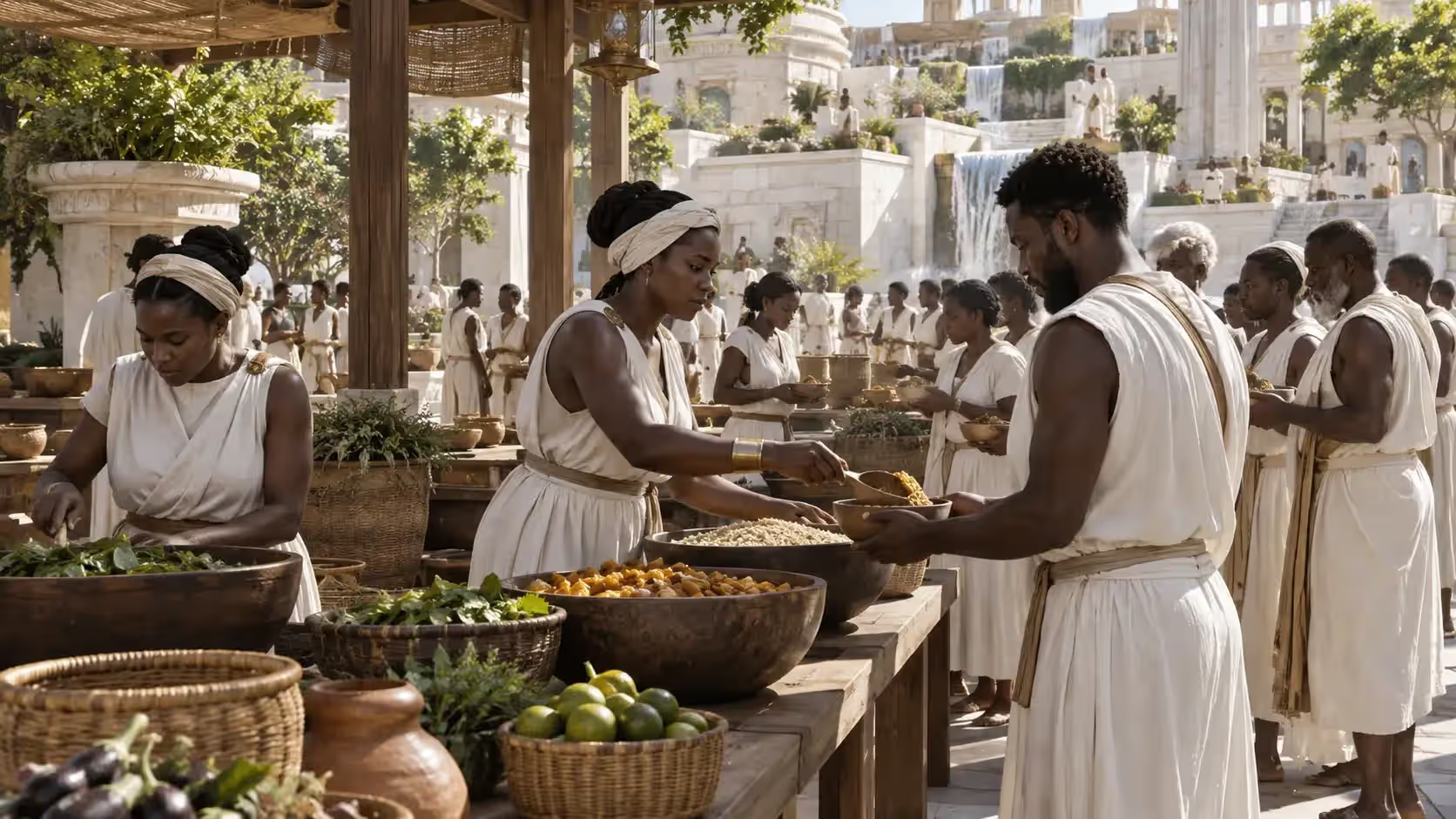
Nothing necessary is sold
Ishtir knows no internal currency, no wages, no domestic prices and no inheritable fortune. Every inhabitant has a right to food, water, housing, health, education, transport, ordinary clothing, basic culture, retirement and protection. The right to live never depends on performance: someone lowered at the Weighing, ill or failing keeps what is necessary.
Ishtir is not a society where everything is unlimited: it is a society where nothing necessary is sold.
Six rights for scarce things
Scarce or dangerous resources go through six kinds of rights: rights of use, access, priority, study, responsibility and, exceptionally, requisition. These rights are personal, precise, temporary or revisable; they are not inherited, transferred or exchanged. They are therefore no hidden currency: a medical certification allows one to practise medicine; it buys neither housing nor a journey.
Rank above all changes access. One does not receive more: one reaches other doors, other tools and other responsibilities, and one rank’s access rights do not cross another rank’s walls.
Contributing without wages
Every adult contributes according to health, abilities, certifications, preferences and collective need. Refusal or sabotage can be sanctioned, but never by withdrawing necessities. Assigners and arbiters prepare postings and allotments; the system keeps scarcity from becoming hereditary wealth.
Foreign trade goes through the orders and regulated ports, which may use barter, contracts, units of account and Volonian or other foreign currencies. These instruments stay at the border: they do not circulate as wealth inside the country and buy no promotion.
What a right looks like
A right takes the form of a clay tablet. It gives the person’s name, the object of the right, its scope, its duration, the date of its review and the seal of the office that granted it; a copy stays in the register. A right of use over a potter’s kiln, a right of access to the Auréon archives or a right of responsibility over a herd all take this form, and anyone may ask to see the tablet of whoever exercises a right over a common good.
The small rights of daily life are displayed more simply. In workshops and cohort houses, a board of clay pegs shows the day’s rights: two hours of the fine punch, half a day of waxed thread, three passes of the trough along the outer lane. Each person’s name is tied to a peg. These marks can be neither exchanged nor accumulated: if someone gives up an hour, it does not pass to a neighbour; the arbiter of rights puts it back on the board.
Six rights, six examples
The six kinds of rights are best understood through examples. The right of use lets one employ a good without owning it: a potter receives a kiln for a moon, a carpenter a bronze saw for the length of a building job. The right of access opens a place: the register rooms, a line enclosure, a closed garden. The right of priority settles the order of service when not everyone can be served at once: water in a drought, remedies in an epidemic, places on a barge.
The right of study allows one to take samples, observe or experiment: a carer may thus gather rare herbs to work out a remedy. The right of responsibility entrusts a charge, a herd of some hundred animals, a stretch of canal, a cohort house, and binds whoever receives it. The right of requisition, finally, exists only in times of crisis: during a war or a flood, the army and the orders may requisition barges, storehouses or lodgings, which are returned and repaired afterwards.
Contesting a right
Rights are contested, and this is even an ordinary part of public life. Two potters claiming the same kiln, a quarter that considers its water priority badly calculated, a carer challenging a refusal of access: each can bring the case before the arbiter of rights. The hearing is public, brief, and held in the office courtyard under a solar screen.
The arbiter judges according to an order everyone knows: first need, then competence, then the age of the request. Rank does not enter into the reckoning, except through the responsibilities it brings. A decision may be appealed before a college of arbiters from another region, who know none of the parties. Arbiters are weighed like everyone else, and the best of them are said to hand down decisions that annoy everybody but that nobody manages to overturn.
The Chamber of Rights
Above the quarter offices, the Chamber of Rights in Qer-Aton oversees the whole system. It sets the rules of allocation for each category of rare goods, checks the regional registers and reviews long-term rights every year. At each Weighing it takes back the rights of everyone who changes rank or posting: they fall with the old place and are redistributed, for the rights of one rank do not pass through the walls of another.
The Chamber also makes sure that no right becomes a disguised fortune. A right no longer exercised is withdrawn; a person who accumulates rights without using them is summoned; a right used to obtain something other than its object is cancelled. Its inspectors say their trade consists of preventing scarcity from settling anywhere, the way one keeps silt from settling in a canal.