
Economy
N’Goro: care, access and reciprocity
Medicine, fibres and biosafety carry high value; care can also create an obligation.
High value per unit
Venoms, antidotes, filters, fibres, spores, living wood and medicine support exchange. Their value lies as much in the skills preparing them as in harvested material. Commerce must also preserve conditions of passage: a biological product does not circulate independently of its origin, signature and accompanying protections.
The Breath Debt
Vital care creates an obligation of reciprocity that is not necessarily monetary. It can pass through the social network. N’Goro can thus save those others might abandon while making life without obligations or belonging difficult. Assistance and dependence form two possible consequences of the same relationship.
The dropper and the preparer
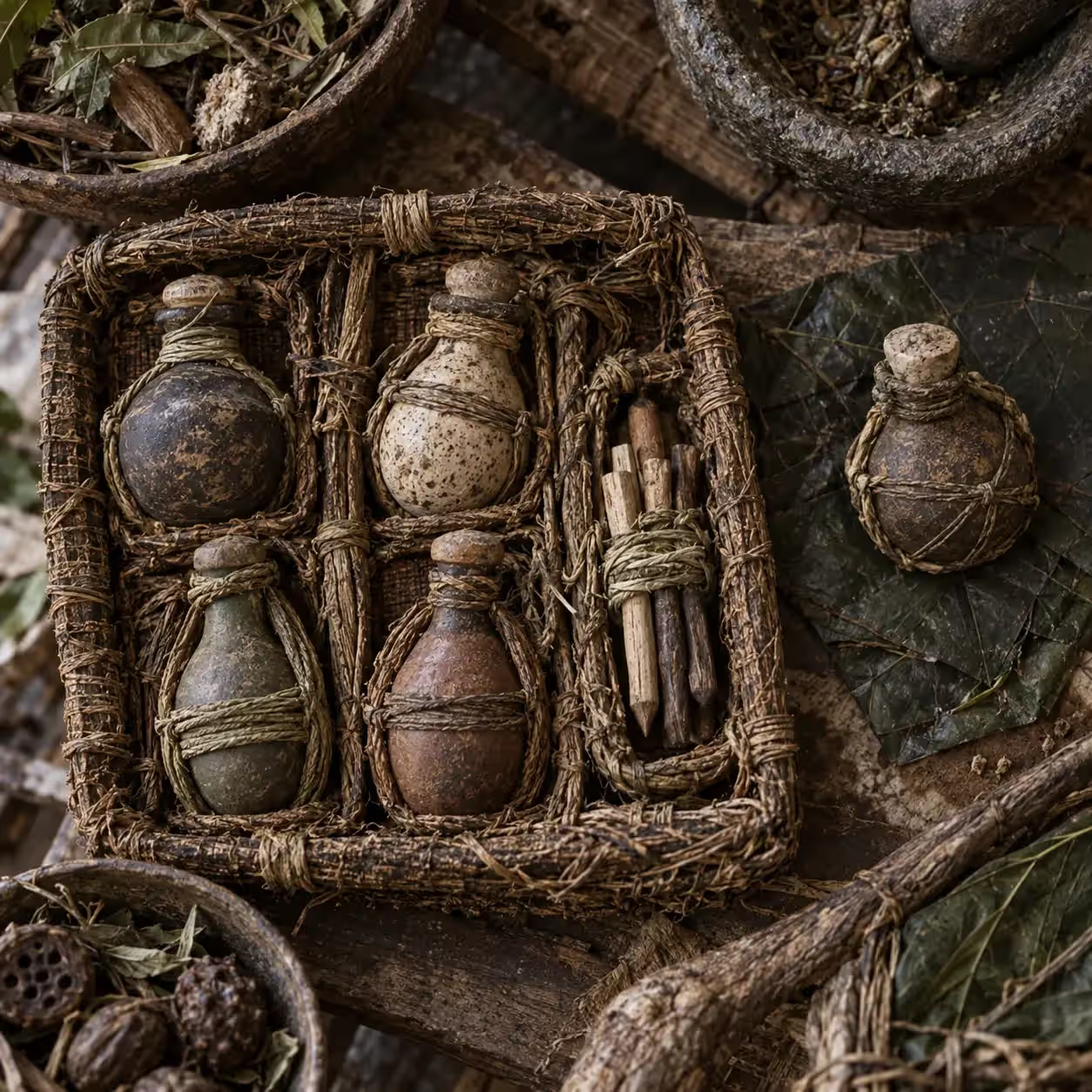
The dropper gives preparation work a tangible scale: a substance is dispensed in small quantities. Preparing an antidote requires attention to the dose as well as the product. In N’Goro, that dose depends on the body, weight, exposure, water, season, health and substances already absorbed. Precision responds to these differences; a quantity suitable for one body does not automatically suit another. The flask therefore carries a preparation whose use still requires knowledge of its recipient and environment.
Reading breath before crossing
The breath reader, filterer and quarantine keeper work before passage is granted. They observe signs useful to a prudent decision: air, water, the state of a body, a filter or a container. Their role is not to pronounce a cure or promise the absence of danger. It is to say what must be prepared, isolated or delayed so others do not discover the risk too late.
Carrying is a threshold trade
The master carrier and wet-passage guarantor organise what must cross without being lost, damaged or handed over improperly. The first distributes effort and grip; the second attests that passage retains workable conditions. Their work does not serve as general permission to enter everywhere. It recalls that a crossing is a relationship between a body, a load, an environment and the people ready to answer for it.
Interpreting without promising control
The spore interpreter, antidote preparer and bone veterinarian work with materials whose effect depends on context. The fisher-trainer adds knowledge of a living animal and water that do not always behave the same way. A correct reading can require waiting, dilution, protection or abandoning an attempt. Knowledge is therefore recognised as much in the limit stated as in the action that succeeds.
Value comes from preparation
In N’Goro, harvested material is not immediately a usable product. Venoms, spores, fibres, glues, enzymes and remedies must be filtered, measured, preserved or linked to a precise context. Time spent preparing matters as much as rarity of the material. People treating these elements work with containers, water, protection and passage procedures. Price or exchange cannot summarise this chain, because a preparation error can make a lot dangerous or useless.
Care slows departures
Filtering, quarantine and reading bodies take time before a person, animal or cargo can continue its route. This wait is not decorative formality. It protects people already present, preserves a fragile environment and allows what must be isolated or treated to be identified. Trade routes and political emergencies must account for this delay. In N’Goro, accelerating without checking can move risk onto people who chose nothing.
N’Goro in figures
The average annual output of an inhabitant of N’Goro is estimated at about 78 Dracos. Industry and crafts make up 26% of it, agriculture and fodder 18%, trade and finance 15%, administration and learning 14%, animal husbandry 12%, elite rents 10% and the army 5%.
Remedies and venoms cost far less than the average rate there (0.70), since they are produced there; metal and grain much more (1.35), because of transport and danger. Abroad, N’Goro sells its remedies at a premium.
The currencies of the marsh
The Draco is legal tender in N’Goro as everywhere, but people rarely pay in gold Scales. The country’s own currency is the Venom Phial, a commodity-money worth about five gold Scales whose rate follows that of dosage: a sealed, signed phial holding a named dose, used for large transactions and contracts. For small purchases people pay in shells, in marsh pearls in the hidden ports, in salt on inland markets, or in bronze Scales with foreign merchants.
The country’s treasury does not resemble other nations’ either. The Mist Reserve, in the capital, Muu-Shanga, holds remedies, antidotes and emergency eggs rather than metal; goods are deposited there in exchange for certificates denominated in doses of antidote, which circulate like money. Their value rises when an epidemic threatens, and the reserve antidote, multi-purpose, sealed and numbered, serves as the standard of this shadow-money. In N’Goro one grows rich not by hoarding gold but by holding what others will need in order to survive.
The lands of work
Each region of N’Goro has its speciality, and the barges link these specialities together. The Control Basins and their surroundings make anti-rot glue, antidotes and counter-flasks, and sell their quarantines and inspections to the whole country; it is the richest region, because the Sap-Keepers sell dearly what they dose. Yveth and the Floating Gardens supply medicinal plants and balms; the Long Boughs, carrying, lianas and living wood; the Silver Reeds, chitin, caterpillar silk, canvas and ropes.
The Singing Mists sell peat amber, medicinal spores and the crystal sponge for filters; the Bay of Roots, the League’s carrying, salt and the Houses’ credit; the lakes of the Living Mirror, the fish that feeds the country; the eastern Overflows, tubers and fodder from the flood lands; the Terres Englouties, spore-black leather and the produce of the hunt. The fishing, flood and hunting regions are poorer than those of healing, and in N’Goro they say you earn more by dosing a drop than by fishing a basketful.
Who N’Goro trades with
Trade weighs more heavily in N’Goro’s life than among its neighbours: low mass, high value per treatment. Urnok buys anti-rot glue, antidotes and balms, and sells in return Sarnor fodder, leathers, blood and glands from its renderers, and grain; the old hostility in the south has never interrupted this trade. Korath buys glues and balms for its cables and ballistas, and sells iron, rivets and tools. Arkhan buys the glue of its composite bows and sells bones, hides, blood and glands.
Volonia buys balms, antidotes and glues, sells its sea salt, its insurance and its luxury goods, and shares with N’Goro, through the Vaesh Quarantine, a knowledge of biosecurity that each power watches in the other. The High Jungles supply crown fruits, spices and black-wood pulleys for the living barges. But N’Goro’s largest export is not a product: it is its threshold services — quarantines, hold fumigations, inspections and passages — which foreign ships and caravans pay for the right to enter.
What N’Goro cannot make
N’Goro’s economic strength has its other side. The country has almost no metal, little stone, little salt, little grain and no abundance of dry wood; it brings in from abroad its tools, its rivets, part of its food and what it needs to light its lamps. Its neighbours depend on its remedies, but it depends on their goods, and the threat of a quarantine or sanitary refusal weighs on it as much as on them, since its own merchandise is also its danger.
The Sap-Keepers draw a constant caution from this. Cutting off the glue would rot the bows and bridges of a continent, but a blockade of salt and metal would starve the marsh. That is why N’Goro, which could hold the world to ransom, almost always refrains, and why the other powers know that in a great war it can be forced to choose a side. The merchants of Muu-Shanga have a sentence for it: “We hold what keeps the world from rotting, and the world holds what keeps us from going hungry.”