

Culture
Workshops and their supporters
Colours, songs and rivalry give trades a public following.
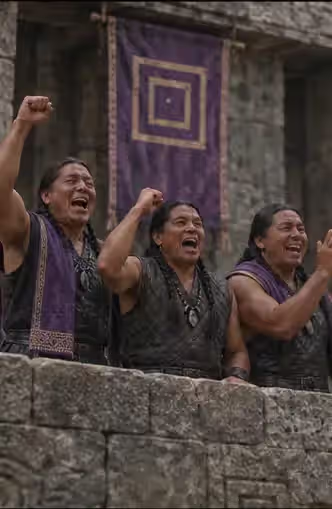
An allegiance sung aloud
Workshops have colours, emblems, songs, supporters, youth schools and legends. Technical reputation is joined by popular attachment: a workshop can be followed as a community of work and memory. Its successes, rivals and influential inventors become stories known even by people outside its speciality.
Marteau ancien et échantillons de basalte sur l’établi
Vue de détail.
A season of proofs
Publications, filings, counterproofs, rankings, contracts and accidents shape a season followed by the public. Transfers of inventors, teams and professors generate rumours and gossip. This movement makes success fragile and visible: a reputation rests on hands, demonstrations and commitments that may move to another workshop.
Two answers to the same question
In a derby, two workshops can publicly solve the same problem with identical materials, budget and deadline. Rivalry then centres on methods rather than a mere claim to prestige. Audiences see different solutions face the same constraint. An invention is understood through the test comparing it with another before people who want it to succeed.
Being a supporter
People are not always born into the workshop they support, but they often support it all their lives. Supporters wear its colours as a scarf or an armband, sing its songs in the taverns and follow its demonstrations from the stands of the Great Chamber or the lava stadiums. On derby days whole districts line up behind two banners, and taverns show the colour of their regulars.
The bond is financial too. Workshop-clubs sell shares to their faithful: a share entitles its holder to a small fraction of licence income, to seats in the stands and to a vote on transfer decisions. Many modest families own one, handed down from parent to child, which they would not sell for anything, even when the workshop is going through a bad season.
The inventors’ transfer market
Transfers of inventors, teams and teachers excite the public as much as the demonstrations do. A great engineer who changes workshop takes his knowledge with him, but not his former house’s drawings, and the transfer contract spells out at length what he may carry away in his head and what he must leave on the bench. The sums involved, counted in Dracos and in shares of future patents, are published and discussed like records.
The busiest period follows the Great Patent Tournament, when winning workshops try to keep their talents and losing ones try to buy them. The evening gazettes live on these rumours. The transfer market of the Side of Motion, where winch and recoil mechanics are fought over, is held to be the most absurd in the country: a workshop there was once seen buying an entire team for a single hinge.
A workshop’s youth school
Every workshop that matters keeps a youth school. Children enter at about nine or ten, often after a recruiter has noticed a particularly careful childhood patent. The workshop pays for their training and, for the best, helps the family with a share of heating or lodging closer to the Vein. In return the child commits to working for the workshop for a few years after training.
These schools have their own derbies, small problems solved in public by teams of children, which supporters follow with mocking tenderness. Future talents are spotted there, and the gazettes sometimes print the name of a child who has beaten a rival school. Families still hesitate: a child trained by a workshop owes it a great deal, and leaving later will be costly.
Rivalries and legends
Workshop rivalries often began with a priority lawsuit, a poaching or a humiliating counter-proof, and they last far longer than their cause. Supporters know the history of their quarrels by heart and tell it to the children. Every workshop has its legends: a founder who came from nothing, a failed demonstration that became famous, an apprentice who beat the masters, like the one remembered by the war of the Thirty-One Teeth.
Supporters’ songs draw on workshop vocabulary. The opponent is called a “decorative hinge”, its patents “tavern patents”, its team “out of square”. Satire can go far, but it stops at the same threshold as everywhere in Korath: a workshop, a family or an inventor may be mocked, never military power.
When war comes
The Korathi reserve is organised by workshop, and club rivalries follow the journeymen into it. In peacetime, the contingents of rival workshops compare their closing times and their shooting rankings. In war they serve side by side, and the unwritten rule says that quarrels stop for as long as the gates are shut.
The demonstration stands then become assembly points, club colours vanish from the streets in favour of district badges, and supporters’ songs fall silent. Korathi like to tell how, after an alert, two workshops that had been enemies for three generations shared their rations in the same refuge hall, then went back to insulting each other the day after the gates reopened.