

Power and institutions
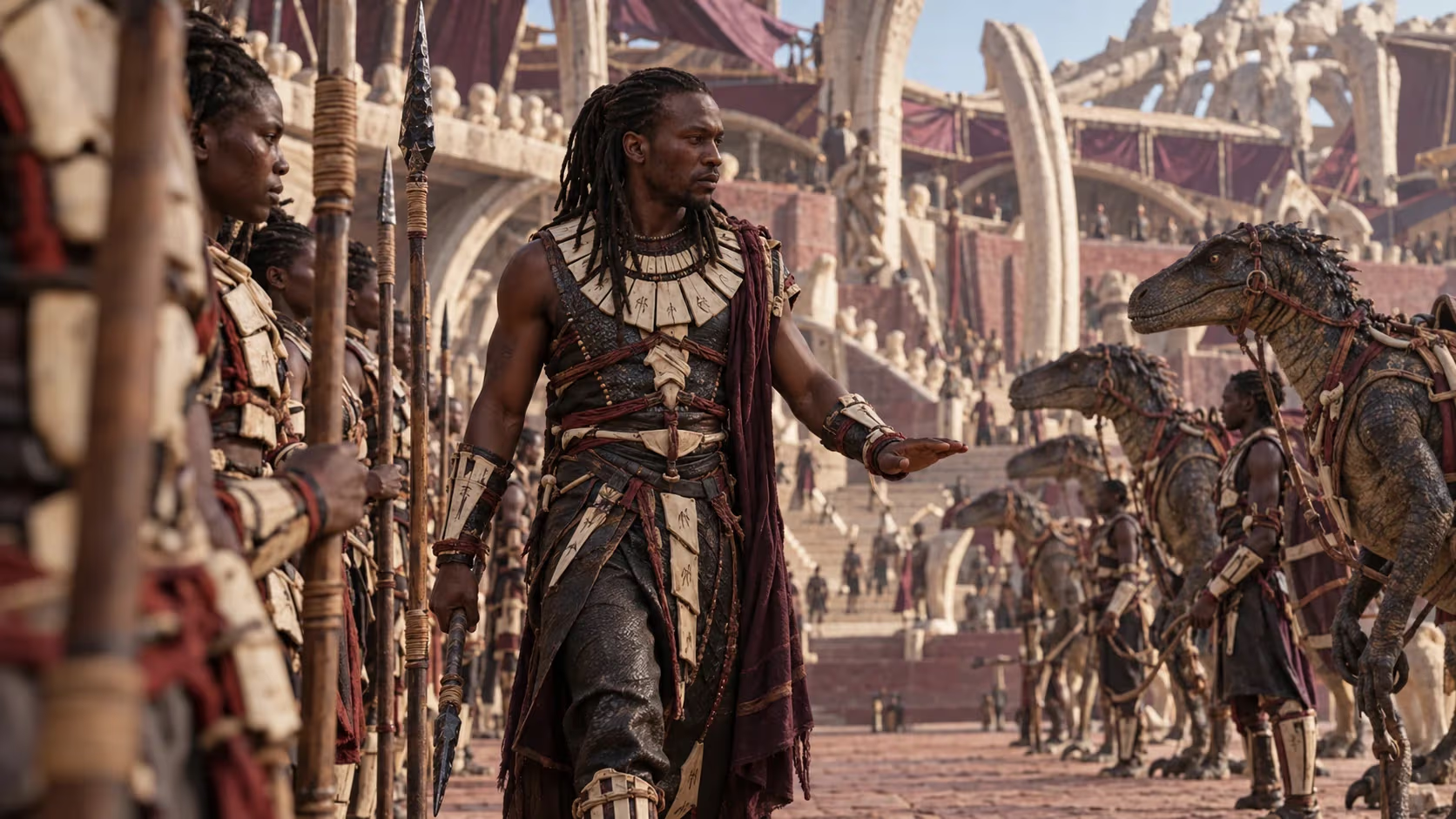
The Supreme Khan
The summit of the Arkhan Confederation: the Supreme Khan federates and commands the great banners without owning Arkhan, and must leave Qor-Zaï at every Great Shedding.
Federating the great banners
The Supreme Khan stands at the summit of Arkhan. The great banners keep their forces, trades, traditions and interests; the Supreme Khan’s power consists in federating and commanding them within a political whole that does not abolish these allegiances. The office’s prerogatives are summed up in two terms: the Call of the Horde and arbitration. Orgaï holds the office today.
The office does not own Arkhan
The Supreme Khan does not own Arkhan. The Supreme Khan’s line holds the right to call the convergence as long as it completes the Tour of the Seven Trails, and the office can pass to another clan after a crisis. Nor does a khan’s authority amount to permanent ownership of a city: the Great Shedding obliges rulers to hand back the works they have used.
The Call of the Horde
The Call of the Horde requisitions the khans and their Apex. All answer, but each arrives with beasts, debts and pride, and remains politically bound to their own khan: obedience is fragmented. The Horde is a convergence of forces that remain autonomous; it does not become a permanent bureaucratic army. It is the higher mobilisation, placed under Orgaï.
A capital one must be able to leave
Qor-Zaï remains the capital during the Great Shedding, with the Council of the Trails, the treasury and the archives, but the Supreme Khan must leave it. The Tour of the Seven Trails takes the Supreme Khan away for months to attend the handovers, confirm khans, settle disputes and inspect the cities; the Guardians of the Empty Saddle watch the throne in the meantime. The doctrine is explicit: Qor-Zaï belongs to the Supreme Khan as long as the Supreme Khan can still leave it, and the day that is no longer possible, Qor-Zaï must look for a successor.
An office born against taking root
The office bears the mark of the War of the Seven Thrones. The great khans were then taking root in their cities, making their palaces hereditary and minting their own coin, while obedience to the Supreme Khan declined. A Supreme Khan waged fifteen years of war and then imposed the common rule on which the Great Shedding rests: no great people governs the same city twice in a row, and no khan hands a city on to his son. Control of the calendar, confirmations and arbitration have since kept the bond between the centre and the powers of the trails.
The Supreme Horde
The Supreme Horde rises only once per reign, and only against a recognised outside enemy. It therefore cannot be used against the khans themselves, and a Supreme Khan has it at his disposal only once.
The right hand
Orgaï relies on Nzaru l’Ombre-Longue, from the Marcheurs du Vent: he is his voice and his eyes. Theirs is an alliance of function, not of blood — power on one side, vision on the other; with no strong trail of his own, Nzaru’s power exists only as long as Orgaï lives.
Some holders of the office
Arkhan memory keeps the names of several Supreme Khans. The most famous is Zar-Khan the Wall-less, who fought the War of the Seven Thrones for fifteen years against the entrenched khans and imposed the law of the Great Shedding. Another, Zarsalaï, reigned at the time of the battle of the Three Waves: a man of about sixty, reputed violent, moody, treacherous and intelligent, who is said to have taken power by poisoning his own family’s well. While Orgaï fought at the Three Waves, Zarsalaï won a major victory in Ishtir and paid little attention to his subordinate’s local defeat.
These two figures show the two faces of the office: the founder who wrests their cities from the khans, the sovereign who wins by spending other men’s armies. Orgaï, the present holder, from the Première Piste, entered history as the officer of the Three Waves before entering it as Supreme Khan.
The saddle, the tyrant and the tooth
The Supreme Khan’s insignia are things of the trail. His throne in Qor-Zaï is watched like a saddle: the Guardians of the Empty Saddle keep it when its holder goes out onto the trails. The intact tyrant tooth, almost never exported, serves the court, the throne and the rite. The lineage of the tyrants of Qor-Zaï, which is never sold, is reserved for him: it is from one of these beasts, Morg-Khaï, that Orgaï commands.
Riding a sovereign’s Apex requires a whole apparatus: throne-saddles, jaw lines, scent pennants, bone drums and trainers’ platforms. A sovereign tyrant requires up to forty-five trainers and costs between two thousand two hundred and four thousand two hundred Dracos a year to keep; on campaign these costs are multiplied by a factor of one point eight to three. The Supreme Khan is therefore also an administrator of meat, trainers and taboos, and his mount reminds every council of what his power costs the clans that feed it.
What he cannot order
The Supreme Khan holds no absolute royal authority: he arbitrates, persuades, distributes and threatens. Beneath him the khans keep considerable freedom. They may make war on one another, trade, ally against a third, send fighters to another Horde and maintain marriages between enemy clans; an independent khan may carry out a raid, a seizure, a vendetta or a trail war without the Horde being committed.
Some things lie entirely beyond his orders. Water belongs to the Water Masters, who can stop an army without a battle; breeders fall to the Keepers of the Lineages, who can refuse a campaign that threatens them; booty passes through the Keeper of the Share, and debts through the Bone-Bearer’s memory. A confederal campaign requires the consent of the khans and the water masters. A saying attributed to the water masters sums up these counter-powers: “You can order the march. Not the water.”
When Qor-Zaï seeks a successor
No rule of seniority designates the Supreme Khan. Lineage counts but is not enough: a khan unable to feed his beasts, travel the trails and bring about convergence loses the office, and the office of Supreme Khan can pass to another clan after a crisis. The doctrine of the Tour sets the threshold: the day the Supreme Khan can no longer leave Qor-Zaï, Qor-Zaï must look for his successor.
Tradition holds that this search takes place around the Conseil des Pistes, gathered as an electoral assembly, which the language calls a kurultai. The khans come with their beasts, their debts and their pride; Bone-Bearers recall the precedents, water masters what the wells can sustain. A candidate does not win by birth alone: he must show that he can call convergence, feed the tyrants of the Première Piste and leave. The old say a Supreme Khan is never elected, only followed.
Part of this article covers events of season 1. Turn spoilers on in the menu to read it.