

Trades
Mirvane and Tolmen: support and fit
A beam and a pulley answer to distinct trades in the timber chain.
Reading a forest in spans
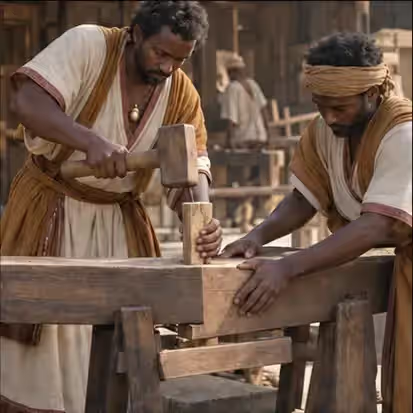
Mirvane handles framing and construction: roof trusses, bridges, halls and scaffolds. The Line turns wood into load-bearing volumes. Its district contains tall spaces and cranes. Work follows basins and drying areas; it depends on what upstream links have prepared rather than on an abstractly available forest.
The small link that breaks
Tolmen handles fine joinery and turning: hubs, axles, pulleys and calibrated parts. Its chain does not produce the same goods as Mirvane. This intermediate link is less monumental than a hall but necessary to its uses. A fitted part has a register entry and a door at which accountability can be sought.
Wood also depends on glue
Corvel adhesives contribute to joints and veneers. The timber chain therefore contains materials no longer resembling a tree: binder, rope, pigment and tannin. Refined joinery does not abolish these dependencies. Choosing and repairing a part also concerns the intermediate products that hold it together.
Between the drying shed and the workshop
Timber does not reach the Mirvane and the Tolmen as it left the forest. On leaving the drying sheds and steam rooms, the seasoned logs are sorted one by one. Long, straight trunks go to the framers, dense, close-grained wood to the lathes, irregular pieces to the shingle splitters or the sleeper gaugers. This sorting is done in the presence of both Lines, which often quarrel over the finest pieces.
Between the two tiers work trades that are barely noticed: the pit sawyers, who cut logs in pairs, one standing on the trunk, the other in the pit below; the splitters, who open the wood with wedges rather than saws to follow its grain; the gaugers, who bring sleepers to common measures. A mistake in sorting or cutting turns up years later, in a beam that sags or a hub that splits.
Trusses, hubs and sleepers
The two Lines sell pieces that are paid for very differently. A large Mirvane roof truss, ready to raise, costs around thirty Dracos, roughly a hundred days of a journeyman’s pay; a gauged sleeper, a few Dracos; a batch of split shingles, barely more than one. At the Tolmen, it is wheels, axles and pulleys that make the turnover, sold by the tens of thousands each year to wheelwrights, relays and building sites.
The customers are not the same. Framing works for the great buildings: halls, granaries, bridges, relay canopies, the scaffolds of Karûm-Brakh’s and the Chancellery’s sites. Turning supplies everything that rolls and everything that lifts, from farm carts to the hoists of the Bralnor quarries. The two meet in the army’s orders, which buy temporary bridges and spare axles in one and the same movement.
Joining without iron
Metal comes from far away, from Velmor or Korath, and is expensive: the carpenters of Orlantis have learned to do without it. Their joints hold by the wood itself: tenons driven into mortises, dovetails, half-lap joints, hardwood pegs hammered into holes drilled slightly out of line so as to draw the pieces tight. Nalen rope lashings hold the scaffolds, and Corvel glue the veneers and fine pieces. Bronze fittings are kept for the points that work hardest.
A workshop saying holds that a nail is an expense and a peg a habit. Master carpenters judge an apprentice by his pegs: well cut, they go in with a clear sound and never come out. This economy of metal also makes the reputation of Orlantis frames abroad: they can be taken apart, transported and put back together without losing their strength.
The test and the works register
A master piece does not leave the workshop without a test. A new truss is trial-assembled and loaded with blocks for a whole day; an axle is laid on two supports and weighted to the promised load, then beyond. The results are recorded, and the piece receives both the Line’s mark and a number that refers to its test.
When a piece goes into a large building, its number passes into the works register, which follows the building all its life. If a bridge sags thirty years later, the register shows which truss was laid where, and which workshop it came from; the Mirvane registers are then opened, and sometimes, behind them, those of the Tolmen who turned the pegs and of the drying sheds that prepared the wood. The two Lines have long intermarried, and in Orlantis they say it is so they never have to judge each other before a stranger.