

Families and social ties
The Living Armouries
An industrial structure assembling protection, inspection and military supply.
Armour is a work chain
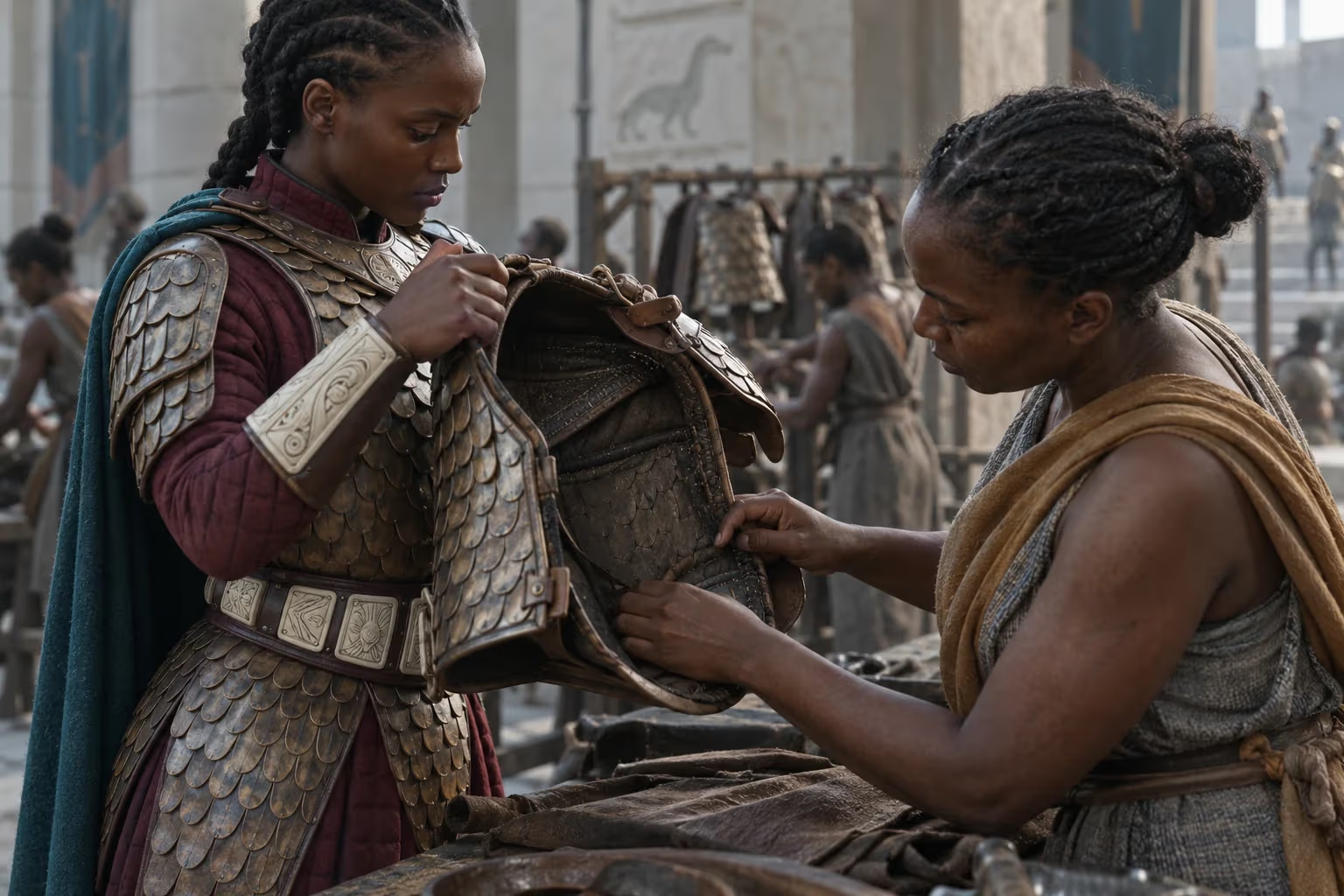
The Living Armouries can operate as a state-contracted company tied to command armour, plates and shock dissipation. Their activity connects prepared material, fitted component, testing, repair and inspection.
Cuir épais et plaques non façonnées sur l’établi
Vue de détail.
Military work depends on several territories
The Armouries work in contact with Velmor, Calaron and Korath. They can therefore be read as coordination among materials, chancery and manufacturing knowledge, without assigning them a territorial monopoly. Every military order remains subject to procedures, component inspection and the supply chains that provide materials.
A contract does not replace institutions
The Armouries replace neither imperial decision makers, ducal Houses nor workshops responsible for a component.
In figures
According to the imperial tax register, the Living Armouries turn over 1.3 million Dracos a year at a 22% margin. After the 30% tax, on top of which come their special contracts, they keep about 0.20 million in profit.
Arming the living without killing it
The Living Armouries’ formula fits in a line: militarise the living without killing it. They make living cuirasses, plates for the very large and mid-rank beasts, soles, throat guards and shock-dissipating gear. They also make human weapons and armour, and above all interfaces, where harness, armour and safety are one piece.
They hold no monopoly: they are the largest of the armouries, the one that holds the whole chain, from metal to part, fitting, testing and maintenance, with access to the great state contracts. The armour of a great beast is repaired like a mobile fortress.
The rare part comes from Korath
The Armouries depend on Velmor’s black stone and on parts from Korath. The division of labour is well known: Korath forges the rare part; Urnok invents the doctrine. The Black Road links Velmor, Korath and Calaron; draught ankylosaurs and armoured convoys carry black stone, rivets, chains and unique parts along it. The danger is industrial strangulation: one delivery slowed in the passes is enough to weaken the Empire’s workshops.
The trade has its scandals. A single assembly flaw, and the beast tears itself open while running: this is the drama of the bites, which at once becomes a political affair. There is talk too of rivets “that sing”, an acoustic sabotage that tires the animal and drives it to panic.
Three workshops, one chain
The Armouries have their headquarters in Velmor and workshops in Calaron and in Korath. In Velmor they make the parts that need black stone: anvils, plate moulds, forms on which cuirasses are hammered and fitted, as well as the black leather of war harnesses. In Calaron, near the great imperial enclosures, assembly, fitting on the animal and testing are done. In the passes of Korath, partner workshops forge the rivets, chains and rare parts the Empire cannot produce itself.
A great animal’s cuirass thus passes through all three sites before delivery. The house’s register follows each piece, from the raw plate to the fastening, with the name of the workshop that made it; it is this register that is opened when a cuirass fails.
Testing a barding
No piece leaves without a test on the animal that will wear it. The barding is laid on the animal at rest and strapped, then the animal walks, trots, turns and lies down. The inspectors watch for the points where the leather rubs and where the plate hampers the joint; they start again the next day, because the wounds from a badly fitted harness often appear only after a day.
A great animal’s armour must let it breathe, sweat and bend. A plate that is too long cuts into the shoulder at every step; a badly set rivet can give under strain and open the animal’s flank at full run. The harness inspectors sign the test, and their signature commits their own responsibility as much as the workshop’s. That is what makes, in the trade, the difference between a cuirass that impresses and a cuirass that can be sent to war.
Dama Oryn Velmor-Calaris
The house is run by Dama Oryn Velmor-Calaris, a woman in her forties with a dry, contractual way of speaking. Her double name ties her both to the archduchy, where her workshops and her materials are, and to the imperial centre, where her orders and her inspectors are. In ordinary times this position earns her the trust of both sides, and the mistrust of both sides when Velmor and the Crown are at odds.
She is credited with a habit all her craftsmen know: she engraves her mark on the inside of every cuirass, on the face that touches the animal or the body, where nobody will see it once the piece is worn. The workers say she signs for the day when the armour has to be opened.