

Power and institutions
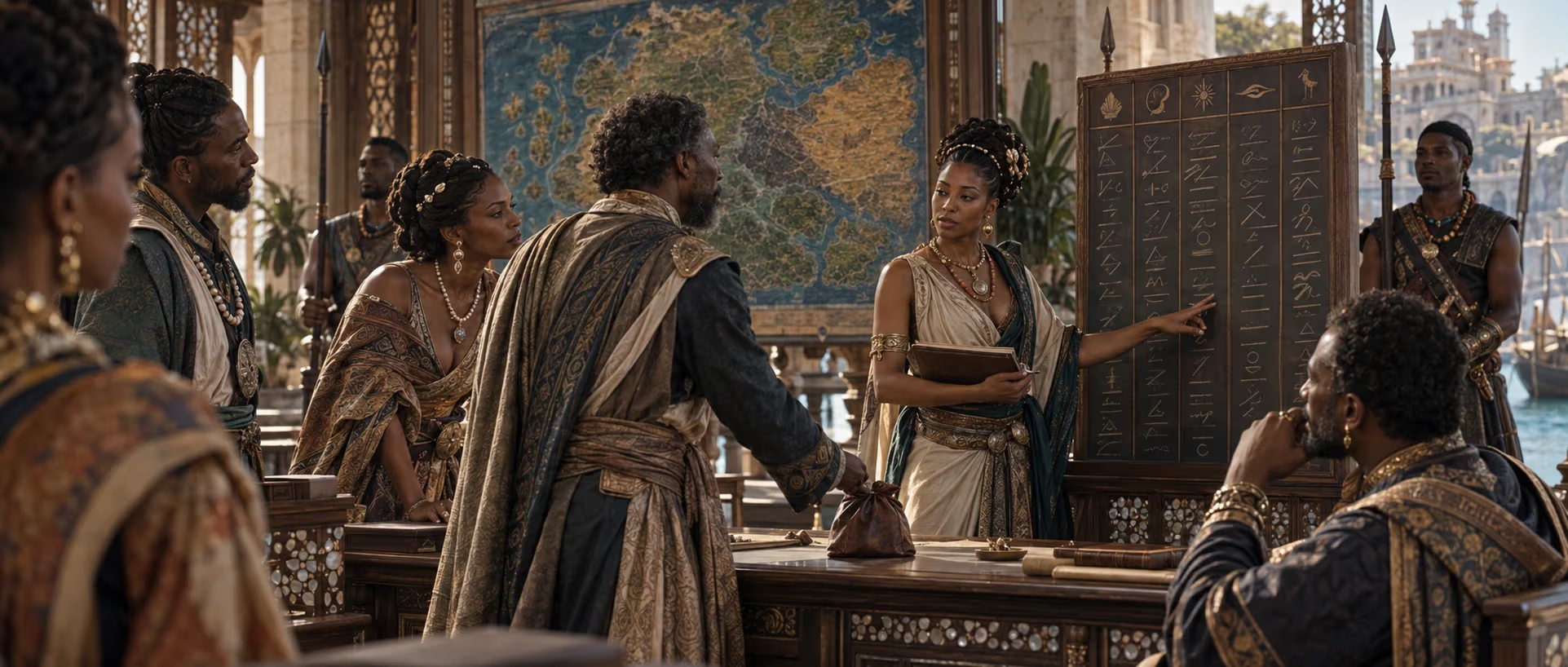
The Stake Chambers
A Grand Board makes proposals, contributions and beneficiaries visible.
Watching support form
The Stake Chambers display proposals, committed sums and their contributors on a live Grand Board. Houses, unions and actual beneficiaries must be identifiable. Political contributions belong to the declared, taxed and traceable world. The assembly thus shows the interests supporting a decision rather than separating it from the means contributed to it.
Money can be pooled
A coalition can combine families, artisans, unions, middle classes, companies and celebrities. Their pooled support can outweigh a single House. Volonia’s monetary power therefore also depends on organising interests and persuading people. The sum matters, but the collective process that forms it gives relationships, reputations and projects a concrete political role.
Contribution, share and bet
Three objects circulate around a project: political funding, shares providing material expedition returns, and predictive bets on its outcome, duration or losses. They remain distinct. People can support a decision, participate in campaign returns or bet on an event. The political board belongs to the first relationship, in a society that also knows the other two.
A vote that is weighed
The Volonian vote is weighted by the money committed. There is no egalitarian fallback ballot: a small sum carries little weight, a large sum a great deal. The vote is divisible: the same actor can spread their money across several candidates, measures or coalitions. Major votes take place in the Chambers, in Port Volon, and the stake broker gathers and displays political funds without hiding their beneficiaries.
Hidden money
Political money must be declared, taxed and traceable. Hiding a backer is not a matter of commercial discretion: hidden money is treated as an attack on the system, and untaxed political money can amount to constitutional treason. Volonia states the rule this way: money can give power only after it has paid its dues.
A session at the Chambers
The Chambers of Stakes sit in Port Volon, in a great hall lined with galleries the public can climb to. The Great Board covers an entire wall: an assembly of painted slats, columns and wooden rails along which board-keepers, perched on ladders and walkways, slide plaques of figures and names. Each proposal has its column; beneath it line up the sums committed, the contributors and the coalitions, and a red stroke marks the real beneficiaries.
Deposits are made at the counters. The contributor brings coins or an endorsed letter of credit, receives a receipt, and the stake appears on the board within the hour. Criers announce the important movements aloud, and bells mark the opening and closing of the vote. During the great ballots the hall never empties: people eat there, bet in the corridors, and watch the columns rise the way one watches a race.
The stake broker
The stake broker is the trade attached to the Chambers. He pools the political funds of those who will not, or cannot, come and deposit them in person: a dockers’ union, a craft guild, a neighbourhood association, a captains’ society. He displays these funds without hiding their beneficiaries; his commission is declared and taxed, like everything else.
Coalitions often go through him. A district organisation, such as the Union of the Tide Nights that gathers the women workers of certain ports, can entrust its stakes to a broker who places them on one measure, spreads part of them over another and reports back to the members. A broker who mixes the funds of two rival coalitions, or keeps an entrusted stake for himself, loses his licence and falls into the territory of fraud.
What becomes of the stakes
Political funding is not a symbolic gift: it pays for the decision. A measure that wins, the dredging of a pass, the building of a quay, a convoy escort, an expedition against pirates, is carried out with the funds gathered in its favour, under the supervision of the Great Counting House. Stakes placed on the losing measure are returned at the next tide, minus a board fee that keeps the Chambers running.
The great votes are held in Port Volon, but every large port has its own chambers for local affairs: paving the terraces, night patrols, the upkeep of basins. It is at this level that small coalitions weigh most. The rate of the Fifteenth, for its part, is not voted on: it is the same for everyone, and it is precisely because money has paid that share that it has the right to speak.
What Volonians think of it
Most Volonians are attached to their weighted vote. They see it as the logical consequence of the Volonian dream: anyone can come, work, grow rich, and weigh in proportion to what they have built and declared. The poorest weigh little, and they know it; their weapon is the coalition. Criticism is not lacking for all that, in the taverns as in the theatres, where satirists like to show columns that rise all by themselves.
Foreigners judge more harshly. In Urnok, where people vote little and record everything, they speak of a state sold at auction; Volonians answer that a state whose price you can see is more honest than one whose buyer you do not know. Both camps agree on one point: in Volonia, hidden money is the one fault the Great Board does not forgive.