

Places and landscapes
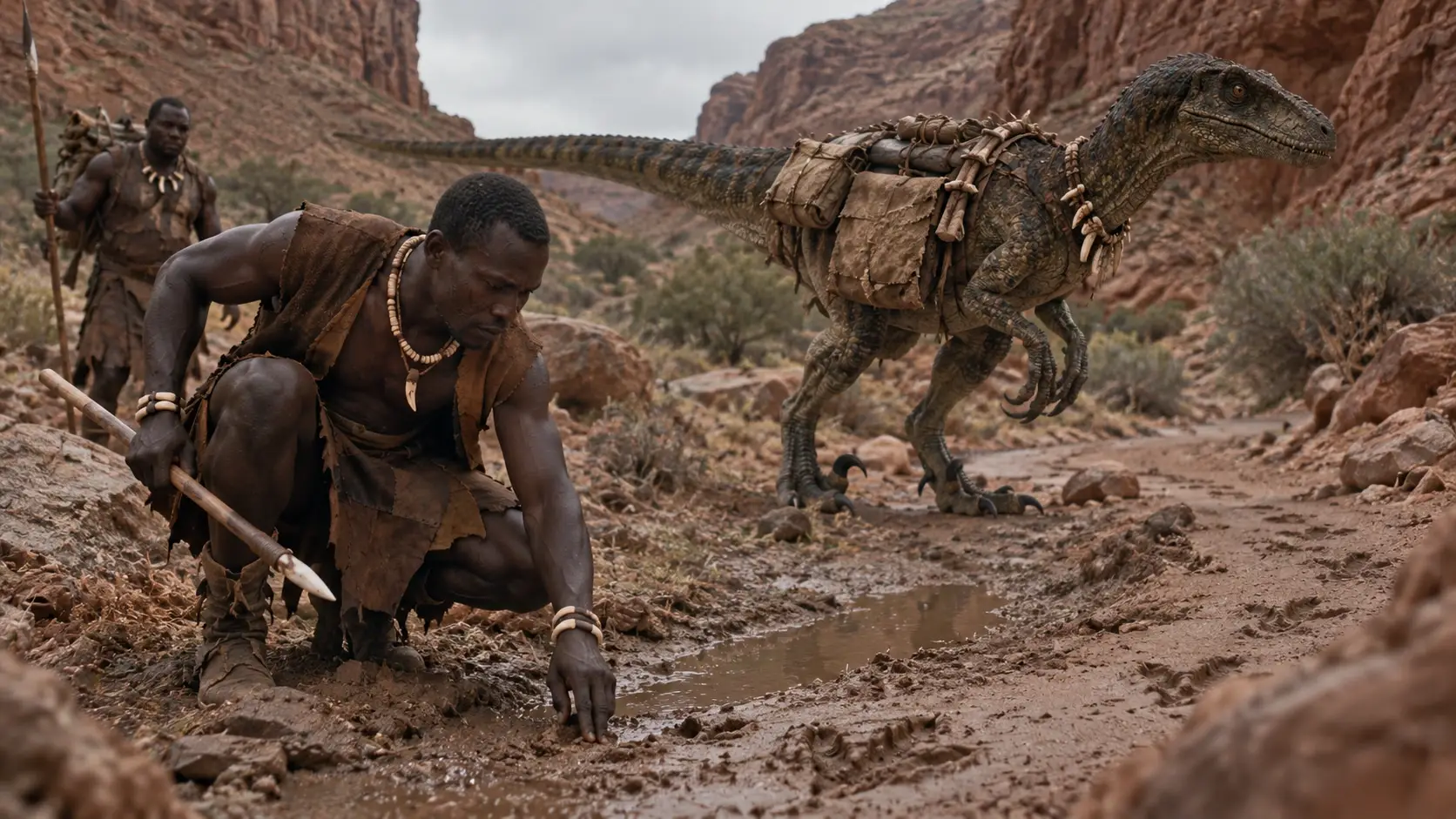
Arkhan: the track chain
A journey depends on water, shelter, temporary markets and people able to read the terrain.
A track is a condition of terrain
In Arkhan, a track is not a guaranteed line. It can serve caravans, herds and migrations, or become seasonally unusable. Scouts and convoy workers must know water, rest areas, shelters and animal crossings before committing a load. A route is shared terrain memory, corrected with every passage.
The stop works before the market
A useful stop first receives the operations that make departure possible: water, repair, shelter, animal separation and load counting. Sellers, money changers and artisans depend on this space for rest and inspection. At Sand Port, contract, containment, inspection and exchange make passage between a track economy and maritime circuits possible.
Tracks that change status
In Arkhan, every landform becomes a track. A track can be a trade route, a caravan route, a nomad route, a raiding route, or dead for part of the year; its status changes with the landscape and the season. The Seven Tracks, organised around Qor-Zaï arkhan, form a territorial and social structure; a track there is not automatically a family.
Wells, relays and track readers
A track is made of stages where one can drink, rest, repair and find the way again. The Water-Master checks the supply needed for the next stage; the Wind-Tracer watches scattered signs; the Track Interpreter links them to the memory of past journeys. Their advice can lead a column to slow down, go round or wait.
Arkhan’s administration is light by choice: it rests on the track, memory and reputation. Songs, testimonies and portable knots keep a debt or a memory when peoples change cities.
Speed and its limits
On a dry track, a Horde covers twenty-five to forty leagues a day: this extreme mobility is its whole doctrine. It remains bounded by water and food, because riders, porters and carnivores do not have the same needs, and a road one can run along cannot always feed a large concentration of forces.
The Seven Trails
The Seven Trails leave Qor-Zaï like the fingers of an open hand. They were fixed very long ago, in the period the songs call the Age of the Seven Trails, at the same time as the Supreme Khan’s Tour, which travels all of them. The first carries the name of the Relay of the Broken Column; another, the Cutting Wind trail, takes the name of the plains it crosses.
The name has crossed borders. On Korath’s south-eastern exit, the pass markers simply read “Towards Arkhan — the Seven Trails”, and at the gates of the imperial marches the guards ask travellers, to know where to direct them: “Imperial march or Seven Trails?” For a foreigner the Seven Trails are the whole of Arkhan; for an Arkhan they are only the greatest of countless trails.
The bone road and the skull-markers
Some trails are marked. On the bone road that runs down to Sand Port, beasts’ skulls planted on stakes punctuate the grey plain at intervals. These skull-markers are not trophies: their snout points towards the nearest water, notches cut into the bone give the number of days’ march to reach it, and a touch of pigment shows the clan that maintains the marker. An overturned skull signals a dead well.
The markers are redone after every rainy season, and whoever moves one to lead a rival astray commits an offence that the water masters judge as harshly as stealing water. There is no marker made from a human skull; the very idea would make an Arkhan child recoil.
Paying to pass
Everything that crosses the steppe pays the movement tax. It is paid at wells, at relays, at pass crossings, to a khan, to a coalition of tents or to a band that holds the trail that season; it is paid in beasts, in meat, in Dracos or in services. Proof of payment is knotted on a cord or carried as a marked object, shown at the next post.
Refusing to pay is not an offence that anyone judges: it is an invitation to a raid. Foreign caravans therefore hire guides who know who is owed what, and in which language to say it. In war the same knowledge serves the other way round: Arkhan scouts lay counter-trails, false tracks and false relays meant to lead the enemy far from water.
Part of this article covers events of season 1. Turn spoilers on in the menu to read it.