

Institutions
Receiving travellers at relay stations
A relay allows people, animals and loads to resume their journey without shifting travel risks onto the surrounding community.
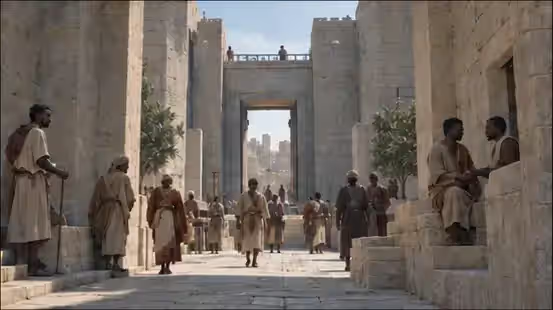
Water, rest, repair and information
A useful relay brings together water, a place to rest, repair materials, separate spaces and information about the road. Travellers are not received through a symbolic gesture: they must be able to understand what is possible, wait safely and depart with a checked load.
Different traffic does not use the same space
Pedestrians, working animals, carts and heavy loads cannot all turn, drink or wait in the same place. A relay’s organisation therefore provides priorities, safety margins and clearance periods. These choices avoid treating a convoy’s speed as an absolute right of way.
Hospitality has material limits
Receiving does not mean promising unlimited space, immediate access or exemption from checks. Relay teams must preserve water, fodder, access and people already present. This responsibility governs waiting, the relay and the sharing of water, fodder and access.
Arriving at the relay
At a relay’s gate the first gesture is to write. A register keeper records the name of the traveller or convoy chief, where they come from, where they are going, the number and species of their animals and the nature of their load. Holders of a safe-conduct present it; grain convoys show their convoy letter. This register makes it possible to know who is on the road, and to trace a traveller who never reached the next relay.
Then comes water, and in an order that surprises foreigners: the animal drinks before the man. The animals are led to the troughs, the largest separately, then to the rest pens; travellers sit down only once their mounts have been served. The rule is old and nobody disputes it, because an exhausted animal endangers everyone sharing the road with it.
The relay master
Each relay is run by a relay master, most often trained in the Road schools of Calaron, where the trades of steward and convoy driver are also taught. He answers for the water, the fodder, the pens, the repairs and the safety of those present. He reports to the High Chancellery of the Living Roads, which inspects the relays and can strip him of his post.
The relay master has a power that hurried travellers discover to their cost: he can refuse entry. When the water drops in the cistern or fodder runs short, he closes his gates to newcomers rather than deprive those already there. He can also hold back a convoy whose animals are too tired to leave, and enter his opinion in the register; a convoy chief who overrides it carries the responsibility alone.
What a halt costs
A halt must be paid for, but at rates posted on the gate. A convoy’s toll at a guard post costs about three quarters of a Draco; water for the animals is counted by the trough, fodder by the bundle, a place in a pen by the night. A fifty-litre amphora of drinking water is worth about twenty-two hundredths of a Draco; a health inspection with its entry in the register, a little over half a Draco.
Travellers on foot and day labourers sleep under the halt vaults, covered shelters where one pays little or nothing. Relay masters owe water to anyone who comes to the gate, even without money: refusing a drink is a fault the Chancellery’s inspectors never forgive. Lodging, fodder and repairs, on the other hand, are never free.
The relay as a news office
A relay is where one learns the state of the road. Near the gate, a tablet announces the flooded fords, closed bridges, sections under repair and relays further on that are short of water. Imperial couriers change mounts there without stopping longer than a mouthful; relaying one another this way, they cover forty to sixty leagues a day.
In the evening, in the yard, the chronicles from the capital are read aloud, those of the Petit Fourrage first, and travellers exchange what they saw on the way. Relay masters sort the rumours, pass on to the couriers what must go up and keep the rest to themselves. Part of what the Crown knows about the Empire reaches it this way, from relay to relay.
Relays with a name
Relays have an official name, entered in the Chancellery’s registers, and often another given by those who work and pass through them. This everyday name comes from an animal that remained famous, a relay master people remember, an event on the road or simply a quality: people speak of the relay where the water is always cool, or the one where nobody ever sleeps.
These names sometimes end up replacing the official ones on everyone’s lips, without anyone having decided it. In an empire that honours office more than titles, this is one of the most lasting forms of memory: a place that served well keeps the name of those who made it serve well.