
Religion and rites
The Basalt Oath
Korath’s great forge festival: oaths are sworn on the rock and the year’s metal contracts are carved into basalt.
Carving the contract in stone
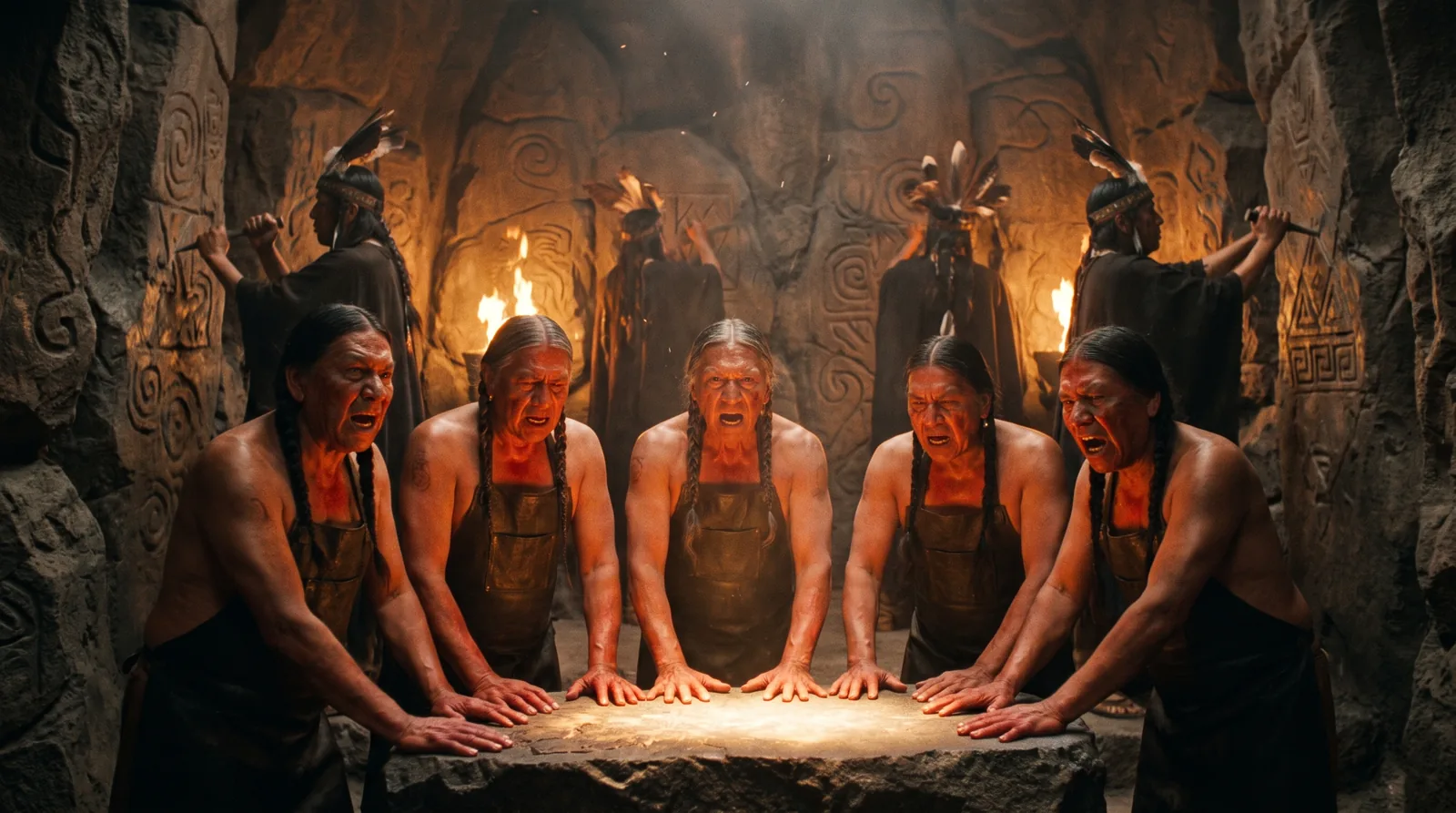
The Basalt Oath (Serment de Basalte) is the great forge festival. Those swearing lay their hands flat on the rock while chisels carve the year’s metal contracts into the basalt; the oaths are shouted over the noise of the forges. Breaking a carved oath is a sacrilege.
The buyers in the front row
Master smiths come by household. Foreign buyers attend under escort; the envoys of Urnok’s Living Armouries, Korath’s customers, stand in the front row. The basalt walls are studded with the oaths of past years.
The walls of oaths
Every great Korathi city has its wall of oaths, a dressed face of basalt near the forges, in the warm layer where the rock stays lukewarm all year round. The stone is cut into a grid of regular squares, one square per contract, set out in rows. The lowest rows carry the oaths of the first centuries; each year the engravers climb one row higher. When a face is full, the stonecutters of the Side of Form dress a new one beside it, and the wall slowly spreads along the gallery.
In the oldest cities these walls run for hundreds of paces. People come to them as to an archive: a buyer checks a workshop’s word before dealing with it, an apprentice looks for his house’s first contract, a historian follows the growth of a trade from one year to the next. The smaller pass towns have short walls, often cut straight into the rock of the gate, where the season’s chain and rivet contracts are engraved.
What an oath says
An engraved oath fits inside a square one cubit on each side. From top to bottom it gives the name of the workshop that commits itself and that of the buyer, the material promised, the quantity, the state gauge the pieces must match, the deadline and, inside a more deeply cut frame, the declared tolerance: the share of pieces the workshop agrees may be rejected without the oath being broken. The price, counted in Dracos, sits at the bottom, beside the red disc in the black square that seals every contract.
The engravers use an abbreviated script made of trade signs that every Korathi learns at school: one stroke for iron, two for bronze, a notch for chain, a dot for rivets. A foreigner sees only a mute grid; a journeyman reads in a few seconds that a pass workshop has sworn four thousand links for the autumn. The largest contracts, those of the Forges or of Urnok’s Living Armouries, take up four squares joined together.
The day of the oath
The festival begins at the dawn gong, and the forges do not stop for it: the noise is part of the rite. An oath that cannot be shouted over the hammers, people say, is not worth engraving. The households of master smiths come before the wall one after another. A sacred geometer measures the reserved square, checks that it is true, then announces aloud the material, the quantity and the tolerance.
The swearers then lay their palms flat on the stone, heated by the nearby furnaces until it is barely bearable. They must keep them there until the engraver has finished the first line; pulling the hands away before the end is taken as a lack of composure, and the crowd notices. The buyer repeats the commitment, the engraver signs in the corner of the square, and the next household steps forward. In the evening the taverns of the warm city fill up, and the year’s oaths are discussed there the way other peoples discuss a harvest.
Breaking or amending
Breaking an engraved oath is a sacrilege, but the word covers a precise fault: letting the deadline pass without a word, or delivering pieces outside the gauge while presenting them as compliant. Like every false precision, the breach is never erased. A line cut across the square marks it, with the date, and the square stays on the wall for as long as the wall itself. The guilty workshop loses its place at the next Oath, which, for a house that lives on contracts, looks very much like an announced bankruptcy.
Korathi law nevertheless leaves an honest way out. A workshop that knows it will not keep its promise can declare the gap before the deadline, in front of a sacred geometer and the buyer. The amendment is then engraved in a small square set against the first: new quantity, new deadline, reason for the delay. Korathi see no shame in it. A wall covered with amended squares shows a house that works hard and does not lie; a wall slashed with lines shows the opposite.
What foreigners read
The walls are public, and foreign buyers know it. The Urnok envoys who attend the Oath leave with a fairly accurate idea of what the mountain will produce during the year: how many chains, how many rivets, which workshops are working at full load and which are struggling. Volonian houses send clerks to copy the grids and estimate the season’s prices, and the bankers who lend to workshops come to check how sound their debtors are.
The Forges know all about this reading and take it into account. Their own military orders are never engraved in public: they are sworn on the same day, but in a hall of the deep core, on a wall seen only by the officers and masters involved. What appears on the wall of oaths is therefore the part of Korath the mountain agrees to show, and foreigners soon learn to read the empty rows as well.