
People

Nala Vey
Herbalist and envoy of N’Goro; at Urnok’s Croc Fendu, a healer who sells her remedies by the dose.
Knowledge of plants
Nala Vey works as an herbalist and envoy. In N’Goro a preparation depends on the season, the body, the water and exposures; her trade requires recognising those differences. A useful substance does not keep a fixed value once it leaves the place where it was prepared.
Envoy between communities
The role of envoy links that skill to relations between communities. Routes, recognitions and protections are negotiated between groups whose interests do not always coincide; moving information or a preparation means knowing the parties and the conditions of passage. The Foam Marches, the flotillas and the networks of fisher-trainers give these exchanges a maritime dimension.
At the Croc Fendu
In Urnok, Nala Vey offers her remedies at the Croc Fendu, Mako’s tavern. She sells doses there: her medicine is counted in drops, and she knows the exact limit of each body. Two drops let you walk; three make you miss tomorrow. She doses everything, her tenderness included, and says so without irony.
With the tavern keeper, who forgets out loud, she forms a duo of the common people: he erases, she measures.
A rank her trade does not show
Nala Vey’s stall deceives foreigners. What they see — a herbalist counting her drops in an Urnok tavern — is true, but it is only part of her function. In truth she is the real representative of a bloc of peripheral great spinosaurids: behind the healer stands a power of the water, and her visible trade does not reveal her full rank.
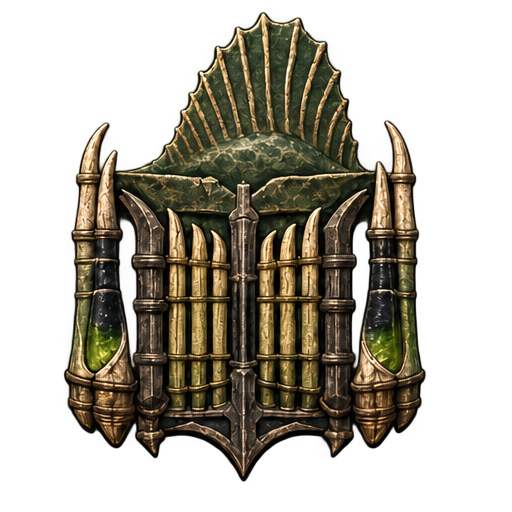
Her name says so to those who can hear it. In N’Goro one carries the name of one’s water, and Nala Vey’s echoes the House of Nala-Vey, the great peripheral lineage of fisher-trainers, flotillas and spinosaurids of the Foam Marches, which answers to the central authority of Muu-Shanga. When she speaks as an envoy, then, it is not an isolated voice negotiating: it is a lineage whose beasts and barges are indispensable to any mobilisation of the estuary, starting with the Foam March. Through her mother, Nala Vey also belongs to the Vey clan, the herbalist-dosers who prepare balms and antidotes for the Conservatory of Yveth. The House of Nala-Vey, said to be nearly three thousand years old, has the motto “The dose knows the truth”: Nala Vey is its most ordinary embodiment, a woman who weighs every drop.
Filtre, the baryonyx that smells water
Nala Vey travels the channels on Filtre, a damp-green channel baryonyx, a spinosaurid lighter than the great Siirmuu of the estuary. It is an amphibious mount, able to follow a barge, climb a bank of roots and carry its rider where a dugout runs aground. Its real worth lies elsewhere: it smells contaminated water.
Faced with water that does not suit it, the animal stops, lifts its snout and snorts loudly; if pressed, it backs away. Nala Vey does not override it. She prepares no remedy with water Filtre has refused, and she notes those refusals on a strip of fibre, with place and season, the way others note prices. For her, medicine cannot be separated from territory: a sound remedy prepared with false water becomes a slow poison. The estuary trainers say, laughing, that Filtre is the best Sap-Keeper in the House and asks only one fish per opinion.
What she carries
Like most adults in N’Goro, Nala Vey never goes out without her threshold kit, but hers is closer to a dispensary. At her belt hangs a row of horn and clay flasks sealed with wax, a measuring spoon carved from bone, a small funnel of hammered copper and knotted cords in which each knot is worth one drop. Clear Breath for wheezing chests, Red Moult to stop bleeding, Counter-milk for those who have taken too much Black Milk: for each she knows the limit beyond which care becomes a fault.
She sells by the drop because the dose is the remedy. A whole Venom Phial, N’Goro’s commodity money worth about five Gold Scales, would far exceed a soldier’s purse; a few drops, paid in bronze, are within reach. Each sale comes with a short instruction, often traced in spore ink on a strip of hide: how much, when, with what water, and what must above all not be mixed. She repeats the instruction aloud, then has it repeated back.
A useful foreigner in Urnok
In Urnok, Nala Vey remains a foreigner, tolerated as long as she is useful. At the Croc Fendu her customers look like the war seen from below: Long-Stride soldiers coming back with weeping wounds, carriers with clogged lungs, serving women who no longer sleep. She treats them all without asking which side they are on. She has a distant colleague in Tesfa, the Long-Strides’ veterinarian: he doses the beast, she doses the man, and people in the taproom say these are the world’s two medicines.
The anti-rot glue she keeps in stock is the same product N’Goro sells to every nation, the one that stops tendons, leathers and bone cements from rotting before battle. In a city that counts in fodder and roads, a healer who also knows how to poison inspires as much gratitude as mistrust. Nala Vey ignores neither. She merely reminds anyone who threatens her that the counter-flask of each of her poisons sleeps with the Sap-Keepers, and that she never sells a venom whose antidote she would refuse.