
Institutions
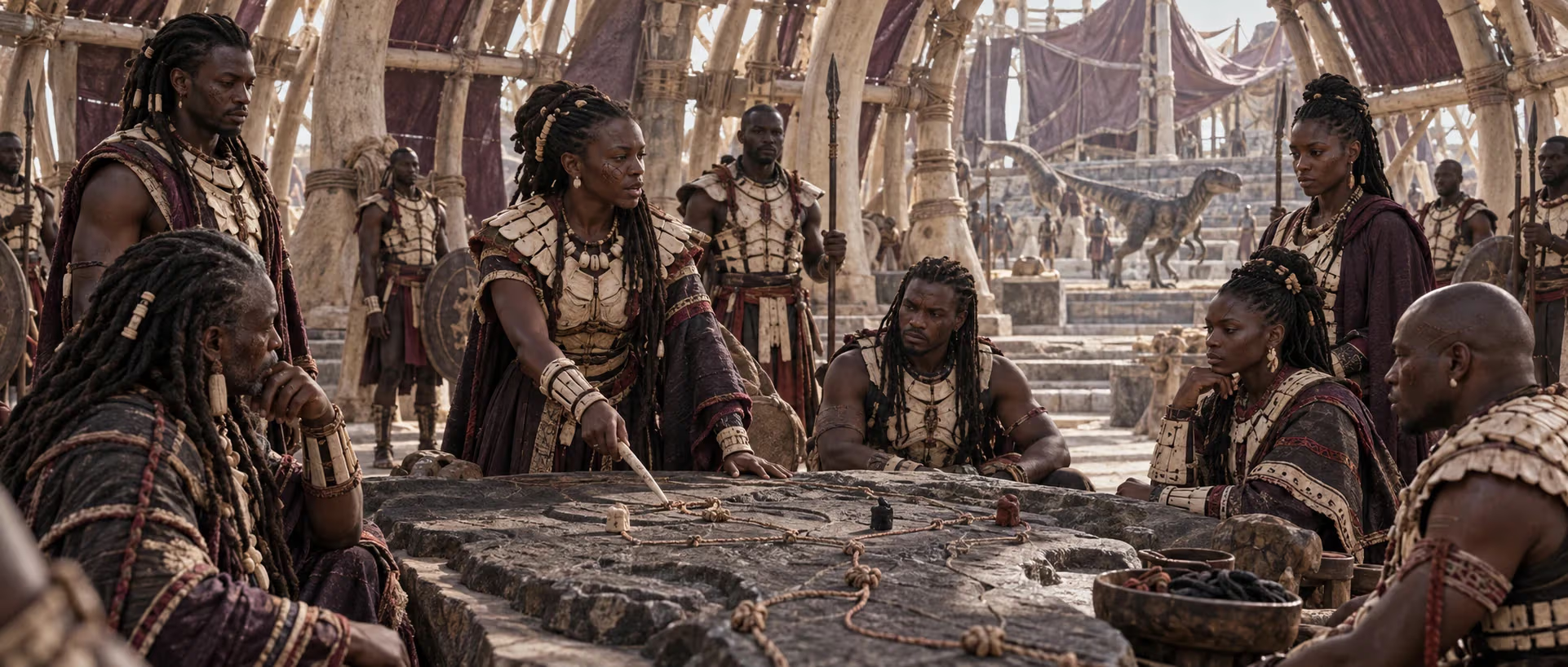
The Council of the Trails
In Qor-Zaï, the common meeting place of a mobile Confederation: the Council sits beside the treasury and archives and stays fixed while the governing peoples change cities.
A fixed centre
Qor-Zaï houses the Council of the Trails, the treasury and the archives of the Confederation. The City of Bones is the centre of the Seven Trails: it gives a lasting place to a Confederation whose governing populations move. During the Great Shedding, the capital stays fixed with its institutions, even when the Supreme Khan leaves on the Tour of the Seven Trails. Decisions about migration and relations between great peoples thus have a common place.
A light administration by choice
Arkhan is not a bureaucratic central state. Its administration is weak by choice: it rests on the trail, memory and reputation. Its trail memory is made of oral administration, reputation, tracks, songs, debts and rights of passage. The archives of Qor-Zaï keep part of the Confederation’s memory; in the other cities, the Anchored look after the works, debts and customs.
The Seven Trails
The Seven Trails form a territorial and social structure organised around the centre at Qor-Zaï. A trail is not automatically a genealogical family. Trails can be for trade, caravans, nomads or raids, or be seasonally dead, and wells, caravan relays, corrals, hatcheries and camps carry more weight on them than continuous borders.
Who sits
The Conseil des Pistes gathers around the Supreme Khan the Confederation’s great khanates and the clan of the Fils de la Faim. Each khan sits in person or through his voice, a spokesman authorised to affirm and contest in his name. The seats are saddles set up in a circle, as at the evening gatherings where lineages are knotted: no one sits higher than another, except the one who presides.
Around this circle sit, without a vote but with real weight, those who hold the Horde’s counter-powers: the Water Masters, the Keeper of the Share, the Bone-Bearer, the mothers of lineage. One can order the march, not the water nor the breeders, and it is in the Council that this limit makes itself heard. War-singers announce the khans’ titles as they enter, and witnesses from the trails listen from the tiers.
Ha, ho, hû
The Council’s debates follow the grammar of arḫán, which has made debate a grammatical form. One affirms with ha, contests with ho, and only the one presiding may close with hû. An Arkhan verbal duel can be heard in this rhythm of ha and ho, which may last for hours; when the hû falls, the question is closed, and reopening it is taken as an insult to the one presiding.
Every statement must also say how one knows. A khan reporting news specifies whether he saw it with his own eyes, read it in a trace or received it through song; words without a witness are wind, and opponents are quick to ask where a claim comes from. Closed decisions are knotted on cords before witnesses, then entrusted to the archives: in Qor-Zaï a treaty is knotted, and breaking a pact is called cutting the cord.
The treasury and the archives
The Council sits beside the treasury and the archives, and the proximity is no accident. The Confederation’s treasury does not resemble Urnok’s: it holds above all certified bones and teeth, claws, prestige pieces and Dracos come from Port de Sable. In Qor-Zaï the ritual certification of bones, carried out at the Bone Tribunal, serves as both bank and court; an intact tyrant tooth is used there for rite and judgement more than for trade.
The archives keep a memory made of knotted cords, engraved bones, plates and accounts their keepers can recite. They do not hold all of Arkhan’s memory, which also travels with the peoples, but they keep its common part: treaties between great peoples, the calendars of past Sheddings, the confirmations of khans. That is the part the Council consults when a dispute involves several trails at once.
When the Supreme Khan is on the trails
During the Great Shedding the Supreme Khan leaves for the Tour of the Seven Trails and leaves his throne to the Guardians of the Empty Saddle. The Council remains in Qor-Zaï with the treasury and the archives, but its working changes. Without the one who presides, no one can pronounce the hû: the Council debates, prepares and gathers testimony, but does not close the great questions.
Arkhans call these the months of ha and ho without hû. Ordinary business, the calendar of the columns, water disputes, the treasury accounts, is settled between the khans present and the water masters, under the Guardians’ eyes. The great decisions wait for the Supreme Khan’s return, and on arrival he takes up each question in the order in which it was raised. The delay protects the Confederation against decisions made in the absence of the one who will have to carry them.