

Materials and resources
Aversin: the resin signature
Tapping, cooking, pitch, varnishes and balms make resin a material with many uses.
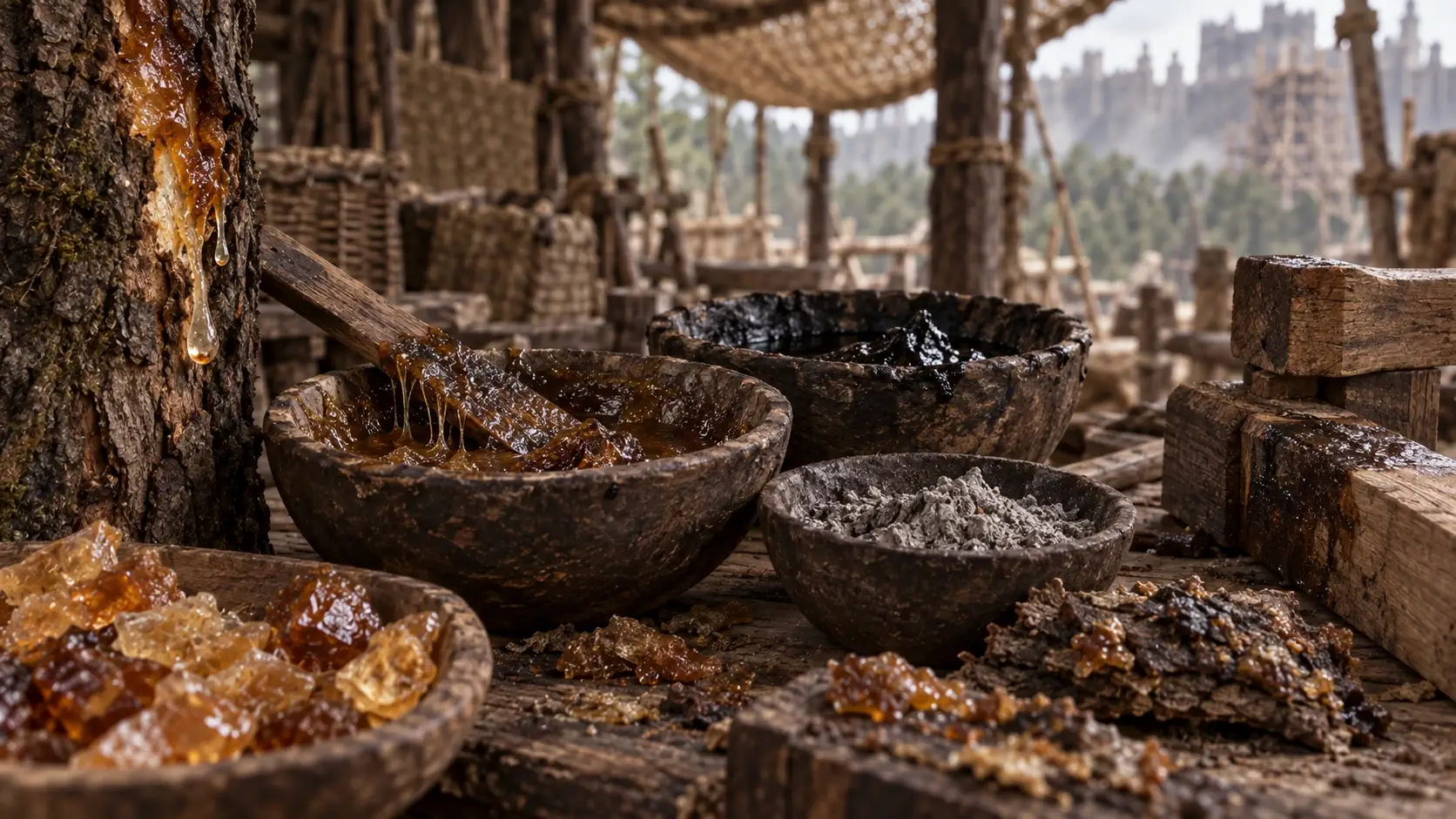
From tapping to balm
Aversin handles Orlantis resins: tapping, cooking, pitch, varnishes and balms. These stages connect a forest harvest to several destinations. The duchy’s amber-resin signature has a productive origin: it comes from material worked, carried and applied. A sheen on timber can therefore bear the history of a Line other than the one that shaped it.
Cooking outside the walls
The Aversin cooking district stands downwind and outside the walls because resin burns. This separation governs the whole urban chain. It is not a decorative choice: the fire’s location changes traffic, neighbours and risk. Resin workshops are not interchangeable with drying areas or animal enclosures.
A forest in the hull
Regular flows connect Orlantis timber, resins and cordage to Volonia. Binders enter composites, harnesses and boats; their absence can make another delivered material unusable.
The resin road
Resin leaves Orlantis by the resin road, which links the duchy to the capital, to the march of Qor Zaï and to the ports where cargoes are shipped for Volonia. The jars sealed by the Aversin travel along it on the backs of lambeosaurs, the pack animal of the resin forests, from relay to relay. These resin relays are forest halts kept by a handful of labourers, a few carpenters and glue makers, who check the seals, take back cracked jars and feed the animals.
Resin caravans are escorted, and their escorts are often stegosaurids of the Lomvar Line, hired with their handler for the length of the journey. Resin is a commodity people gladly steal: it resells easily, and a lost jar costs the Line that sealed it dearly. Convoys therefore leave at irregular hours and stop only at the relays, where the jars spend the night under guard.
Fresh resin and titanic amber
Two materials that the Empire carefully distinguishes are often confused. Aversin resin is fresh: tapped from the pines and araucarias of the Orlantis valley, it goes into pitches, ordinary varnishes, balms, glues and ropes, and sells for a few tenths of a Draco a kilo. Titanic amber is a fossil resin, hardened over ages, extracted from pits where, it is said, the titans once went to die; it is a controlled material, worth hundreds of times more.
Amber serves what must last and must not lie: the seals of notaries and silo chiefs, whose imprint cannot be counterfeited without breaking the stone, and amber varnish, made of amber dissolved in hot oil, which coats ducal plaques, seals and register cases. Fresh resin gives Orlantis its colour; amber gives the Empire its proof.
The balms of care
Part of Aversin’s resin ends up in carers’ jars. Softened with fats and herbs, it makes wound balms, which protect an injury from dust and rot; harness balms, greasier, which soothe chafing; resin dressings, strips of impregnated fibre applied hot that harden as they dry. Each cookery employs at least one herbalist, who chooses the plants and watches over the mixtures.
These balms treat people and animals alike. They are found in relay pharmacies, in convoy carers’ packs, in the jars of the veterinarians who follow the armies and at the thermal gardens of Orlantis, where the stegosaurids are cared for. A resin dressing costs only a few hundredths of a Draco, and armies carry them away by the crate.
Court varnish
Aversin’s varnishes give Orlantis its gleam. They coat the wooden façades, the lacquered galleries of the walls, the furniture of rich houses and the pieces of fine wood the duchy sells to the court. The finest use is kept for the ceremonial stegosaurids: for ceremonies, the back plates of the animals of the House and of the Lomvar Line are cleaned, polished and varnished with amber, and shine in the sun like goldsmith’s work.
Varnish is laid in thin coats with a brush, each dried for several days before the next, and a fine façade varnish has about ten. It must be renewed every few years, and teams of varnishers regularly climb back onto the scaffolds of the great houses. An Orlantis saying claims that a family’s fortune is judged by the number of coats of its varnish, and its prudence by the date of the last one.