

Culture
Reading the city and its inventions
Plans, newspapers and technical disputes belong to popular culture.
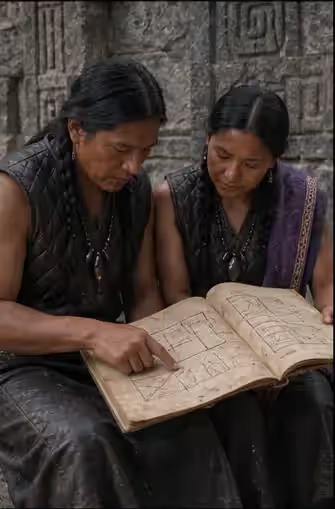
Signs useful to urban life
Reading standards, signals, procedures and plans is a survival need in deep cities. Korath literacy is therefore not confined to scholars and archives. Residents encounter systems whose rules must be understood for proper use. Drawings and text make constraints accessible even when an object’s shape alone does not reveal them.
Counterproof becomes public reading
Articles, protocols, demonstrations and limits are read far beyond universities. Each discipline has several journals, and even the general press publishes diagrams. A patent can therefore be known through its results as well as its promises. Readers follow what a workshop announces, what it has actually tested and what counterproof allows others to question.
The detail reaches the tavern
The Great Dispute of Detail turns small technical questions into editorials, songs, family arguments and tavern disputes. Transfers, plagiarism, romances and rivalries among inventors also feed popular newspapers. Knowledge thus has a noisy social life: a discussion begun around a mechanism can continue in print, in song or over a drink.
What a gazette contains
A Korathi gazette is read in two stages. The morning sheets print protocols, the previous day’s filings at the Great Chamber, the results of trials and counter-proofs, announcements from the Forges and the tables of district closings. The evening ones are lighter: the inventors’ transfer market, priority lawsuits, chronicles of the Hearts of the Rift, workshop romances and rivalries, caricatures. Many readers buy both and make no secret of it.
All of them print diagrams. Even the most popular sheet explains a mechanism with a dimensioned drawing, and readers quarrel over whether an arrow is right the way others quarrel over a race result. A gazette costs little, a few fractions of a Draco, and passes from hand to hand: a single issue goes through the workshop canteen, the tavern and the bath before ending up, cut out, on an apprentice’s wall.
What satire dares
Korathi satire is merciless. It draws the bourgeois of the Four Sides as gilded hinges that carry nothing, vain inventors as clocks that chime without telling the time, judges of the Chamber as warped set-squares. No workshop, family or mechanism escapes it, and its victims know it is better to laugh publicly than to complain: complaining about an accurate caricature counts as one more fault.
A single subject stays out of reach: the very principle of military power. One may mock the slowness of an army supplier or a corridor engineer’s bad calculation; one does not mock the right to close the gate, nor the person who holds it. Editors know this border to the line, and no law needs to recall it: it is part of everyone’s upbringing, like the story of the refused revocation patent that every schoolchild hears one day.
Reading aloud
Although nearly every Korathi can read, the gazette is often read aloud. In the square-rule taverns one customer reads the article of the day while the others redo the calculation in chalk on the slate tabletops; in the baths, a reader paid by the house reads the news for those whose hands are in the water. Press debates are thus shouted from table to table, and a technical controversy can gather a whole room around a single diagram.
These public readings have their rules. The reader is allowed to finish, one disputes a figure rather than a person, and whoever claims to be right must be able to show it on the slate. Foreigners are often astonished to see porters and miners argue over a hinge tolerance with more passion than other peoples bring to talking politics.
The press when war comes
In wartime the gazettes change their content without changing their tone. They print rationing rules, the district gong codes, the results of closing drills and the lists of spare parts the workshops must deliver. Black patents multiply, and the serious press refrains from any speculation about their object, as it already does in peacetime.
The evening sheets keep coming out, because Korathi feel that a city that no longer laughs is a city that is afraid. Their satire then turns against the enemy and against those who profit from shortages. They also print the names of those who died in the passes, each with the note that their square is closed, and these lists are often the page people cut out and keep.