
Institutions
Border controls in Ishtir
Ishtir’s gates, marches and terraces organise the entry of people, animals and loads according to the territory’s real capacities.
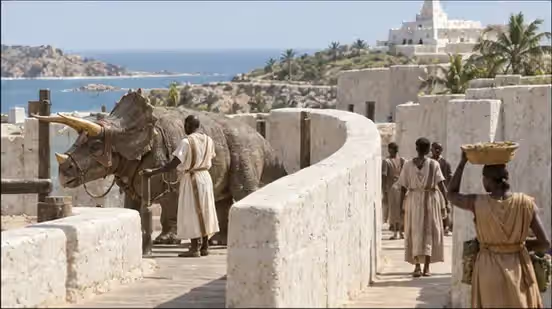
A gate checks a passage
Entries slow arrivals in order to distribute loads towards yards, terraces and stores. Guards, carriers, handlers and inspectors do not carry out the same function, but their sequence prevents an arrival from becoming congestion or danger for people already there.
Permission depends on local capacity
Water, resting space, access stability and available teams determine whether passage can be received. Permission does not promise speed: it takes local constraints into account and may require waiting, a relay or another route.
The frontier does not fix an identity
Transit operations organise the movement of people, animals and cargoes. They rest on health conditions, routes and the responsibilities of each stage.
An island and its thresholds
Ishtir is an island, and its borders are shores first of all. One enters through the ports of the Côtes des Alizés, through the secondary ports of the Îles du Soleil Levant, through the western marches that face the sea and Arkhan, and through the marches facing Velmor and Aryel, where two civilisations come close. Elsewhere, between Ishtir and the other powers, there is no drawn line, only weeks of sea or empty land.
Each threshold therefore has its own rule. A regulated port receives merchants and their cargoes; a march gate receives troops, animals and tired travellers; a cliff relay receives what flies. Keepers, porters, carers and inspectors work there from different tablets, and a passage granted at one does not open the others.
The clay permit
A foreigner wears no biography on their sleeves. At the gate they are given one, a provisional one: a sealed clay slip on which the inspector engraves their name, the purpose of their visit, the places they may go and the length of their permit. That length is counted like everything else in Ishtir, in days, in moons or, for a simple visit, in lines of shadow on the copper groove set into the wall. The inspector checks the edge of the slip, the temporary seal and the number of the threshold; a broken or scratched slip counts as a refusal.
The permit opens specific doors and no others. A Volonian merchant authorised at the port cannot travel up the canals; an Urnok handler come to collect ceratops does not enter the cohort courtyards. Anyone who wants to go further asks again, and is often told to wait.
Animals, eggs and quarantine
What is alive goes through a second gate. Arriving animals are led to quarantine pens with separate water, following the Ishtiri rule that never mixes drinking water, animal water, washing water and the water of the sick. Carers examine them, feed them and decide how long they must wait; a suspect animal does not cross the march, however urgent its driver’s business.
In the other direction the border is harder still. No egg of a sacred ceratopsian, no fertile ceratopsian, no great war pterosaur leaves Ishtir, and trafficking is punished by death. At the ports, the Greffiers du Nid inspect egg cargoes and humidity chests; at the marches, inspectors count the animals of each convoy on the way in and on the way out. Ishtir observes the customs of the Pact of Scales, but its own prohibitions go further.
The Gate Keepers
The marches have soldiers of their own. The Gate Keepers, posted to the fortified belts, fight only where the wall opens. Their long pikes are blessed at the threshold of each gate; it is said they are planted, not carried. Behind them, removable barriers, rounded bollards, passage gauges and buffer pens let a column of animals be absorbed without turning the gate into a trap.
The chronicles trace this fortification of the gates back to an ancient war, the Excursion of the Solar Horns, a raid by Arkhan khans aimed at ceratopsian eggs and sanctuaries. Arkhan took captives but could not hold the heights. Since then, a gate of Ishtir has been a place of service in peacetime and a bottleneck in wartime, and the same men hold both.
What foreigners discover
Travellers who cross a threshold of Ishtir all tell of the same surprise: nothing can be bought there. Volonian and foreign coin, contracts and barter stay at the port, between the orders and their partners; beyond it, an authorised foreigner’s lodging, water and food are allocated, as they are to everyone. There are no tips to give and no prices to haggle over, and a merchant who tries to pay a porter has the coin politely handed back.
The Arkhans have a phrase for it, which Ishtiris like to repeat: “They sell nobody. They assign everybody.” A captive taken in war enters the same system, assessed, classified and posted under observation; captive children join a cohort and simply become Ishtiri.
The Port of Alizéon and its tokens
Ishtir’s trade with foreign powers passes through a small number of regulated ports, the largest being the Port of Alizéon, on the Côtes des Alizés. It houses the only office in the country allowed to handle money, the Bureau of Enclave Tokens: it changes foreign coin into tokens valid inside the port alone, and settles the contracts the orders make with their partners. A token does not pass the port gate; beyond it, it is worth nothing.
The Silver Mirrors check cargoes and contracts there, and a counter of the Greffiers du Nid certifies the lineages leaving or arriving. Foreign sailors call the port “the last shop in the world”, because beyond it nothing is sold.