

Institutions
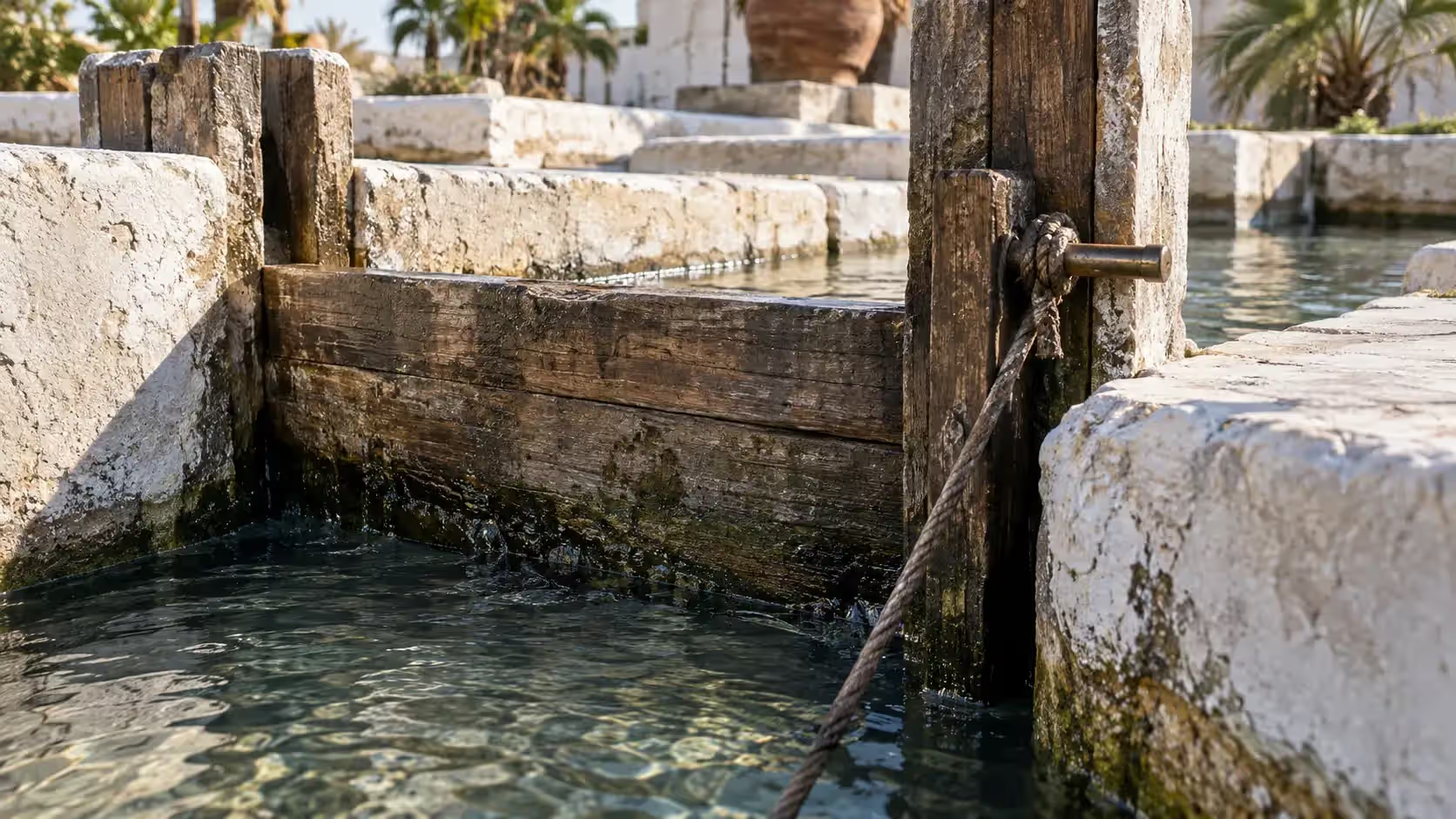
The Canaux Clairs
A Bronze-rank order in charge of irrigation, water, maintenance and the resilience of Ishtir’s networks.
Keeping the water
The Canaux Clairs maintain Ishtir’s irrigation and water networks: sluices, filters, jars, bridges and measuring devices. In garden cities as in irrigated plains, drinking water, troughs, washing, waste and quarantine follow separate circuits, and the order makes sure that no collective need compromises another. In wetlands, passage also depends on the state of the ground and on the teams’ ability to maintain the thresholds.
The work takes the shape of each region. In the Jardin du Levant, canals serve production, water distribution, orchard upkeep and making movement bearable in the heat; in the Marais Lumineux, footbridges, filters and water circuits must be maintained without mixing drinking water, irrigation, washing and drainage.
Water that never stops
Water is one of the functions Ishtir never stops. During the Great Respiration, when the whole country goes off to celebrate, the networks run on watch teams whose week is given back afterwards. The Gardens themselves depend on this work: a place of rest exists only if people can drink, move and gather there safely.
The water round
A Canaux Clairs keeper’s day begins before the sun. At dawn they read the measuring poles of their sector and note the level of every basin; they open or close the wooden sluices according to the day’s board, check that the bronze pegs hold and clean the filter baskets the night has clogged. The quarters live by the rhythm of these water rounds: people know that after the first round the fountain water is clearest, and they say a job must be finished “before the next water round”, a phrase every Ishtiri uses without thinking of the canals.
The afternoon goes to maintenance: clearing the channels, repairing the small bridges, checking the reserve jars and the thresholds of the wetlands.
Flood years
Floods are the order’s ordeal. When the waters rise, the Canaux Clairs call on every hand: the spillways are opened, the sluices of the drinking-water circuits closed so they are not fouled, the jars moved and the lowest pens evacuated together with the people of the Plaines Brontes. A flood night is told for years afterwards, and basin testimonies go into Weighing files: having held a threshold during a flood earns a citation.
Flood holidays, shared by all ranks, follow the falling of the waters. They are not Respiration; they are days given back to those who spent the night in the water, and everyone uses them first to sleep.
Water at war
An Ishtiri town holds by its basins. The great cities keep behind their walls deep water reserves and granaries able to last far longer than an enemy army can stay before them, and the Canaux Clairs maintain them. In wartime the order closes exposed intakes, doubles the guard on sluices and covered conduits, and readies the emergency circuits that let people drink even when a quarter is lost.
The order’s people do not carry weapons in the front line, but they are among the last to leave a town. In the marches they say an enemy can take a rampart in a day, but if it does not take the water, it has taken nothing.
A sought-after order
The Canaux Clairs are among the postings the young ask for most often at their First Weighing. The work is hard and dirty, but it is respected: a quarter whose water is clear knows who gives it. Water keepers can be recognised by their hands, marked by the sluice ropes, and by the pole they carry on their shoulder.
Children happily follow them on their rounds, and the keepers let them read the level, on condition that they do not jump into the canal.
The grades of water
The order has its grades, which one climbs without leaving Bronze. One starts as a sluice apprentice, carrying baskets and reading poles under an elder’s guidance; one becomes a sector keeper, responsible for a few basins and their channels; the best become water masters of a quarter or a town, answering for every circuit, from fountain to quarantine.
The great works, aqueducts, dams and covered networks, belong to Silver engineers, who design them; it is the people of the Canaux Clairs who keep them alive. Between the two there is respect and argument, usually about the slope of a channel.
Port-Lotus and the fisheries
The order has its seat at Port-Lotus, in the Marais Lumineux, among the rice fields, water gardens and locks it maintains. Rice and solar lotus are grown there, reeds are woven, collective baths and basic medicine are kept, and water keepers from all over the country are trained.
Further off, in the atolls of the Îles du Soleil Levant, Bronze fishermen attached to the order run the Fisheries of the Perches: live fish goes to the pterosaur perches, dried fish to the relays.
Part of this article covers events of season 1. Turn spoilers on in the menu to read it.