

Armies
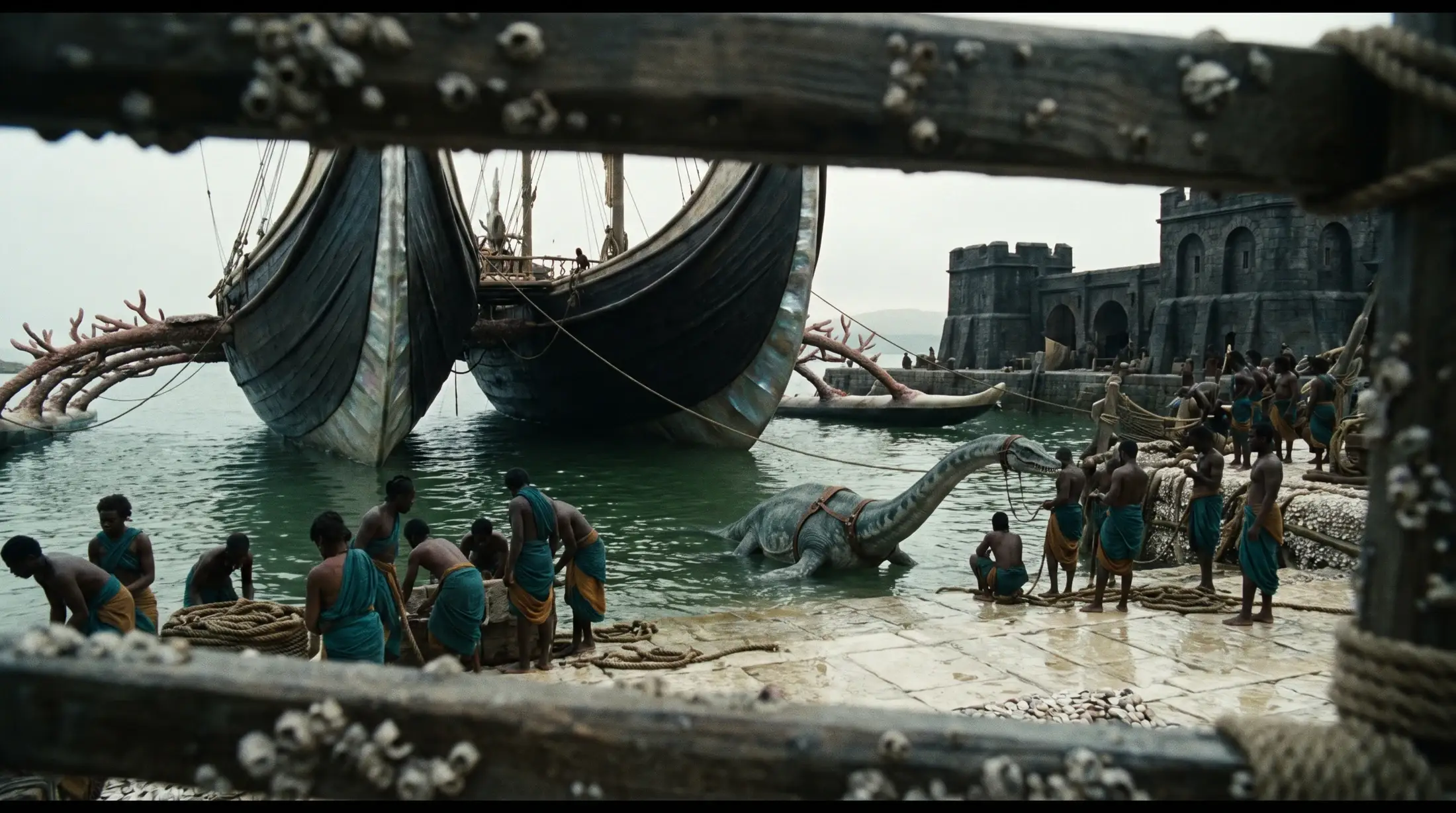
The Phare Mobile
A navigation ship (“Mobile Lighthouse”) that marks passages at night, observes the weather and serves for training.
Lighting a route
The Phare Mobile marks passages at night, supports weather observation and serves for training. It is a small sailing vessel of twenty-five to fifty metres, with minimal defence and a crew of eighty to one hundred and eighty.
For Volonia, a distance is measured in tide, current, depth and breath; signalling a route at night is part of that measure.
The lantern and the reflector
The Phare Mobile carries its light aft, on a low wooden tower sheathed with copper plates against fire. The lantern burns clarified fish oil in several wicks, before a reflector of polished bronze that concentrates the glare towards the horizon. Wooden shutters, worked by hand, mask and uncover the flame in agreed rhythms, so that a single ship can announce a safe passage, a danger, a change of course or the approach of a fleet.
Light is also the first danger aboard. The Phare Mobile carries considerable oil stores for its size, kept far from the lantern in jars bedded in sand; buckets of sand and water surround the tower, and fire discipline is stricter there than on any other ship. A lantern keeper who lets a wick drip onto the deck loses his post, and sometimes more.
Watching the weather
The Phare Mobile watches the weather for the whole fleet. Its crews record at fixed hours the direction and strength of the wind, the shape and height of the swell, the colour of the sky, the movement of the clouds, the temperature of water drawn in a bucket and the behaviour of the small mast pterosaurs, which often sense a storm before people do. These observations are entered in a log and compared from one day to the next.
When the weather turns, the Phare Mobile gives warning. At night its lantern passes the alert to the ships of the convoy; by day its mirrors and flags relay the message, and its pterosaurs carry dispatches further. At the end of each crossing its log goes to the College of Pilots, which uses it to adjust the calendar of windows.
A school of the night
Small, lightly armed and always on the move, the Phare Mobile is a good ship to learn on. Young pilots and future masters of signals spend part of their training aboard, often after their first outings on the training ships. They learn there to steer by night, to recognize a coast by its lights, to read other ships’ signals and to compose their own with the code book.
Above all, they learn responsibility. A badly composed signal can send a convoy onto a reef or make a fleet believe the way is clear. Students therefore spend long nights on watch beside the lantern keepers, and it is said in the Pilots’ Isles that a pilot trained on a Phare Mobile never mistakes a star for a light.
The Phare Mobile at war
In war, the Phare Mobile guides the gathered fleet through the darkness. It marks an approach for a landing, the mouth of a pass for the Porte-Barges, the rallying point for the squadrons. It also knows how to go dark: a fleet that wants to surprise the enemy advances with all lights masked behind its lighthouse ship, which relights its lantern only at the agreed moment.
Its presence also protects against false lights. On certain coasts, clans of wreckers are accused of lighting deceptive fires to lure ships onto the reefs, and an enemy can use the same trick. The Phare Mobile’s lights follow rhythms changed every season and known only to the League’s pilots: a Volonian captain who sees a light without its rhythm knows he must not trust it. Its minimal defence, on the other hand, makes it vulnerable, and it always sails under escort.
On the routes of peace
In peacetime, Phares Mobiles accompany the great convoys and station themselves where no fixed tower can be built: shifting sandbanks, passes that change after every storm, temporary anchorages. The College of Pilots hires them out to the houses for the seasons of heavy traffic, and night convoys sailing behind one of them pay a lower insurance premium.