

Armies
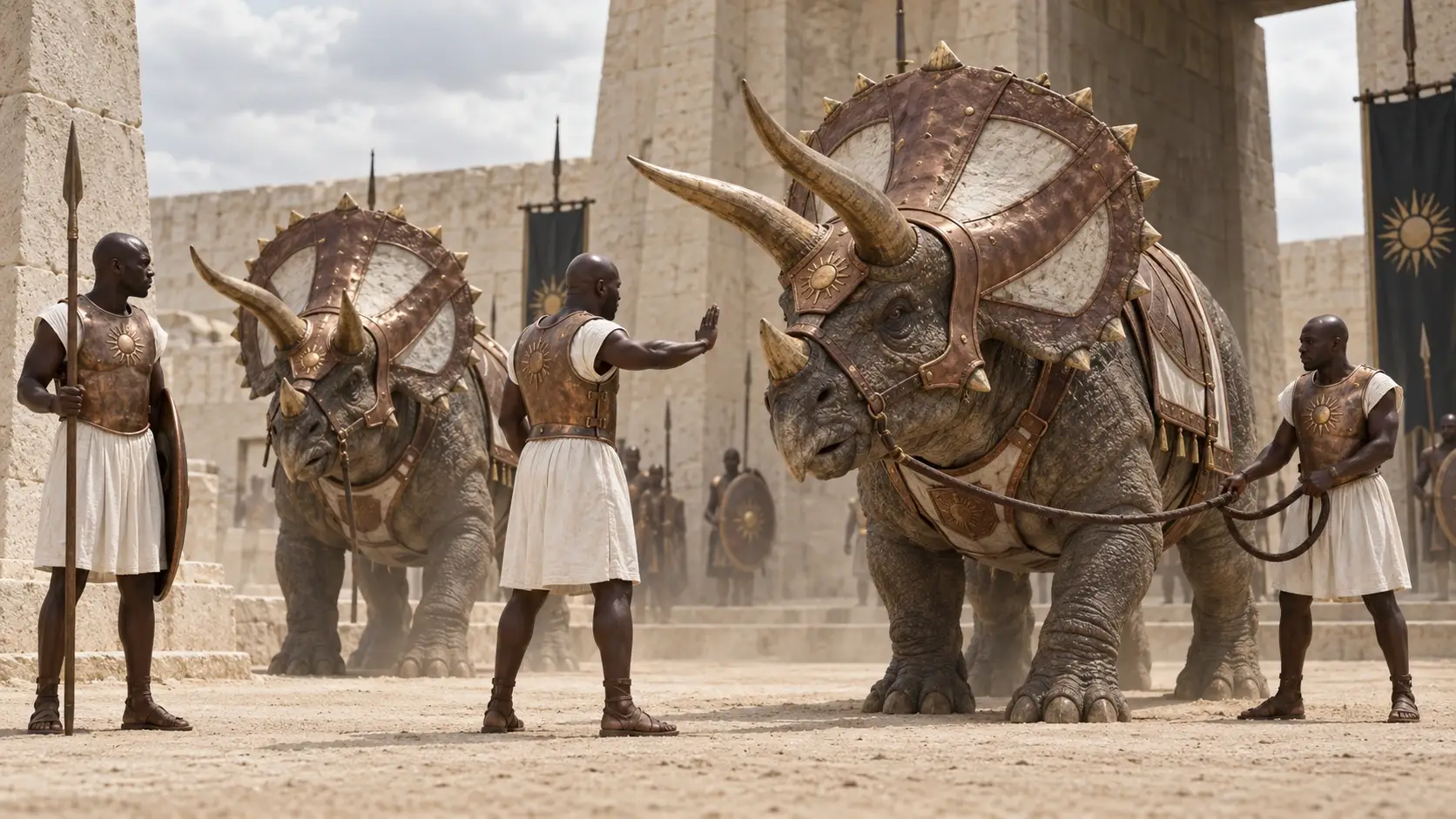
The forces of Ishtir
Cohesion, certification and cooperation between ground and sky.
A place earned by proof
Military organisation belongs to a society governed by the Weighing. Silver rank carries command, certification, ceratopsians and large pterosaurs. Children begin as Bronze; their First Weighing occurs at eighteen. Command is part of this system of responsibility and mobility.
Bodies and orders
Ishtir’s public forces combine cohesion, aerial capability and ceratopsians. Silver discipline channels the intensity of action towards a precise target and requires an immediate stop on command. Effectiveness depends on coordinating people, animals and equipment.
Routes for living bodies
Working with ceratopsians requires side yards, horn clearance and wide turning radii. Aerial networks depend on relay stations, supplies and rest. Care facilities and emergency exits are part of ordinary infrastructure.
Imposing the right cadence
Ishtiri doctrine seeks to impose the right cadence. Its sword brings together ceratopsians, the mobile Silver and converging strikes; its shield, cohesion, architecture and the sky. Its advantage lies in coordinating ground and sky and in the immediate stop on command: rage is channelled at a precise target, then ceases. Orders nest according to rank, and the formation has something of a liturgy.
Its weakness is that of the Weighing itself: information from below can be ignored, everyone’s fixed place makes the army rigid, and irregular warfare suits it poorly. The system can honestly measure the wrong thing.
Ground and sky
The Bronze provide the mass infantry and the garrisons of the marches. The Silver carries expertise, command and certification; it employs ceratopsians — a ground wall that closes the wings, delivers the shock and defends thresholds — and working pterosaurs for reconnaissance, command and dives on enemy beast-masters, harnesses, necks and platforms. The Silver gondola carries thirty soldiers, towed by four pterosaurs, and allows rapid landings from cliffs and towers. The Silver Horns, Winds and Mirrors share these functions between them.
The one hundred and twenty
Ishtir’s one hundred and twenty great living animals are giant combat pteranodons, twelve to eighteen metres in wingspan, with armoured claws: they strike, seize men and do not stay in place. All of them are under the public control of the Order of Gold.
A response by rank
Ishtir grades its military response. Silver leads ordinary campaigns, administers intermediate territories and answers border attacks; it depends on information from Bronze and on doctrinal validation from Gold. Gold interprets solar law and authorises the commitment of the sacred reserves: it answers what threatens Ishtir’s existence, not an incursion. Bronze has no national leader; its local councils run the cities and raise district defence.
What rank does to information
Rank also sorts information. A Bronze worker on the coast may spot a raft track, a smell of salted leather or a disturbed current; the report risks being judged too vague, badly worded, outside its author’s field or insufficiently certified. Three superiors in turn may correct its wording: by the time the report becomes admissible, it may be too late.
The Bronze infantry
The mass of the Ishtiri army is Bronze. At the centre stands the White Phalanx, heavy infantry with great whitewashed shields that throw the sun into the enemy’s eyes; it holds the centre, absorbs the blows, buys time for the horns and the sky, and never falls back at a slant. The Gate Wardens form the pike walls that stop great animals; the Terrace Archers shoot from the heights, more slowly than Arkhan’s archers but together, on the signal; lightly armed javelin skirmishers open the fight and harass.
These troops are raised in the quarters and villages by the local Bronze councils, which keep the defence lists. Every quarter knows how many men and women it must provide, where the shields and pikes are stored, and who takes the place of those who leave in the kitchens, workshops and gardens.
Raising an army
A levy follows the hierarchy of response. When the alarm sounds, the march garrisons and the Wardens hold the thresholds; the quarter councils raise the local defence and gather water and grain. Silver then mobilises the Horns and the Winds, which the Silver Mirrors inform about the enemy forces, and the Plaines des Brontes open their lists for requisitioning animals and fodder. The commitment of the great living ones belongs to the summit alone.
None of this happens without the trades of the rear. An army on campaign takes its healers of people and animals, its harness makers, water carriers, cooks and teams for recovering the wounded, and every column has its marching days calculated on the pace of its ceratops.
Orders of magnitude
Ishtir counts about sixteen million inhabitants, of whom a little over four in ten work. About one worker in fourteen serves the army in the broad sense: at the gates, in the barracks, in the march forts, in the nacelles and in the eyries. That is a lot for a country that does not seek conquest, and it comes down to geography: an island of ports and marches must permanently guard thousands of thresholds.
In wartime these standing forces are only the front rank. Behind them every quarter can raise its defence, and the Silver orders recall certified members who practise another trade. The number of great war ceratops and pterosaurs, on the other hand, cannot grow quickly: a war animal is not made, it is reared, and that takes years.
The signals of command
An Ishtiri army is commanded by signals more than by shouts. By day bronze mirrors pass orders from one height to another, and vertical standards, raised or lowered, set the movements of the lines; by night fires and lanterns take their place. Signal pterosaurs carry written orders between an army’s wings and the relays, and the Towers of the Zenith relay orders from one rank to another.
The most important of these signals is the one to stop. It is the same in every unit, on the ground as in the sky, and every soldier learns it before learning to charge. Ishtir’s officers like to say that an army that cannot stop is not an army, but a fire.
The old wars
Ishtir’s army is made of the memories of its wars. The First Wars of the Boundary Stones set it against the ancestors of Urnok over passages, pilgrimages and pastures; the War of the Hundred Stones, later, over imperial measurements imposed on sacred lands. The Excursion of the Solar Horns, a series of Arkhan raids aimed at ceratopsian eggs, sanctuaries and captives, explains the multiplication of gates and walls around the nests.
The heaviest war in recent memory remains the campaign of the Three Waves. While Urnok’s armies held the Qor-Zaï theatre, the supreme Khan Zarsalaï won a major victory in Ishtir itself. Ishtir’s officers still study that campaign as proof that an island is never entirely safe.
What the officers fear
Ishtir’s officers know their army’s weaknesses. Ceratops die from the flank and the rear and turn slowly; pterosaurs fall to the cables, nets and ballistae that Korath has made its speciality; irregular war, ambushes and the fast raids of Arkhan cavalry suit lines built to fight head-on poorly. The military schools teach these limits as thoroughly as the victories.
Hence the weight given to the Silver Mirrors, the relays and cross-checking: an army that strikes true must know where to strike. But in Ishtir information also passes through rank, and the schools like to cite the case of the report from below that was corrected three times before anyone read it.
Part of this article covers events of season 1. Turn spoilers on in the menu to read it.