
Armies
The forces of N’Goro
Water defence, canopy networks and centralised power.
Centralised power
N’Goro has one hundred and twenty great spinosaurids. Power there is ultra-centralised around Sûma, in Muu-Shanga, seat of the Circle of Balances. The Insectophiles and the Houses of Black Milk resist it clandestinely.
Low waters and canopy
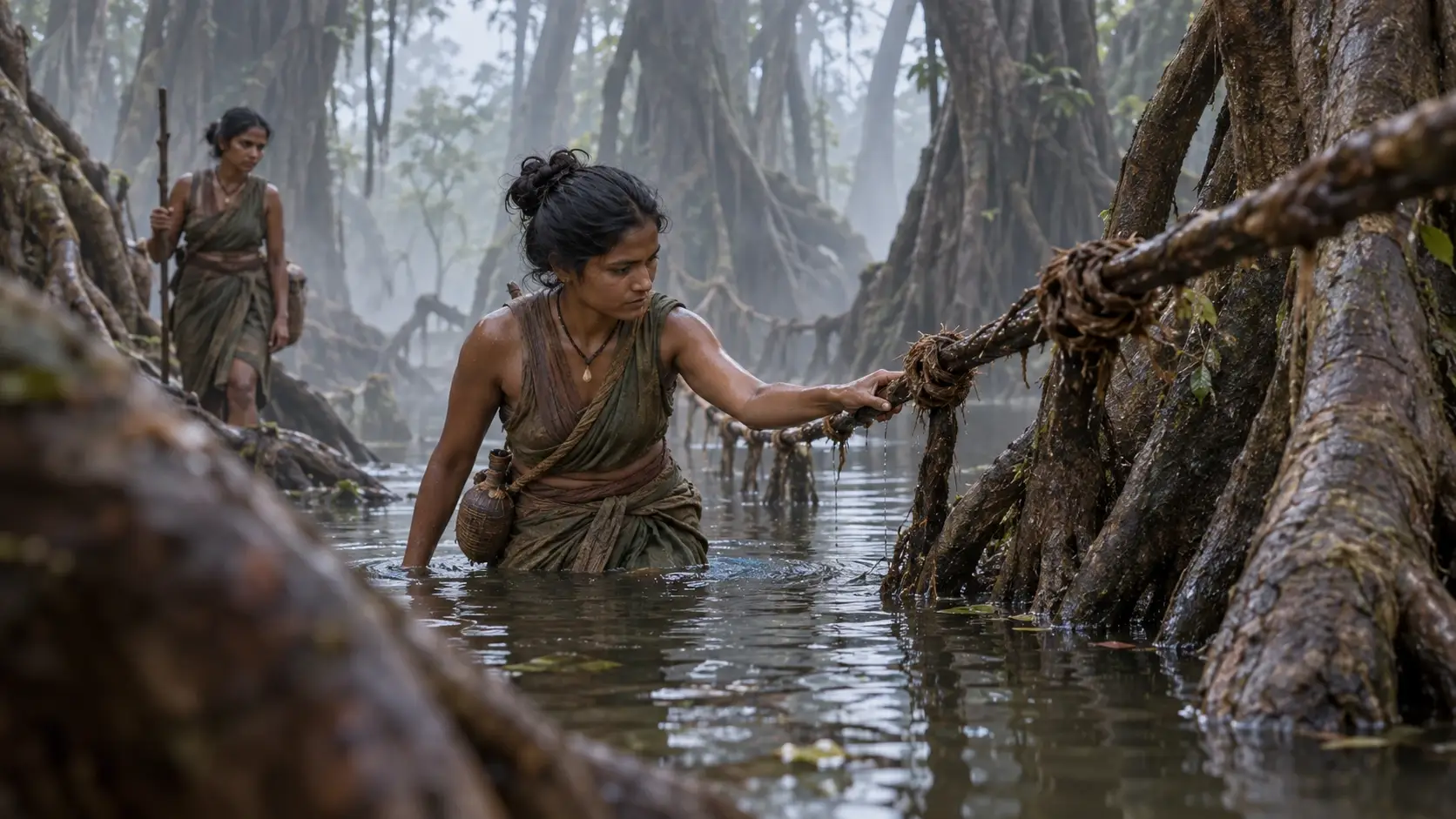
Spinosaurids contribute to estuary defence, rescue and the Foam Marches. The Knotters of Yveth combine messaging, mapping, gardening and combat skills. Vines, seasonal routes and biological signs form a three-dimensional network maintained by skilled trades.
Biological passage
Quarantine, antidotes, filters and inspections allow the Synod of Sapkeepers to close routes. Each basin has its own waters and hazards. Animal protocols work with hunger, pain, smell, sleep and territory; even precise preparation cannot fully control a great living animal.
Letting the environment fight
N’Goro lets the environment fight. Its sword brings together spinosaurids, swarms, thresholds and toxins; its shield, the biome, canals, medicine and quarantine. Its advantage is to destroy the enemy before the last contact: road, body, senses, logistics, insects and canals wear it down before the great spinosaurids conclude a defeat the biome has already produced. The territory is an organism.
Poison there obeys a law: it may be accepted if it is named, dosed, signed, marked and accompanied by a counter-vial when one exists. Preparations depend on the body, the dose, the season and the water; they are never automatic magic. A quarantine can act as a blockade without any declaration of war. N’Goro’s weakness is dry, open ground: outside its biome, its reach is weak.
A power already at war
N’Goro has already fought Urnok. At the time of the Three Waves, the two powers were at war in the south, on a frozen front; the former N’Goro power detached thirty thousand fighters to Arkhan to pin down part of the imperial force elsewhere. On that field, its terrain corps reshaped canals, bearing ground and soils, and its low units won crossings, before pulling back methodically towards the canals.
An army of clans, commanded by women
N’Goro maintains almost no standing troops. Its forces are those of its water-clans, its minors and its great institutions, raised when danger demands: each clan owes the defence a number of fighters and barges proportionate to its waters, each Shedding Village supplies its scouts, each minor its specialists. Only a few corps live under arms all year round — the guards of the Control Basins, ford militias such as Croc-Amphibe, the crews of the great spinosaurids. In a country of some 1.3 million people, a great levy gathers several tens of thousands of fighters; the loss of a single clan is already a wound.
It is also a military matriarchy. Pass, channel and basin captains are overwhelmingly women, and tradition holds that supreme command in war falls to a woman. An old saying of the country’s great bodies sums it up: “The great bodies know how to survive apart. The General reminds them how to kill together.” Men fight, guide and heal; the order to hold or let go of a water almost always comes from a woman.
The troops of the marsh
The heart of N’Goro’s forces is a light ambush infantry. Marsh ambushers are fishers and reed-cutters raised as militia, draped in nets and woven rush, skin smeared with mud and lichen; they begin the battle hidden and strike a flank or a rear before the enemy has understood where they came from. The bridge guards, a hereditary heavy infantry in plates of sap-lacquered carapace, hold the rare dry crossings and the bottlenecks. The stake planters drive into the mud forests of stakes of hardened reed and bone, smeared with sticky resin, on which the great beasts launched against the line tear their flanks.
Behind them come the venom archers, whose shafts kill slowly by fever and black blood, and the support crews that make N’Goro an opponent apart: Black Milk carriers, whose bellows panic enemy mounts; carts and barges of fungal colonies, the spore walls, which spit a blinding fog; arthropleurids lined up across a passage like living dykes. Centipede riders harass, riders of tusked crocodilians hold the reed beds with the forked spear, sentinel dragonflies and the pterosaurs of the Foam Marches keep watch. The great spinosaurids come only at the end.
Weapons and materials
N’Goro’s arsenal contains almost no metal, and hardly needs any. The marsh bow is a heavy reed bow strung with a chitin cord, which does not swell in water; the silver-reed blowpipe, two metres long, shoots waxed darts each carrying a named dose, as the law of poison requires. Armour is made of laced arthropleurid plates: it floats, does not rust and holds no water. Oval shields are cut from a black wood soaked through, helmets have narrow visors against the light, and every fighter wears a chitin mask with a crystal pad against spores.
Rank weapons are handed down and never sold. The harpoon tipped with a Siirmuu tooth, carried by the women who lead the harpooners, passes from hand to hand within the same lineages. Area weapons, lastly, are preparations: grenades made of a thin jar filled with ether mud and irritant powders, which blind a whole column and set it coughing; silk-strung cages holding a war swarm, carried by two men or by a barge, opened only over a marked objective. Metal comes from Korath, in exchange for glues and balms, and goes mostly into tools.
The wars of the past
The Three Waves are not the only war N’Goro remembers. Against Korath, a people related to it and with whom it shares a hatred between brothers, it fought the wars of the two waters: the war of the Black Springs, in which it made a Korath victory useless by withholding its remedies, and the war of the Seven Filters, in which it turned currents and diseases into weapons and from which it emerged with the threshold protocols it still applies. With Urnok there is an old hostility, the frozen southern front where each side watches the other across Gwami and the mouth of the Ur, without the anti-rot glue ever ceasing to go up to the Empire or the fodder to come down.
The Arkhans, for their part, remember a crossing of the marshes they still call the Great Rotten Excursion. A Horde won tactical victories there, then collapsed under fevers, mouldy provisions and waters that did not suit it, without ever fighting the decisive battle it sought. From that disaster grew a discreet trade in antidotes between the khans and the Sap-Keepers, and a lasting Arkhan caution: you do not chase a Ngoro into his water.
What others say of them
The Three Waves left the other nations several images of the N’Goro way. Urnok officers tell of the levee: the N’Goro did not attack the embankment held by the Empire, they opened a canal behind it, and an hour later the reinforcements were wading — pinned without being beaten. The Arkhans tell of the wind: one day the N’Goro smokes turned and blew back over an Arkhan unit that had not received the order to halt; the N’Goro commander was furious with her allies, who, she said, should have seen that “they had marked the wind”. It was not a figure of speech; it was weather.
Above all they tell of the refusal. The N’Goro held the flank entrusted to them, but refused to die for Orgaï’s glory on dry ground that was not theirs; they pulled back saying their mission was over, and it was later admitted that they had been right. Since then N’Goro’s reputation has come down to two phrases heard in every army of the known world: an ally that will not sacrifice itself, and an enemy you never see.