
Places and landscapes
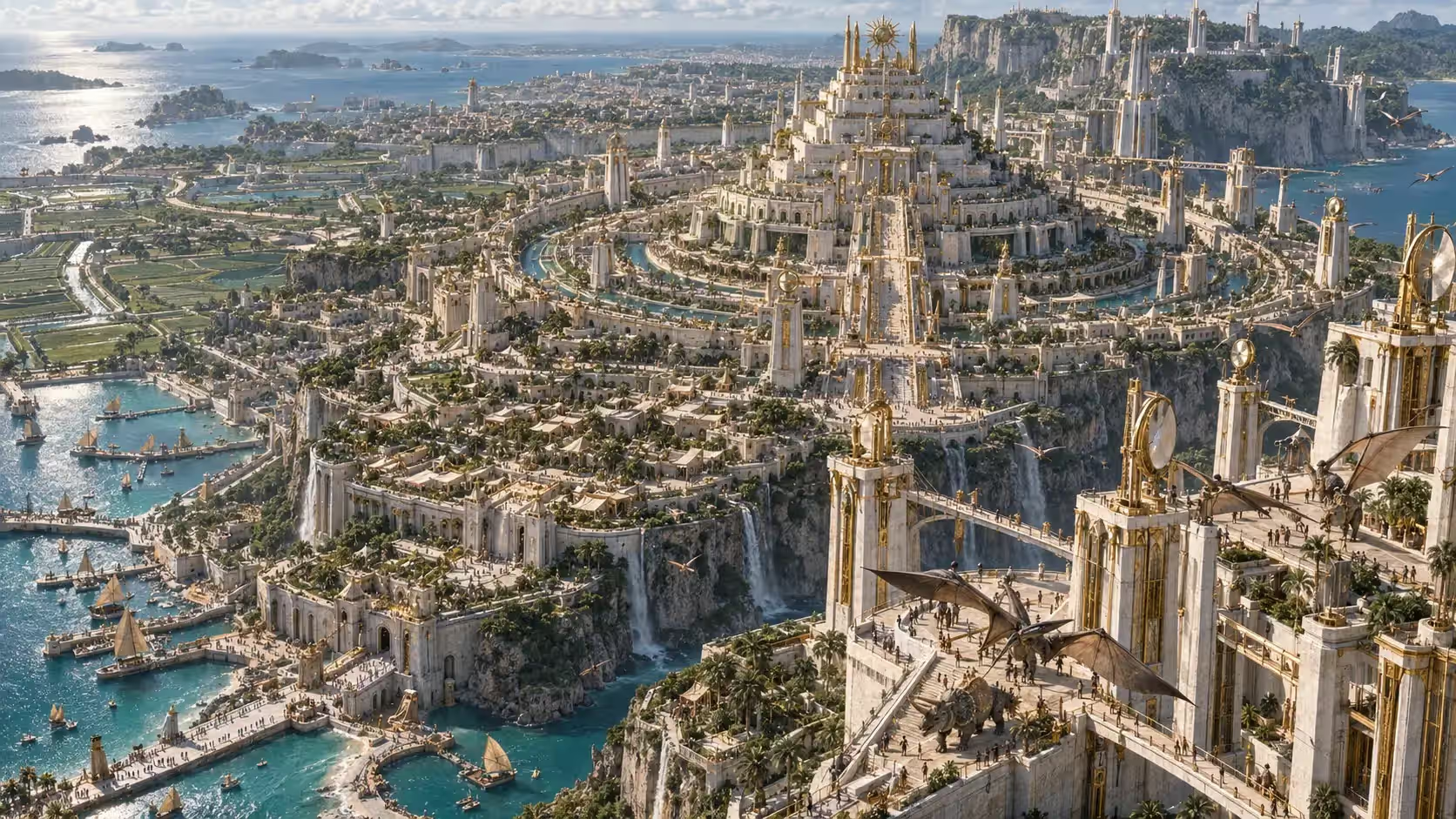
Cliff relays and nacelle hangars of Ishtir
Ishtir’s pteranodons call for cliff buildings: hanging terraces, cornice nests and relays of the Vents d’Argent, where flights take off and land, and great open naves where nacelles are maintained and the animals tended.
Cornice nests
Great pterosaurs belong above all to Ishtir’s line, and that is where cliff buildings find their place: the cliffs of Ishtir, relays of the Vents d’Argent, air posts. The cornice nest clings to the rock face by hanging terraces and canvas bridges, at the price of permanent vertigo. Hammocks, hanging baskets, light chests and screens against rain and spores make up its furniture; redundant anchor lines hold the whole together.
No machine carries anyone up. What might pass for a wind lift is a counterweighted basket, worked by hand.
Naves for the nacelles
Maintaining the nacelles and tending the pterosaurs call for great open naves where air moves freely. Their vault is made of branches, timber and rope, and hand hoists lift the loads; racks, mangers, harnesses, sanitary screens, stretchers and medicinal baskets are kept there. Air passes through by the shape of the building, with no blower: Ishtir’s very advanced aerology remains an empirical science, without machines to control the air.
Choosing a cliff
Not every cliff makes a relay. The Towers of the Zenith, which keep up the sky, look for a face exposed to the prevailing wind, high enough for an animal released into the void to find its lift at once, of sound rock that does not crumble under the anchors. There must also be a spring or room for a cistern at the foot, a sheltered ledge to house the wounded, and a usable path to carry up fish and equipment. A perfect cliff without access by land stays empty.
The great relays carry names known throughout the country: the Relay of Aérantes, seat of the Silver Winds, the Relay of Alcyon or the Tower of the White Wind, in the Couronne de Venthir. Around them, dozens of secondary relays, sometimes a single ledge fitted with three perches and a watch hut, extend the chain to the coasts and the marches.
Fish for the perches
Pterosaurs eat fish, and a cliff relay lives to the rhythm of its supply. A war pteranodon eats about three kilos a day, a great individual far more. The fish comes mostly from the Îles du Soleil Levant, where the Perch Fisheries catch it for this purpose: it arrives alive in boat wells, dried in bundles or salted in jars, then goes up in counterweighted baskets to the cool pits dug at the foot of the towers.
Nothing is lost. Bones and scraps go back to the sea or to the manure pits, and the guano scraped off the ledges every week goes to the nearby Gardens, where it is highly prized. A relay can be recognised from afar by its smell of brine and droppings, and the growers around say there is no better neighbour for a vegetable plot.
A day at the relay
The day begins before dawn with the inspection of membranes: each animal is unfolded, felt and examined against the light, and the slightest tear is noted before any flight. Departures take place in mid-morning, when the sun has warmed the rock face and the currents rise; towards noon the air becomes too turbulent and the animals rest in the shade of the screens. The afternoon is for returns, care and harness repairs; the evening for feeding and cleaning the ledges.
A relay team brings together healers, harness makers, lookouts, basket carriers and a signaller of the Silver Mirrors who keeps the mirror and the message register. At night a watchman tends a banked fire, ready to answer if the chain of signals lights up.
Preparing a nacelle departure
The departure of a Nacelle d’Argent is the most closely watched moment at the relay. The cage is first weighed empty, then loaded in a fixed order: soldiers take their places according to a balance plan posted on the ramp, heavy equipment in the centre, light men at the corners. The four carriers are harnessed one by one, and every attachment is checked by two different people.
Only one voice authorises the release: that of the ramp master, who reads the wind on a cloth sock and on the flight of the small signal pterosaurs. If he raises his arm, everything stops, even at the last instant, and no one argues. The nacelles later come back down onto landing grounds laid out at the foot of the cliffs, wide sand esplanades where the carriers can be unhitched without making them turn on themselves.
The rules of vertigo
On a ledge the rules are short and absolute. No one moves without being clipped to a lifeline; no one passes beneath the path of an animal taking off or landing; no child goes up onto the working ledges, not even on a visit. Tools are tied to the wrist, because a hammer falling a hundred metres kills whoever is below.
Every relay keeps an incident register, read aloud each month before the whole team, and a fall avoided is entered there like a real fall. The cliff people take a quiet pride in this: it is said of them that they always look at their feet before looking at the sky.