

Religion and rites
Ishtir: the Sun and the Gardens
Public beauty, fertility and care belong within religious order.
Organising what the Sun gives
A Garden is useful, fertile, beautiful, habitable and pleasant to cross. The Sun gives; humans organise. Canals, terraces, orchards, shade and pools form civic infrastructure whose maintenance is a religious office of the Order of Gardens. A merely productive land would remain incomplete: beauty is also a public good.
A medical and spiritual function
The Silver healer-priest provides real care while exercising a spiritual function. Faith does not replace cleaning, bandages or the time a body needs. This presence connects medicine and belief without magical healing. Personal gentleness and belonging to a demanding order can coexist within the same profession.
The Zenith, a just order
Ishtir worships the Zenith, the sun at its highest. Vertical light is held to be the manifestation of a just order; measure, straight direction and the legibility of acts carry religious value. A responsibility must be recognisable, a skill proven, a decision tied to the place of whoever exercises it. The Weighing follows from this: it is at once a civic, professional and religious event, and its ranking engages the solar order.
A sincere faith up to the summit
Ishtir’s summit believes. The Ten Golden Wings and the leaders do not treat the cult as a language meant for the people; their authority engages their own faith. Sincerity prevents neither errors nor harshness: an honest jury can judge badly, and genuinely refusing an assignment can lead to execution. To watch over those who rank others, the Weighing of the Weighers provides rotations, blind readings and seals.
Protecting sacred lineages
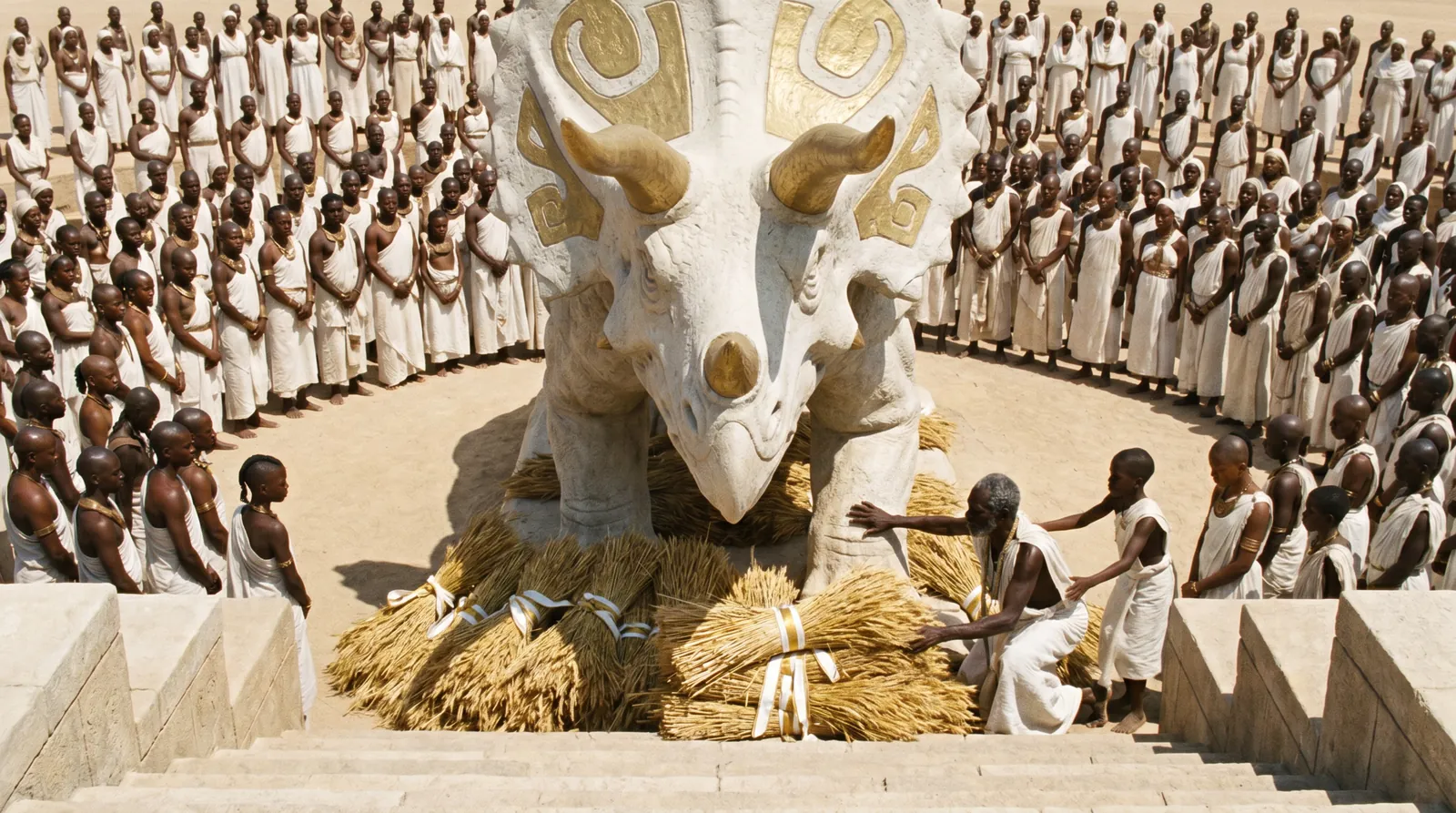
Consecrated ceratopsians carry both theological and military value. Ishtir forbids the export of their eggs and fertile breeders, and trafficking them can be punished by death; war pterosaurs are likewise barred from export. The Zenith Festival blesses certified eggs and lineages, and the Ascent of the Rays leads the sacred ceratopsians up to the solar terraces.
An austere and joyful calendar
The religious calendar alternates great solar ceremonies and lived festivals. The Zenith Festival keeps silence at exact noon; the Vigil of the Winds passes almost without an audience; the Great Respiration gathers the country for a week while watch teams keep water, care, animals and borders running. Baths, walks, shows and dances also belong to religious practice.
The sacred language
Ishtir’s sacred language encodes the order of the world. The same verb has three forms: on the ground for humans, at horn height for the sacred beasts, in the sky for what flies. Politeness marks distance from the sacred, not wealth. The script of Rays and Arcs is geometric; sacred texts are read in a spiral, and the ritual lengthenings of chant are binding.
The lexicon says the same. There is no word that would translate “king”: one says Ray-Bearer, the one whose function is to channel the order of the world. Law is a “just shadow”, which protects from the raw sun; sin is a “misalignment”, leaving one’s path. People bless by saying: “May your step stay aligned, may the horn open the earth to you, may the wing close the sky to you.” The gravest insult takes four words: “You are without shadow.”
Beyond the borders
Ishtir maintains missionaries beyond its borders. Their relay temples create parallel loyalties and spread a sacred literacy; their aim is to make “sky corridors” — pterosaur routes and nesting sites — into sanctuaries.
The straight and the oblique
The faith of the Zenith divides the world along a simple line. What is frontal, legible and straight is sacred; what is oblique, lurking, venomous or nocturnal is impure. The rule does not judge people by their birth but by the way they act, and it can be read everywhere. A temple is approached head-on, never from the side; a serious matter is discussed while looking at the person, never behind their back; an agreement is spoken aloud before witnesses rather than whispered in an ear.
The same line explains how Ishtir sees its neighbours. The marshes of N’Goro, their nights, their poisons and their refusals pass for the exact reverse of vertical light, and Arkhan’s night raids, its ambushes and its packs sent in from the side confirm, in the priests’ eyes, what an impure war looks like. Yet a foreigner can be straight: a merchant who keeps his word and says things to your face is received as such, and the priests point out that impurity is a gesture, not a people.
The four visible orders
Ishtir’s clergy is not a caste. It is divided into four visible orders, which recruit at the Weighing like the others and whose members wear rank and certifications on their sleeve. The Order of the Ray, also called the Guardians of the Sun, is the highest: it belongs to the Gold, keeps the doctrine, the Tablets of the Sun and the gnomons, and the temple priests answer to it. The Order of the Gardens, the Sacred Cultivators, tends the Gardens, the ritual herbs and the closed gardens where the plants for offerings grow. The Order of the Wardens holds the sacred gates, the oases and the boundary stones of the marches, and blesses the thresholds every year. The Order of the Winds, the Navigators of the Sky, watches the sky, reads winds and flights, and supplies the armies with news rather than troops.
The other three orders count Bronze, Silver and a few Gold members, and a Bronze ritual gardener belongs to the same clergy as a doctor of the Ray without sharing his rank. No priest hands down his office, and each is weighed every seven years, like any other adult.
Everyday faith
Ishtiri piety is made of short gestures. On rising, everyone turns east on the threshold of their lodging for the space of three breaths. At exact noon, when the crier announces the true hour, everything stops: workshops fall silent, so do the halls, and work resumes once the gnomon’s shadow has regained the width of a hand. In the evening nobody prays; the lamps are put out in the reverse order of their lighting.
The quarter temple houses no statue. The Sun has no face: it is shown as a disc and rays, and the pediments depict functions rather than people. Offerings are modest and material: a jar of water poured at the foot of the gnomon, the first sheaf of a harvest, a flatbread from the first oven. Prayers are said in the sky register and often fit into a single sentence. They ask to be aligned, seldom to obtain something.
A faith without miracles
Ishtir’s Sun does not heal, does not punish and does not answer. Priests teach it from the cohort courtyards onward: the Sun gives light and measure, and it is for humans to make an order of them. Illness is a matter for carers, a bad harvest for gardeners and the Canaux Clairs, a defeat for officers. Praying before a trial does not change its outcome; it helps one face it straight.
The faith does allow for signs. The flights of the great pterosaurs of the Couronne de Venthir, their height, their direction, their cries at dusk, are watched and read as omens by the priests of the Order of the Winds. Nobody claims these signs bring anything about: they tell the mood of the sky, as the wind tells the mood of the sea. The most learned priests are even reputed to be the most cautious, and one of their sayings is often quoted: “An omen is read, not followed.”
The Sun at war
The motto engraved on the ceratopsians’ solar plate holds for the whole army: “War must have a straight direction.” Ishtir fights by day, preferably under a high sun, in a legible line, and lets the enemy know where the blow will come from. The ceratopsians are a moral force as much as a weapon; the pterosaurs are the sacred sky, the instrument through which the Zenith comes down onto the battlefield.
Before a charge the ranks keep a noon silence, even when the sun is not at its zenith. The priests who follow the armies are carers, criers and wind readers, not fighters. After the battle the army first gathers its own wounded, then those of the enemy who can be saved, and places the captives under observation. An Ishtiri soldier does not finish off an enemy who has surrendered: striking an unarmed man from behind would be, in the most exact sense of the word, a misalignment.