

Creatures
Ishtir — Le vivant, des soins aux manœuvres
Observer les anatomies, entrer dans les enclos, suivre les équipes de soin puis les retrouver sur le terrain d’exercice : ces scènes rapprochent le bestiaire de la vie des civilisations.
Enclos, soins et circulation
This extended reading is currently available in French.
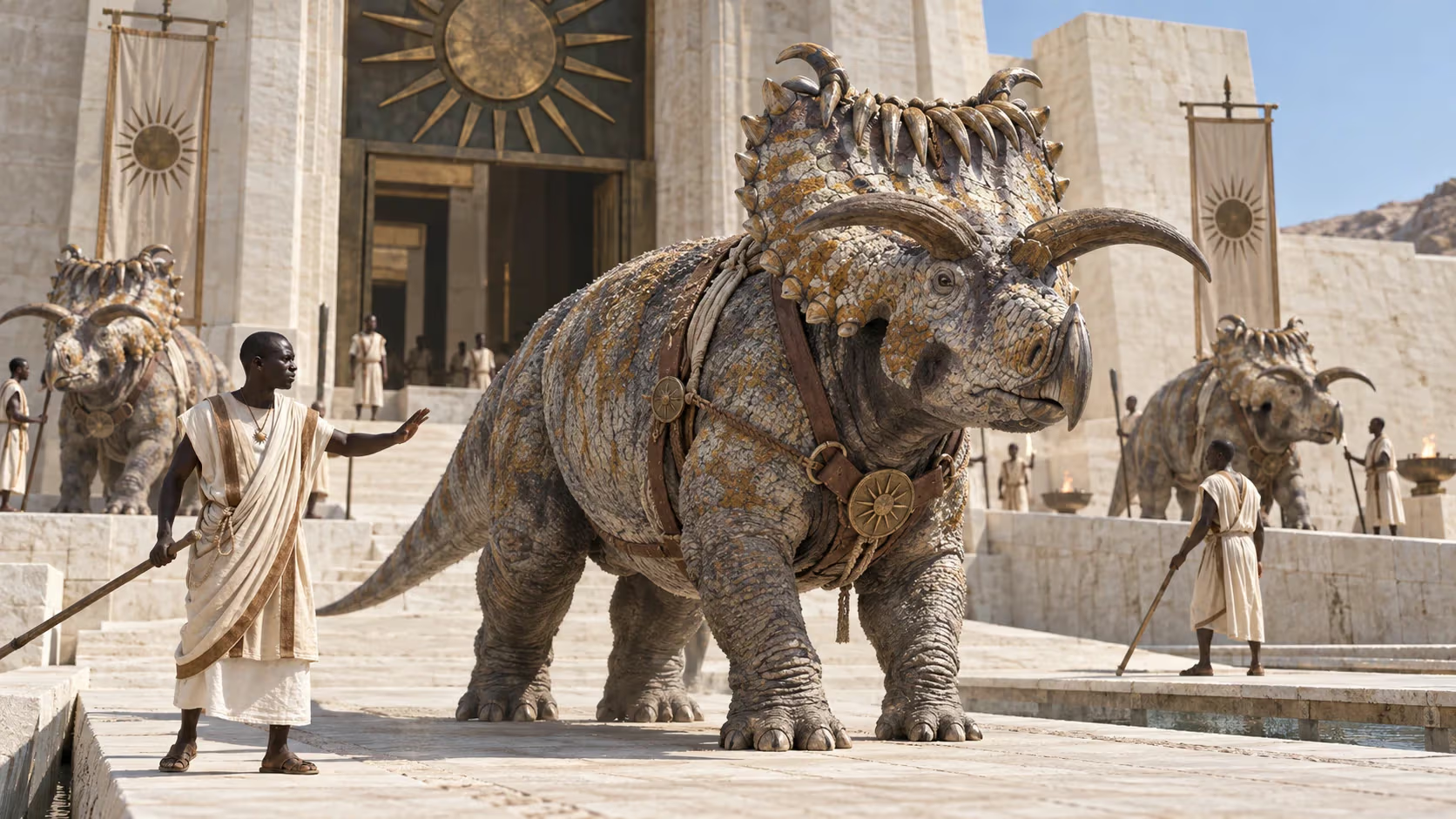
Les soins du vivant rencontrent à Ishtir l’organisation des jardins, de l’eau et des lieux de repos. Les passages et les rampes doivent permettre aux animaux de circuler avec les équipes qui les accompagnent. Une certification n’est utile que si les gestes, les matériaux et les conditions locales permettent de tenir ce qu’elle atteste. Les cératopsiens et les métiers de Qazen rendent visible ce lien entre l’ordre de la cité et l’attention concrète aux corps.
Observe gestures and materials · 6 images
La corne du matin
Cours publiques d’Ishtir · nettoyage des cornes.
La corne recourbée
Élevages publics · inspection des seuils.
Le bain des bosses
Bassins de refroidissement · soins de peau.
Les deux croissants du seuil
Porte solaire · défense d’un passage.
La couronne immobile
Cour de la Mesure · portrait de l’élevage public.
La traversée des Cornes
Rampes de la cité solaire · circulation du troupeau.
Le détail du vivant se découvre dans les gestes ordinaires : un harnais ajusté, un dégagement vérifié, un troupeau orienté.
L’animal au milieu des hommes
L’exercice donne à voir les distances entre formations, les signaux et les zones de rotation. Certains animaux travaillent avec une unité ; la faune sauvage croisée à l’exercice n’en est pas domestiquée pour autant.
Observe gestures and materials · 5 images
Le signal d’arrêt
Élevages publics · arrêt sur signal et cadence.
La poussée du centre
Bassins de refroidissement · poussée et maintien d’un centre.
Les cornes au seuil
Porte solaire · franchissement de porte sous couverture.
La couronne dans la mêlée
Cour de la Mesure · cohésion de ligne et couverture du vivant.
La roue sur les rampes
Rampes de la cité solaire · roue de formation et relève.
Ishtir’s gardens, pastures and care
Care depends on place
Gardens, pastures and fodder reserves condition feeding, rest and preparation for use. Ishtir connects these spaces to a public requirement of measurement and responsibility. Well-prepared equipment does not compensate for a place that no longer meets a living body’s needs.
Ishtir’s gardens, pastures and care
Aptitude must be followed
Care and assignment practices follow aptitude, equipment and the person authorised to intervene. The result can be further preparation rather than immediate use. This approach explains an institutional constraint without claiming every living creature reacts in the same way.
Housing, water and circulation in Ishtir
Assignable housing and shared spaces
Fundamental rights include housing. Cohort districts bring together shared spaces with folding bunks, reassignable chests, communal kitchens and radial exits. This housing can change occupants without being confused with inherited family property.
Housing, water and circulation in Ishtir
Drinking water, animal water and service water
In regional canal cities, wooden gates, bronze pegs, measuring poles, filter baskets and bridges direct water. The central principle is separating uses: drinking water, animal water, washing, waste and quarantine are not the same resource. Hydraulic works organise a sanitary responsibility as much as a landscape.
Housing, water and circulation in Ishtir
Porticoes, courts and service routes
Major links can connect districts, public buildings, enclosures and Weighing sites. Benches, water, rest and wide intersections accompany routes separated by size and function. Movement does not merely reach a monument: it keeps a right, a service and the bodies dependent on it together.
Certification opens a possibility
The Weighing draws on examinations, exercises, service, achievements and the ability to teach. Certification establishes eligibility for a precise responsibility; it never guarantees promotion. Animal care, a manoeuvre or fodder expertise can thus be recognised separately before entering a wider record.
A biography worn in public
Rank, order, active certifications, grade and major medals form a visible biography. Skills receive public recognition in a society without family surnames. A worn sign must correspond to a real permission: it tells what someone can do and which responsibilities have been entrusted to them.
Bodies in the solar order
Ceratopsians are part of Ishtir’s public identity. Silver rank links command and certification with their use. The animals live in a society organised by the Weighing; their anatomy alone does not determine human rights or rank.
Gates wide enough
Side yards, horn clearance and broad turning radii organise schools, arsenals and ceremonial buildings. Removable barriers and cross exits absorb movement by crowds or animals without trapping bodies in an enclosure that is too narrow.
A chain of examination and care
Proof yards include markers, ropes, removable stands and care stations. Living animals require water, refuges and regular exits. An examination provides a specific piece of evidence; it does not replace records, appeals or rights.
Closing the artery, then praying
Qazen is trained in practical medicine and ritual. He treats bodies and can offer spiritual support to a patient who wants it. Calm and gentle humour belong to his work; prayer does not replace medical action.
A convinced Silver
He grew up Bronze, like every child in Ishtir, and became Silver through a Weighing. He sincerely believes in this institution. Compassion for individuals and trust in the social order coexist; his faith is not a façade.
A healer’s habits
He sings badly, eats too quickly and can sleep in a chair or beside a linen store. He keeps small objects left by recovered patients. These habits belong to a man patient with children and less patient with officers who interrupt treatment.
Dawn at the Écuries des Cératopsiens
Before sunrise, the Écuries des Cératopsiens of Qer-Aton are already lit. Oil lamps hang from the stall posts, and carers in white linen move from one animal to the next with their buckets, scrapers and fibre brushes. You hear the breathing of the great bodies, beaks crunching on fodder, the clink of a bronze ring. The smell mixes cut fern, dust and fresh dung.
When daylight comes, the animals are led one by one into the sand yard for their dust bath. The procession triceratops roll heavily in it, the guard styracosaurs half lie down; a pale cloud rises above the walls, and the neighbouring quarters know from it that the Écuries’ day has begun.
The review of the young at Qer-Brontes
Once a year, the staked pen of Qer-Brontes hosts the two-year review. The season’s young ceratops arrive in groups, driven by the herd people, and wait behind a wooden barrier. One by one they enter the sand ring, where the jury walks them, turns them, stops them before a standard raised without warning, then brings them up to a drum struck just once.
The people of the Plains settle on the removable stands and discuss each animal as they would a race. When the jury chalks its mark on the flank, the line animals are applauded and the culled ones consoled aloud, and farm households sometimes come to claim them the moment they leave the ring.
On a ledge of the Couronne
In mid-morning, on a relay ledge of the Couronne de Venthir, the rock face has warmed and the wind is rising. The war pteranodons wait in a row, wings half open, while the carers finish inspecting the membranes against the light. The ramp master watches the cloth sleeve and the flight of the small signal pterosaurs above the void, then raises his hand.
The first pilot stretches out on his saddle and whistles a note. The animal walks to the edge, leans forward and lets itself fall. For a moment it disappears beneath the ledge; then it reappears further out, borne by the current, and climbs in a spiral without a single wingbeat. On the ledge nobody speaks until it has cleared the ridge.