
Institutions
The Towers of the Zenith
Ishtir’s technical institution in the service of the sky: air maintenance, signals, meteorology and the breeding of pterosaurs. It runs across the ranks without forming a fourth caste.
Holding the sky
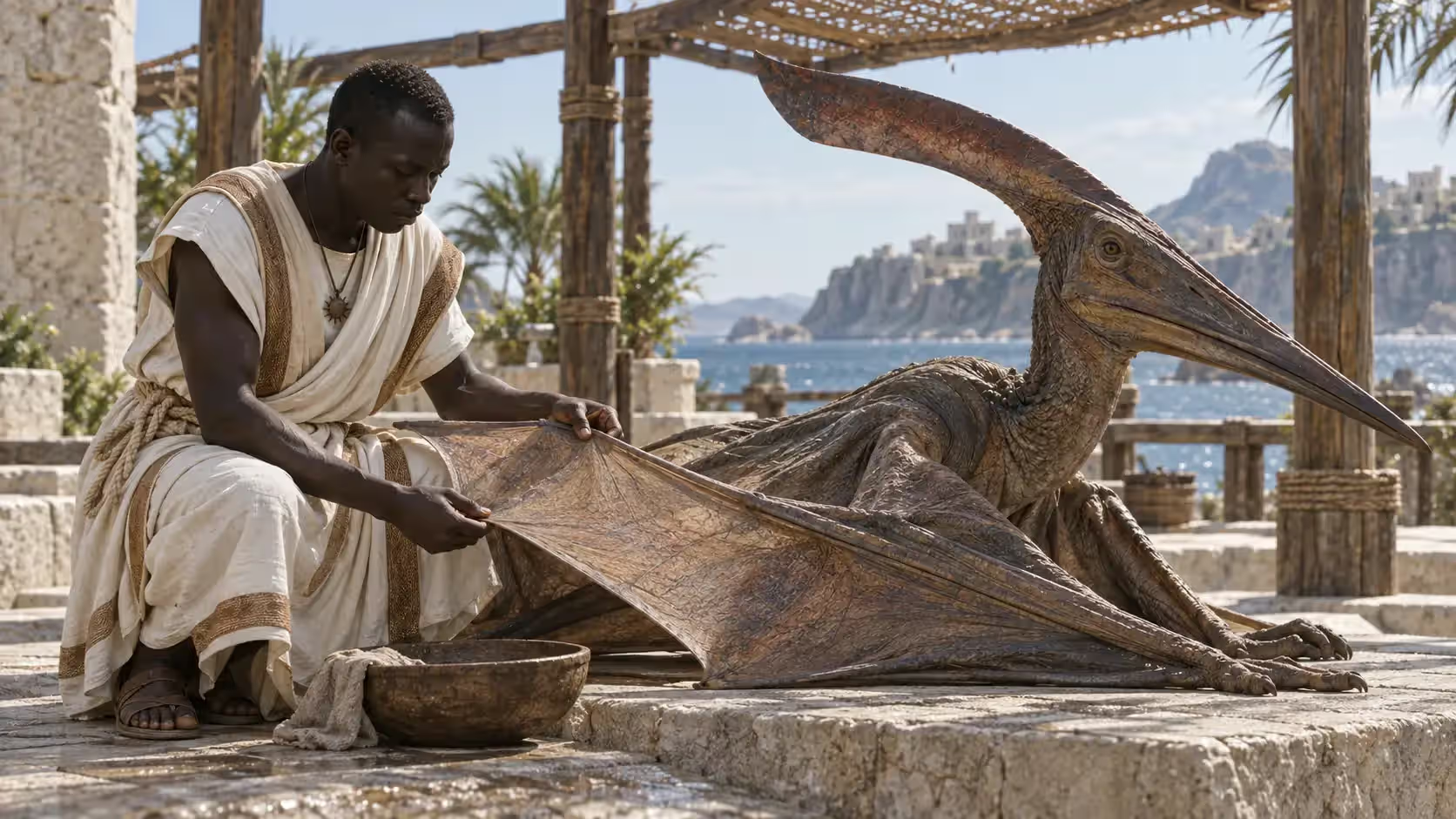
The Towers of the Zenith provide air maintenance, signals, meteorology and the breeding of pterosaurs. They can close sectors of the sky and relay orders from one rank to another. The institution runs across the ranks without forming a fourth: consecrated by Gold, commanded in its operations by Silver, it is maintained by Bronze workers and technicians.
Its high towers, terraces, winches, nests and exposed walkways live in the wind and the hard light. Pale stone and gold at the summits; an oily, technical underside. One hears the wind, membranes, pulleys, cries and distant prayers; one smells oil, leather and pale dust.
The sky depends on what is below
Its maintenance is under-ranked: pulleys, oils and cries come after the liturgy of the sky, and the institution readily erases Bronze hands beneath the perfect image of Gold. Its lie fits in one sentence: “Purity flies alone.”
Its face is Ossar, master mechanic of the pterosaurs, a Silver without religious prestige. He does not talk about the beauty of the sky, but about split membranes, oil, knots and priests who weigh too much. He knows pterosaurs do not take off by faith alone, but by food, tendons, cleaning, currents and repairs. A believer, he can say: “Your Sun, there — if it wants to take off with that wing, let it come and hold the seam itself.”
A tower, from bottom to top
A Zenith tower reads from bottom to top. At its foot are the animals’ kitchens, the cool pits holding the dried and salted fish the pterosaurs eat, the cisterns and the counterweight baskets that lift loads. The middle floors hold the workshops: membrane oils, stitching, ropes, harness, and the racks where canvas dries. Higher up come the nests, the launch terraces and the exposed walkways where the animals land and take off. At the top, finally, in pale stone and gold, are the signal posts, the mirrors, the wind-reading arcs and the priests.
The technicians say a tower prays from the top and lives from the bottom. Visitors usually go only to the summit, and come back down without having seen what matters.
Relaying orders
The Towers relay orders from one rank to another and one region to another. By day they use bronze mirrors that flash the sun back in coded sequences, banners and coloured pennants; by night, ridge fires lit from tower to tower, as during the Vigil of the Winds. Signal pterosaurs carry messages that cannot be spoken in flashes of light. In towns, the quarter towers also tell the hour with an aerial call everyone recognises.
A signal carries only an alert or a short order; everything else travels by convoy or by pterosaur. Signallers therefore learn to send little and send it right. An order crossing ten towers must arrive exactly as it left, and every tower keeps a copy of what it relayed.
Closing a sector of the sky
The Towers’ most visible power is closing a sector of the sky. When a tower raises its closing pennants, no pterosaur may enter the space it watches, whether because a storm is coming, a relay is being repaired, a ceremony such as the Ascent of the Rays is under way or a military operation is in progress. The closure applies to working pterosaurs and officers’ mounts alike; only the great living ones of Gold are exempt, on the order of the Couronne de Venthir.
A pilot who forces a closure answers for it as for disobedience, even if he arrived unharmed.
Reading the wind
The Towers’ meteorology is an empirical science, without machines but of great precision. Observers record wind direction and strength on graduated reading arcs, follow the clouds, measure humidity by the swelling of a fibre cord and fly small canvas kites from the terraces to learn the wind aloft. Their records, kept for generations, make it possible to forecast the season’s flight corridors.
Pilots rely on them. The animals sometimes have their own opinion: Vent-Quatre, Nahel de Venthir’s relay mount, refuses to take off in a wind the doctrine declares favourable, and the observers have learned to note such refusals along with everything else.