

Institutions
Measuring and locating
The Silver Mirrors are one of the three named orders of the Silver rank. Their function combines intelligence and mapping. They share a rank with the Silver Horns and Silver Winds, with a different responsibility. Maps and information therefore belong to a public organisation in which functions have an order and a position.
Rank carries skills
The Silver rank brings together command, certifications, ceratopsians and working pterosaurs. In Ishtir, examinations, service and practice establish skills; certifications and medals form a public biography. The Mirrors belong to this world of qualified functions. A person’s position is read through what they have demonstrated and the responsibilities they can exercise.
Accuracy does not decide everything
The Ishtari system can honestly measure the wrong thing. This limitation gives information a particular importance: the accuracy of a measurement does not guarantee the soundness of the conclusions drawn from it. The intelligence and mapping order works within a civilisation committed to proof, whose strengths of cohesion coexist with this institutional blind spot.
Never deciding on a single report
On campaign, the Silver Mirrors bring mapping, data and cross-checking so that decisions do not rest on a single report; with the command they read the terrain, the roads, the wind and the reserves. Their capacity to observe and verify makes the operations of the Horns and the Winds possible. Their motto: "What is not measured is already lying."
The Mirrors’ tools
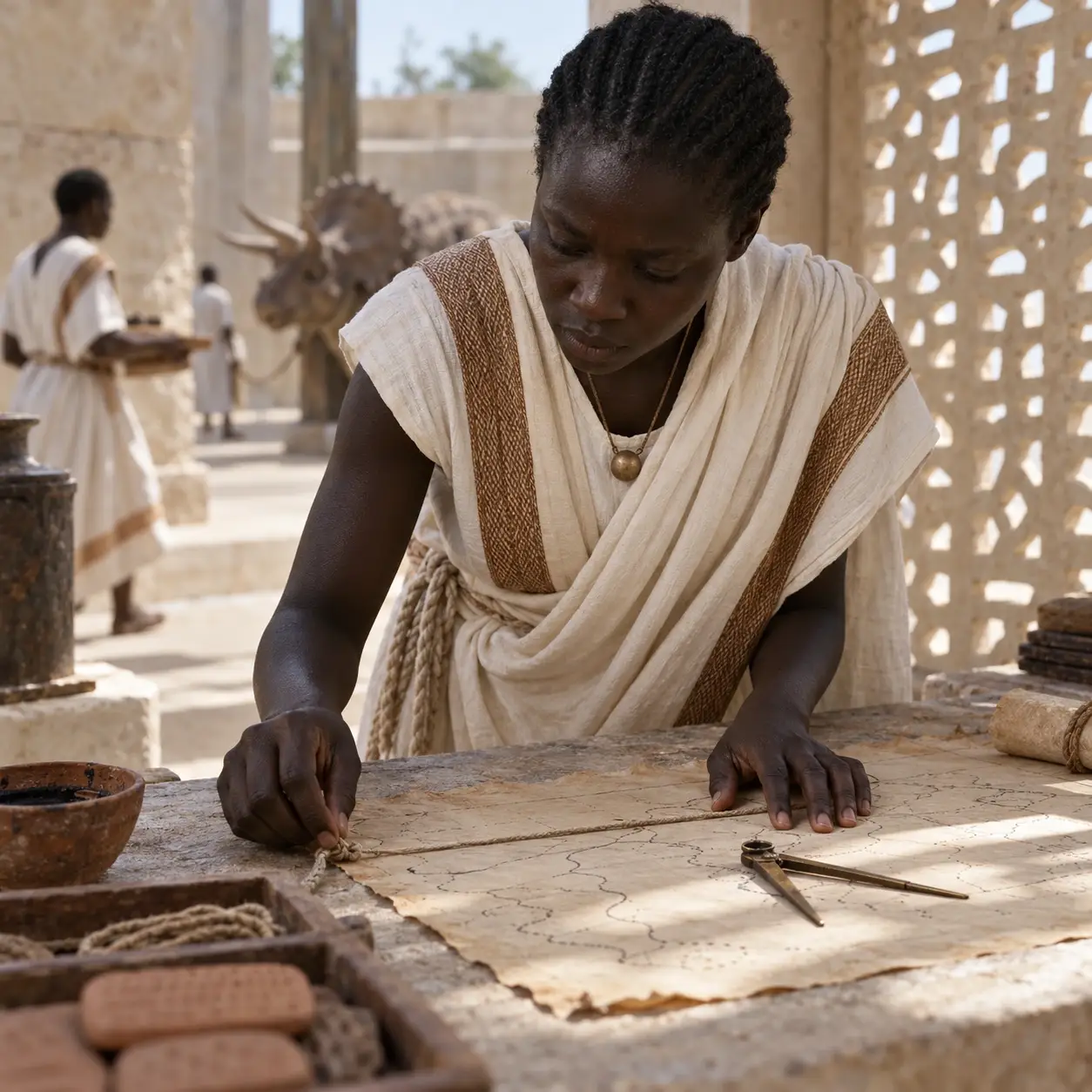
The Mirrors’ work begins with simple, exact gestures. The order’s surveyors measure the ground with knotted cord and markers, record the distances between relays, note the slopes ceratops can take and those they refuse. Observers count what can be seen from afar: the fires of a camp, the height of a dust column, the number of sails off a coast. Everything is entered on slats and tablets, then onto the maps the order keeps up to date in its halls.
These maps are instruments, not ornaments. They show distances in leagues, watering points, thresholds and hours of usable light, and every correction is dated and signed by the person who checked it.
The two-source rule
Cross-checking is the heart of the trade. For the Mirrors, a piece of information becomes data only when a second, independent observation confirms it: a lookout’s report must be corroborated by another post, a map by a second survey, a foreigner’s account by a verifiable fact. As long as the second source is missing, the information stays recorded as “to be weighed”.
The rule has a weakness the order knows well. It guards against error and false news, but it slows down whatever arrives alone. Rank also sorts information: a report from a Bronze on the coast, badly worded or outside their field, may wait longer for its second source than an officer’s report. The best Mirror officers know this and go looking for the confirmation themselves rather than waiting for it.
What the Mirrors know of the outside
Outside Ishtir, the Mirrors have no spies in the sense other nations give the word. They read what comes back: the registers of the regulated ports, the accounts of carers sent to Urnok with the ceratops, the letters of the relay temples that Ishtiri missionaries maintain abroad along the celestial corridors. They question merchants, sailors, captives and refugees, and record each fact with its source.
Their knowledge of the world is therefore broad and slow. It is very reliable about what recurs, more fragile about what happens only once.
Why mirrors
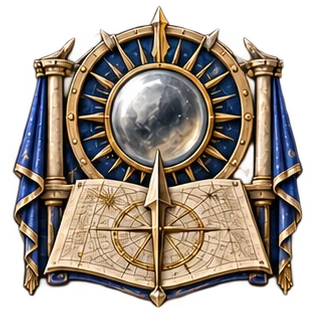
The order takes its name from a tool. Ishtir’s first signallers communicated with polished bronze mirrors, throwing sunlight from ridge to ridge, and the order grew out of their observation posts. The mirror has remained its emblem: a bronze disc ringed with rays, worn on the chest by its officers.
Members of the order like to point out that a mirror makes nothing, that it returns what it receives, and that this is exactly what is expected of them.
Becoming a Mirrors officer
People do not join the Mirrors out of a taste for secrecy but out of a taste for exactness. Candidates often come from Bronze, where they were surveyors, march lookouts or register keepers, and their Weighing files show years of error-free records.
The order’s trials are famous for their dryness: describe a landscape seen only once, recount a dust column from three contradictory reports, find among a batch of tablets the one that was copied. A candidate who fills a gap with a guess fails, even if the guess was right.
At the Archives of Auréon
The order has its seat at the Archives of Auréon, one of the capital’s twelve quarters, where it shares the cool halls with the Greffiers du Nid. Reference maps, observation registers and copies of the reports relayed by the Towers are kept there.
Each region also has its Mirrors Cabinet, which keeps the local registers, checks cargoes and contracts in the regulated ports and maintains the signal mirrors of the cliff relays. Officers say everything that enters the Archives enters twice: once as the report, once as its verification.