
Places and landscapes
Ishtir: island geography
Ishtir is an island: the sea surrounds it on every side and no land links it to the continent.
An island surrounded by sea
Ishtir is an island. The sea surrounds it on every side, and no strip of land and no bridge links it to the continent: it can only be reached by boat or through the air. This island condition shapes everything else, the defence of the coasts, the control of every arrival and the way Ishtir chooses what it lets in.
The garden contains several environments
The island combines a solar centre, gardens, terraces, orchards, coasts, marshes and ceratopsian plains. Marches and service routes belong to this island system. Water, care and animal access structure internal movement: land routes connect Ishtir’s environments without establishing continuity with the continent.
Terrain extends routes into the air
Towers, cliffs, sanctuaries and relays support Ishtir’s pterosaur and gondola projection. The island thinks of routes in three dimensions, with currents and aerial boundaries. Heights provide paths constrained by wind, animals and places where travel can resume; their presence implies no land connection with the continent.
Nine regions
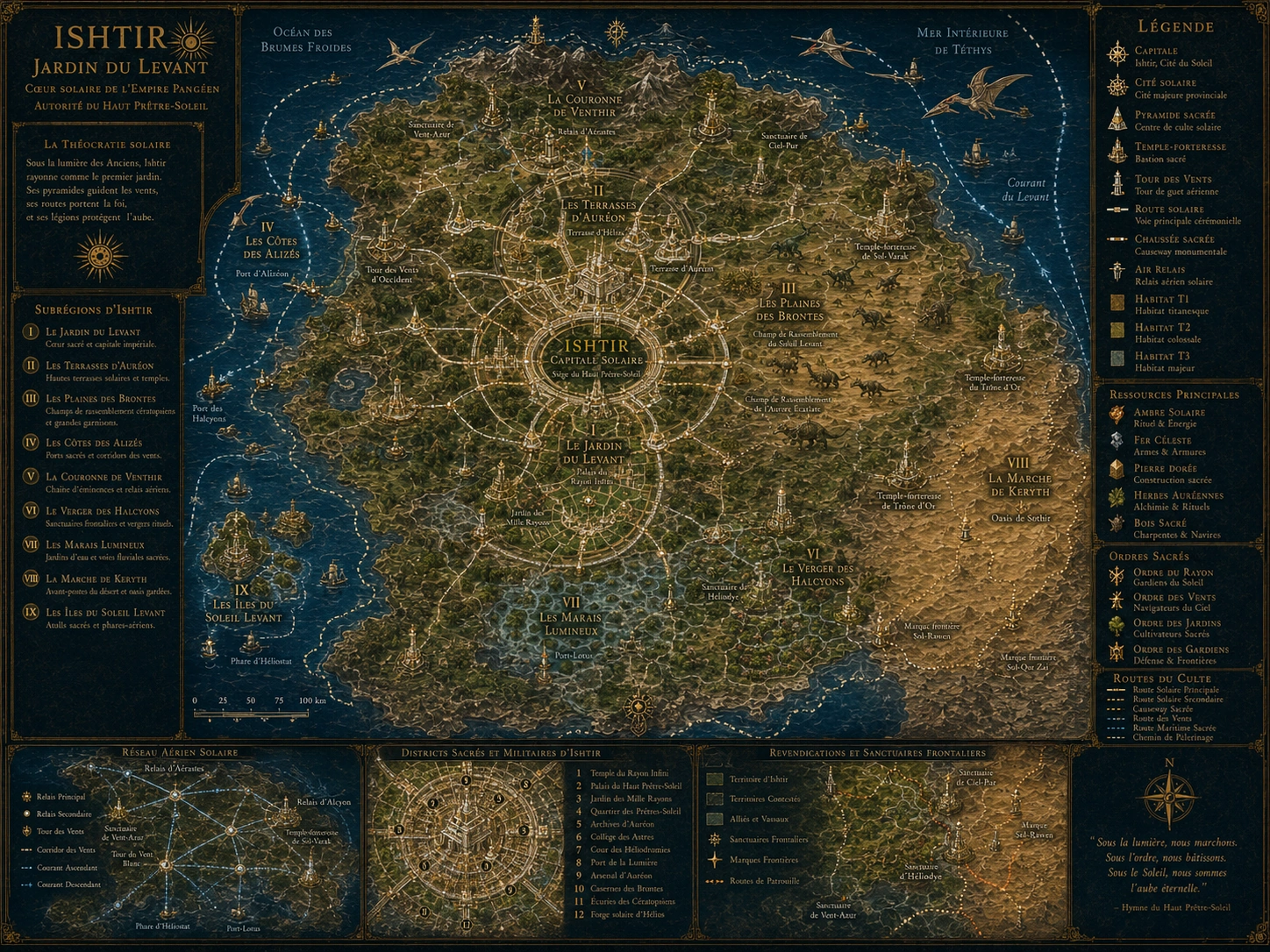
Ishtir has nine regions: the Jardin du Levant, region of the capital, Qer-Aton; the Terrasses d’Auréon; the Plaines des Brontes; the Côtes des Alizés; the Couronne de Venthir; the Verger des Halcyons; the Marais Lumineux; the Marche de Keryth; the Îles du Soleil Levant.
Each has its own landscape, work and way of living the Respiration: a flower carnival in the Jardin du Levant, night festivals on the Terrasses d’Auréon, great open-air gatherings on the Plaines des Brontes, sea and wind on the Côtes des Alizés, retreats in the Couronne de Venthir, banquets in the Verger des Halcyons, lantern nights in the Marais Lumineux, martial games in the Marche de Keryth, beaches and music nights on the Îles du Soleil Levant. Their names designate places, never families.
The seas around the island
Ishtir is bordered by three seas. To the north lies the Wild Northern Sea, cold and often rough, where few ships venture out of season. On another side, the Inner Sea of Tethys washes the slope on which Qer-Aton stands and carries a good share of coastal shipping. The Corridor of Winds, finally, is the trade-wind-beaten arm of sea that runs along the Îles du Soleil Levant and the Plaines des Brontes.
The island covers about one and a half million square kilometres. It takes more than two hundred leagues to cross it from one coast to the other, and its shores are so indented that the length of its coastline is counted in thousands of leagues. No road links it to the continent: one arrives by sea or by sky, and it is by sea that it is threatened.
Relief and climate
Ishtir’s relief reads as a sequence of environments. The massif of the Couronne de Venthir, with its snowy peaks, is the high point; around it, the low hills laid out as the terraces of Auréon run down to the sea. The Plaines des Brontes unroll their grasslands and wet meadows; the Marais Lumineux and the damp forests of the Orchard occupy the lowlands; the Marche de Keryth mixes dry steppe, stony hills and oases.
The climate is hot, with a dry season and a rainy season. The trade winds blow steadily over the coasts, the Rising Current brings storms that throw amber onto the shores, and the light, almost always high and hard, explains the whiteness of the walls, the place of shade in architecture and even the cult of the Zenith.
Roads, causeways and channels
Inside the island several networks overlap. The Main Solar Road and the Sacred Causeway link Qer-Aton to the Terrasses d’Auréon, the Plaines des Brontes and the Verger des Halcyons; march roads reach the forts and the gates; in the marsh, channels take the place of roads. Above them, the air network passes through the relays of the Couronne de Venthir and extends the roads to the coasts and the Islands.
Distances are measured in leagues and in days. An army on the march covers three to four leagues a day, a grain convoy barely more, a courier entrusted to relay pterosaurs forty to sixty. This difference is part of Ishtir’s strength: the alarm almost always arrives well before the enemy.
The densest country in the known world
With about sixteen million inhabitants, Ishtir is the most densely populated country in the known world, far more so than Urnok, which has almost twice as many inhabitants on a land four times larger. The population is concentrated in the Jardin du Levant around the capital, on the Terrasses d’Auréon and along the Côtes des Alizés; the Plaines des Brontes and the Islands come next; the Marshes, the Orchard and above all the Marche de Keryth are much less populated.
This density shows everywhere: little land left untended, towns close to one another, gardens right up to the temple gates. It also explains the importance of rights of use, registers and upkeep: on an island where almost everything is occupied, every spring, every pasture and every path has someone answerable for it.
Beyond the sea
Between Ishtir and its neighbours there is no drawn border, but days of sea and, beyond them, weeks of empty land. To the west lie the marches of Velmor, an archduchy of the Empire of Urnok, with which Ishtir shares an old history of separation and claims inherited from the kingdoms of the past. Further away stretch the lands of Arkhan, whose raids have come by sea, and the sea routes where the fleets of Volonia sail.
This distance protects Ishtir as much as it isolates it. The country cannot be invaded without crossing the sea, and its coasts, ports and cliffs are the first ramparts of the garden-fortress. But an island also lives from what the sea brings it: metal, glues, paper and draught lines arrive through the regulated ports.