

Places and landscapes
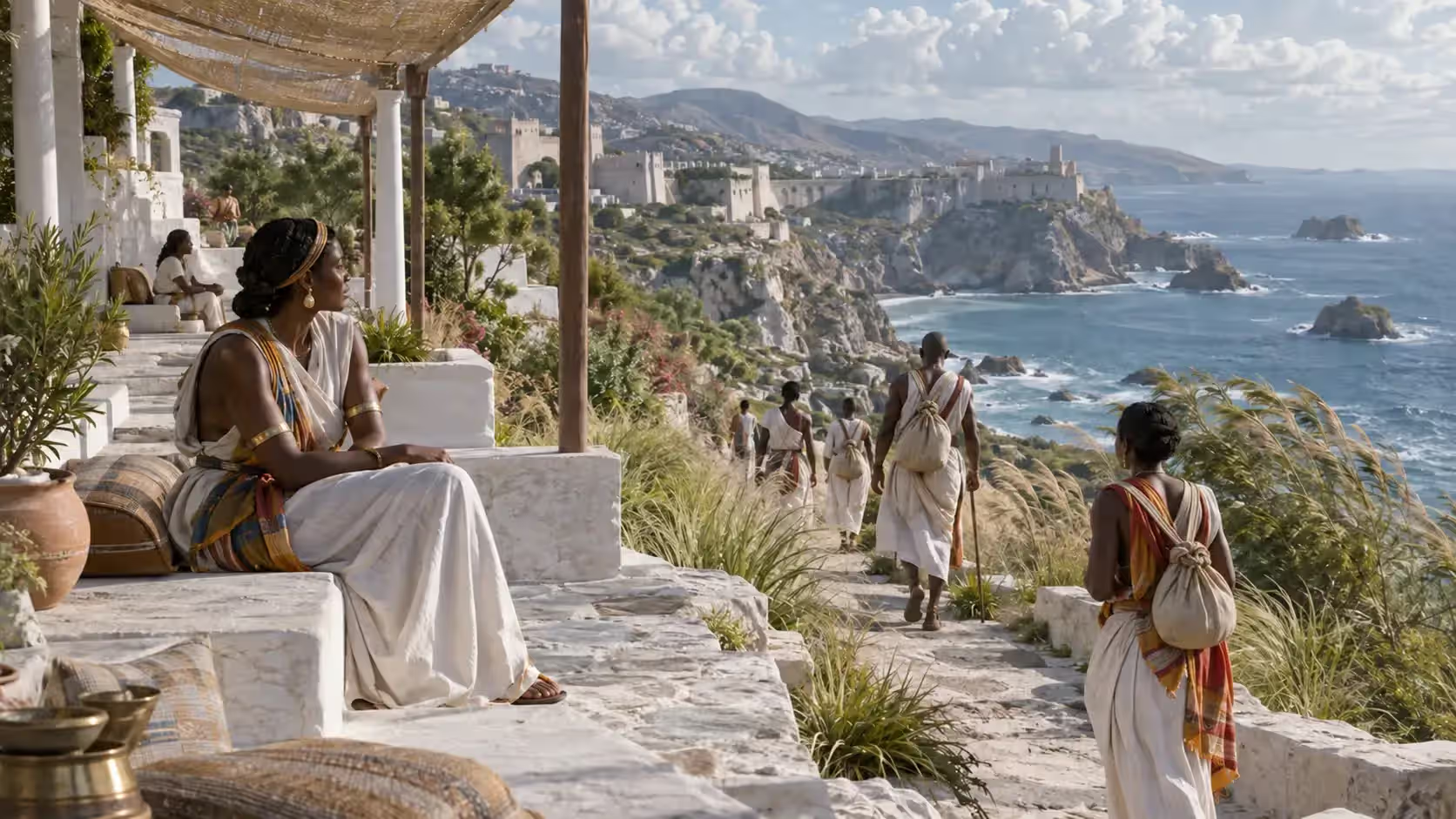
The Côtes des Alizés
A coast of ports, beaches, winds and ports of call: the seafront where Ishtir trades with foreigners under control, and where the Respiration is lived in sails and kites.
Ports, beaches and winds
The Côtes des Alizés are a coast of ports, beaches, winds and ports of call. Maritime activity sits beside hospitality houses, baths and regulated foreign exchange. Together with the Îles du Soleil Levant, they open Ishtir to navigation.
They are a coast of sacred ports and wind corridors, with coastal perches and the defence of the seafront.
Where trade stops
Ishtir has no internal currency, but it trades abroad, and regulated foreign trade takes place on this seafront. In regulated ports, the orders may use barter, contracts, units of account and foreign currencies. These instruments stay at the border: a payment received from a foreign partner does not become private wealth inside the country.
Ishtir’s money market is therefore a matter for the outer ports. Inland, distribution, rights of use and the exchange of services take its place.
Sea and wind
During the Respiration, the Côtes des Alizés are the region of sea and wind: beaches, sailing, giant kites and wind sports. Young Bronze, who have eight weeks, are known to be unmanageable there.
Places and place names
The Vents des Alizés Marchands are among the coast’s named places.
Alistom and the Port of Alizéon
The town of Alistom, known as “of the Golden Quays”, houses the Port of Alizéon, the largest of Ishtir’s regulated ports. The port forms a separate enclosure, closed on the landward side by a single gate: foreign ships anchor in its basins, their crews lodge in its houses of welcome and do not pass the gate without permission. Warehouses, stone quays, cargo-weighing halls, the counter of the Greffiers du Nid and the Bureau of Enclave Tokens crowd together along the water.
Through Alizéon come metal, glues and balms, paper, insurance and certain draught lines; out go solar art, white stone, amber, solar wine and lineage certificates. Foreign merchants find an honest and slow trade there: every cargo is weighed, recorded and cross-checked by the Silver Mirrors before it touches the quay.
The amber of the Rising Current
The shores of the Alizés are the shores of amber. After every storm the Rising Current throws pieces of fossil resin onto the sand, and the pickers of the Amber Works of the Alizés, who answer to the Order of the Gardens, walk the beach at dawn, in lines, before the tide takes back what it has given. The finest pieces, those that hold a leaf or an insect, are reserved for goldsmiths and temples.
The rest is sorted and distilled. It yields lamp amber and amber oil, which light a large share of Ishtir’s dwellings, temples and relays and give the country’s nights their yellow light and faintly resinous smell. In the days after a big storm the coast’s children’s cohorts are let loose on the beaches; they come back with their pockets full, and the pickers then resume the serious work.
Qonhir, Tanhar and Qarnûn
Around Alistom the coast divides into three countries. Qonhir, in the hills of the Merchant Trade Winds, lines up terraced gardens, orchards, fibre fields and woods, and the wind road that runs down to the port. Tanhar is the country of the shores: amber, fishing, salt pans, boats, and the beaches where the Breathing’s houses of welcome are set up. Qarnûn, further on, is a coast of horned pastures where centrosaurs and ceratopsians graze, with its stud farms, stables and a hatchery.
Fishing feeds all three. The coast’s salt pans supply the salt of the refectories and the herds’ licking blocks, and dried fish goes inland.
Wind as a trade
On this coast the wind is a tool. Lookouts fly great kites to read the high wind before a flight, salt workers follow its direction to manage their pans, and boatmasters learn the trade winds as one learns a language. During the Breathing the same kites, enlarged and painted, become games: some reach twenty metres across, held by whole teams.
The wind pendulums, great collective swings that ten or twenty people ride at once, are another speciality of the windy regions. The priest watching over one repeats that it is “high enough”, and the teenagers invariably answer the opposite.