

Places and landscapes
The Blue Terraces
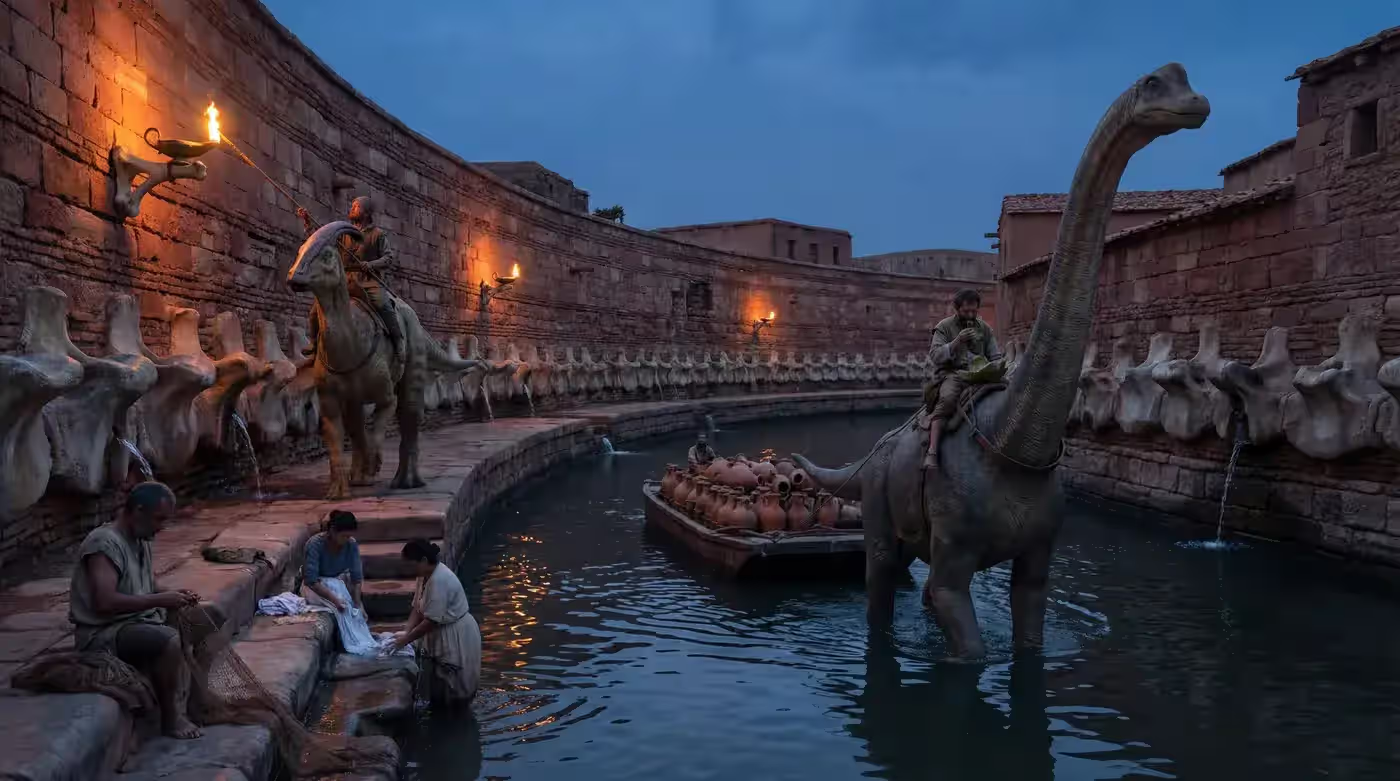
Urnok’s hydraulic system: lake-sized watering basins, canals, monumental drainage and squares that drink the storm. Water becomes an architectural material there, and the sacred lies in the water and shade the giants need.
A city that drinks the storm
Without drainage, great animals destroy everything. The Blue Terraces make Urnok a capital that displays its mastery of water. Large watering basins, true urban lakes, are linked by canals; each also serves as a fire reserve, a sanitary reserve and a political tool. Deep gutters stay visible, carved into the stone, and one sees water move as one sees convoys move. Slabs are slightly cambered, basins connected to the water table, and tamed marshes become water gardens.
On the great squares, filtering terraces — reed gardens, porous stones, permeable ground — drink the storm. Ramps and shade surround the basins. A crowded city, with ground packed down by giant animals and immense water needs, must manage runoff, water quality and floods all at once.
The dyke-temples
A whole style makes it a cult. The sacred there is not the sun but water and shade, indispensable to the giants, and the monuments are dyke-temples. At the heart of districts, lake-basins serve for watering, microclimate and prestige. Stone needles become harness masts, inlaid with metal rings, with their winches and the song of the ropes; stepped fodder granaries, ventilated and ringed with spiral ramps, take the shape of pyramids.
Tall towers frame mirror-lakes, with entry ramps for animals and carved spillways. Flared columns serve as ventilation chimneys for granaries; raised walkways like dykes let gutters and rinsing channels run beneath. Gauge obelisks carry the engraved levels of the fodder, water and egg reserves: an accounting temple. Pale stone, lime and pigments of ochre and verdigris are polished there by countless passages.
Building and clearing the water
Basins come from a worksite chain: dykes, greased leather joints, lake-basins, deep gutters, then upkeep. Stone, lime drawn from eggshells, leather joints, water-repellent grease, bone counterweights, dung bricks and ceramic pipes are used. Clearing is no detail: crews flush the drains, disinfect them and mark them safe, to prevent disease and the collapse of roads.
A day of storm
A storm is prepared for before it breaks. When the sky darkens, the sluice-masters open the spillways of the lake-basins to make room, the cleaners clear the gutter grilles and the drivers move the beasts away from the low squares. A special horn, deeper than the convoy horns, warns the flood-prone quarters.
During the downpour the city works as designed: the filtering squares drink the water off the roofs, the deep gutters carry it to the settling basins, and the largest basins rise several feet in an hour. After the storm comes the cleaning. The silt left in the settling basins is scraped out, dried and sold to gardeners and the surrounding farms, so that a storm also enriches the fields of the outskirts.
Life around the basins
The lake-basins are the capital’s busiest public places. The order of use is posted on a stela: residents’ drinking water is drawn upstream, care water through clean conduits, and the beasts drink downstream, by size and by service. Nobody bathes in them; washing places and baths have basins of their own, and a bather caught in a trough pays a fine in front of the whole quarter.
The edges of the basins are nonetheless full of life. Shaded galleries surround them, where fruit and scented water are sold; children watch the colossi drink at sunset, when the great necks dip together towards the water; small fishing pterosaurs come to dive there, and old people play counters at stone tables.
Water and power
Whoever holds a quarter’s water holds the quarter. The great houses know it: offering a new basin, or having a neglected one cleaned at one’s own expense, is one of the surest ways to win a city’s favour, and the inscriptions on the spillways keep the memory of such gifts. The Crown reserves the major works for itself, the High Cistern and the aqueduct heads, and lets no house take charge of them.
In dry years water becomes a political matter. The basins’ rations are read out in public, the quarters compare their shares, and rumours of favouritism run faster than the water. The capital’s stewards know that a thirsty city rises faster than a hungry one: in their crisis plans, water comes before grain.