

Families and social ties
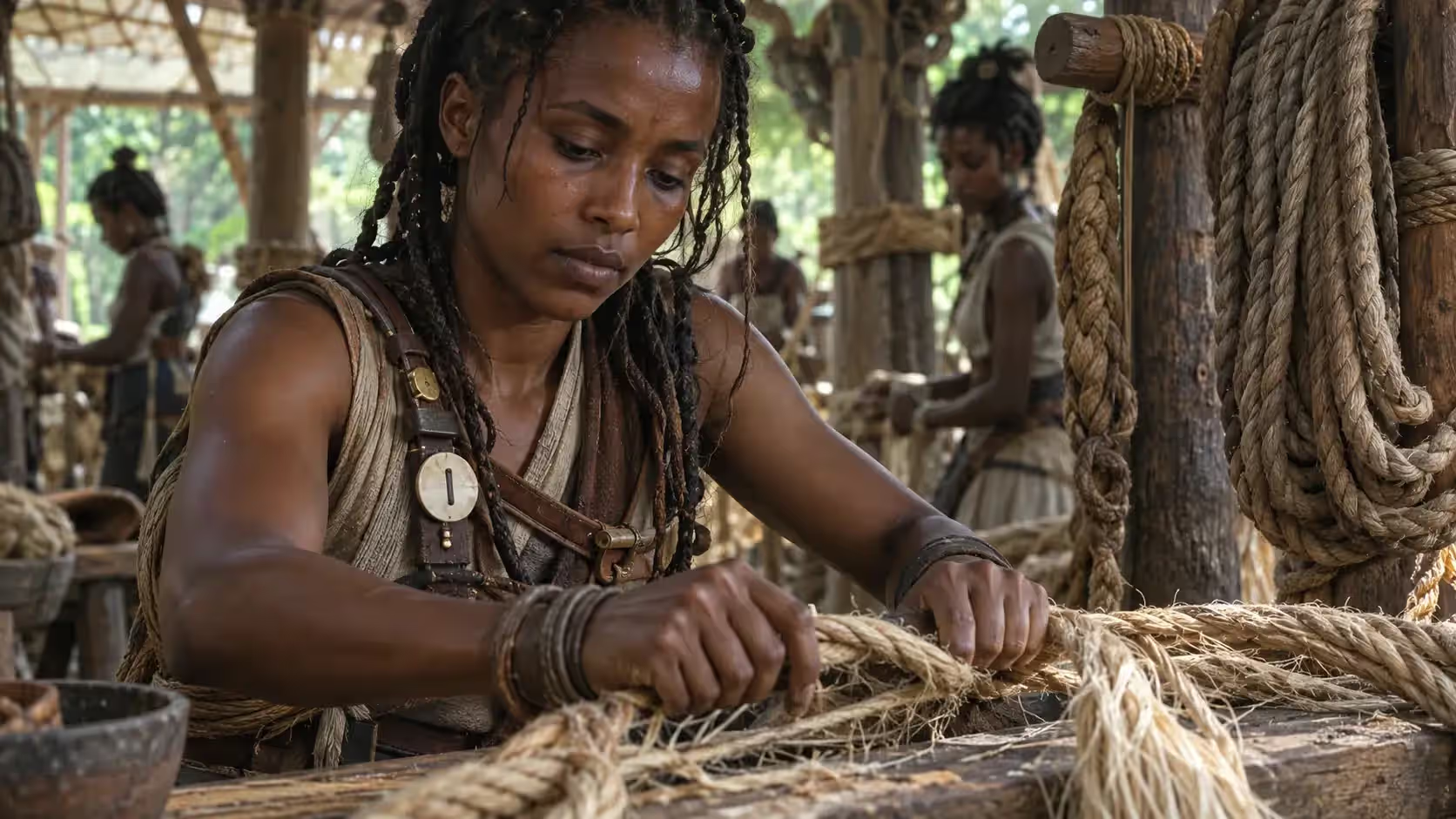
The fibres of movement
A rope transmits a force
The world’s technical level knows ropes, hoists and capstans. A rope does not replace a missing support: it transmits a force between two points, and mobile devices must have anchorages and replaceable parts. Without rope available, hauling and rigging wait for their link.
Velmor depends on the forest
The military archduchy is not self-sufficient in fibres. Its archers and ballistae go with cables and anti-air nets, and those nets pass through a Line of Orlantis. The defence of a fortress also depends on the availability of a trade far away from it.
Where the fibres come from
Nalen ropes are made of plant fibres drawn from the forest of Orlantis: the inner bark of certain trees, fibres from long leaves, stems of edge plants grown along the margins of the woods. The fibres are retted in basins of still water, beaten, combed and dried before being spun. For the most demanding uses, the rope makers mix strands of tendon, more elastic, into the plant fibre, and coat the rope with Aversin pitch to protect it from water.
Quality depends on every stage. Under-retted fibre breaks, over-retted fibre rots; hasty combing leaves knots that become breaking points. The Nalen keep a register of their basins and lots, and an important rope carries a mark that allows it to be traced back to the lot of fibre it was made from.
The ropewalks
The Nalen quarter is recognised by its ropewalks, long narrow sheds where yarn is twisted over several hundred paces. The spinners work there walking backwards: a bundle of fibre round the waist, they move slowly back, letting the yarn run out, while a helper turns by hand the hooks fixed at the other end. For heavy cables, several strands are laid together by a whole crew advancing in step, singing to keep time.
The longest walks are used for hauling and rigging cables, which must be made in a single piece. The quarter is noisy by day and deserted at night, because fibre fears the fire of lamps. It is said that the Nalen are the only people of Orlantis who spend their lives walking backwards, and that they are none the worse for it.
From courier twine to hauling cable
The Nalen produce a whole range. Fine twine is used to tie bales of fodder, sew sacks and close courier packets; medium ropes for harnessing, site tackle and scaffolds; cables as thick as an arm for hauling rafts, rigging ships and lifting the great pieces of carpentry. Each category has its thickness, its number of strands and its guaranteed load.
That load is tested. Before delivery, a sample from every important lot is hung from a gallows frame and loaded with stone blocks up to the promised load, then beyond, until a test piece breaks. Serious buyers, Karûm-Brakh, the Mirvane sites, the armies, ask for the test record with the delivery. An untested rope still sells, but for less, and never to lift anything above someone’s head.
The nets of Velmor
Velmor’s anti-air nets are among the Nalen’s heaviest orders. They are great wide-meshed nets weighted with lead, made of pitch-coated Nalen ropes mixed with tendon cords, stretched between masts above ballista batteries, camps and exposed passages, or launched by ballistae against approaching pterosaurs. They do not make a camp invulnerable; they hamper an attack from the sky and protect what lies beneath.
A net wears out fast: the sun hardens the pitch, rain slackens the mesh, a claw or a blade opens a gap. Velmor therefore replaces them regularly, and the Nalen keep stocks of mesh ready to assemble. The order comes through the Living Armouries or the archduchy’s stewards, and the rope that ends up above a Velmorian battery set out, two seasons earlier, from a retting basin in Orlantis.