
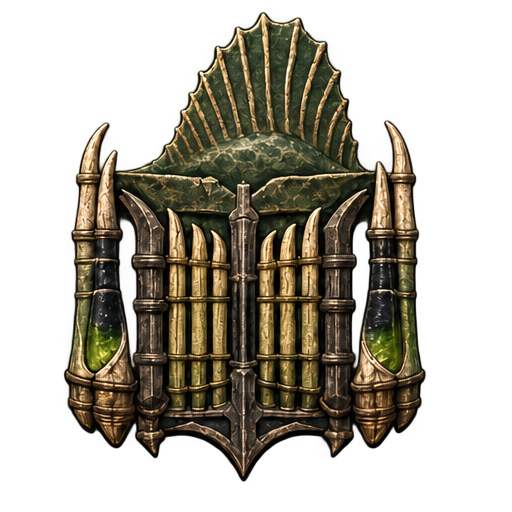
Creatures
N’Goro marshes: coexistence and precaution
In the marshes, crossing, fishing or caring requires reading water and limiting what comes into contact.
Water is not merely a crossing
Marsh waters link food, care, filters and travel. A product, body or animal entering this environment can alter conditions for those who follow. N’Goro practices therefore combine observation, protection and waiting when the context does not permit a safe reading.
Dans la forêt noyée
Un spinosauridé sauvage avance entre les troncs inondés.
Care creates a relationship
The Breath Debt recalls that lifesaving care can create lasting reciprocity. This rule does not turn every assistance into trade or give a carer unlimited power. It makes visible what care leaves behind: memory, an obligation to negotiate and sometimes a bond difficult to leave.
Three storeys of life
The marsh of N’Goro is lived on three storeys, and each has its creatures. In the low waters, among the submerged roots of the giant mangroves, live the great crocodilians, the spinosaurids, the fish, the leeches and the parasites; it is the world of fishermen, ports and floating villages. Higher up, in the Long Boughs, branches and vines hold the canopy towns, the insectariums and the hanging roads, and there one meets centipedes, spiders, mantises, snakes and small climbing dinosaurs. At the very top, the High Canopy belongs to the glowing organisms, the sun insects, the pterosaurs and the winds; medicinal plants are grown there, and resins and fruit gathered.
People pass from one storey to another several times a day, and each passage has its precautions: no one goes down to the water without looking at the surface, no one climbs the vines without testing their tension, and no one lingers in the canopy when the wind turns.
What hunts without intent
In the marsh, not every danger is a beast. Some vines, sensitive to heat, vibration, blood or touch, slowly close round a body or a structure; they are known by their tight knots and no one ever leans against them. Calling flowers, bright-coloured and strong-smelling, kill no one but draw insects, spores, scavengers and predators, and a house built too close to a bed of them sees a procession every night of whatever they call. Floating mats, those vegetable grounds that imitate firm earth, hold a child and give way under an adult above waters that grip.
Against all this the Ngoro have no lasting protection: they learn, pass on and watch. The gardeners of the Conservatory of Yveth record the constrictor vines and keep the list of calling flowers; villages cut the former, move the latter, or plant beds of flowers far away to draw off what they attract.
The marsh by day and by night
The marsh does not sound the same by day and by night. Day belongs to the sun insects, whose sheets of humming rise and fall with the heat, to the drops falling endlessly from the canopies and to the bubbles of the mudflats. At night other insects take over, amphibians call, the great crocodilians move, and the green mist lights up with glimmers: phosphorescent fungi on the trunks, farmed fireflies in the street cages, spore lamps in the houses, waters where tiny organisms shine. A foreigner spending his first night in a town of the Long Boughs often believes himself in the middle of a sky that has fallen into the water.
The Ngoro listen above all for what stops. When the insects fall silent all at once along a bank, when the amphibians stop calling, when the fireflies in a cage go out for lack of air, something has changed, and children are taught to freeze rather than run. Complete silence is, in the marsh, the first sign of danger.
Taking from the marsh
The Ngoro live off what the marsh lets them take, and they have old rules for it. Venoms are milked rather than snakes killed, mangrove sap is tapped without felling the tree, the sail of a dead spinosaurid is gathered but none is ever killed for it. No basin is emptied of its fish: every water has its reserved share, watched over by the water keepers. The hunters of the house of Saek, who live by hunting in the wild lands, do not take the titans and declare every beast they bring down.
These rules come not from any particular tenderness for living things but from experience. A basin emptied of its fish swarms with mosquitoes and parasites; a bank cleared of its snakes fills with crabs and amphibians that devour the young shoots; a felled forest gives its inhabitants up to the floods. The Conservatory of Yveth teaches these chains of cause to its students, and the old women sum them up for the children in their own way: when you take something from the marsh, you must know what will come in its place.