
Places and landscapes
The Hautes Îles
An archipelago of white cliffs, fibres and pterosaur nests, guarded by lookouts and by the fort du Hauban.
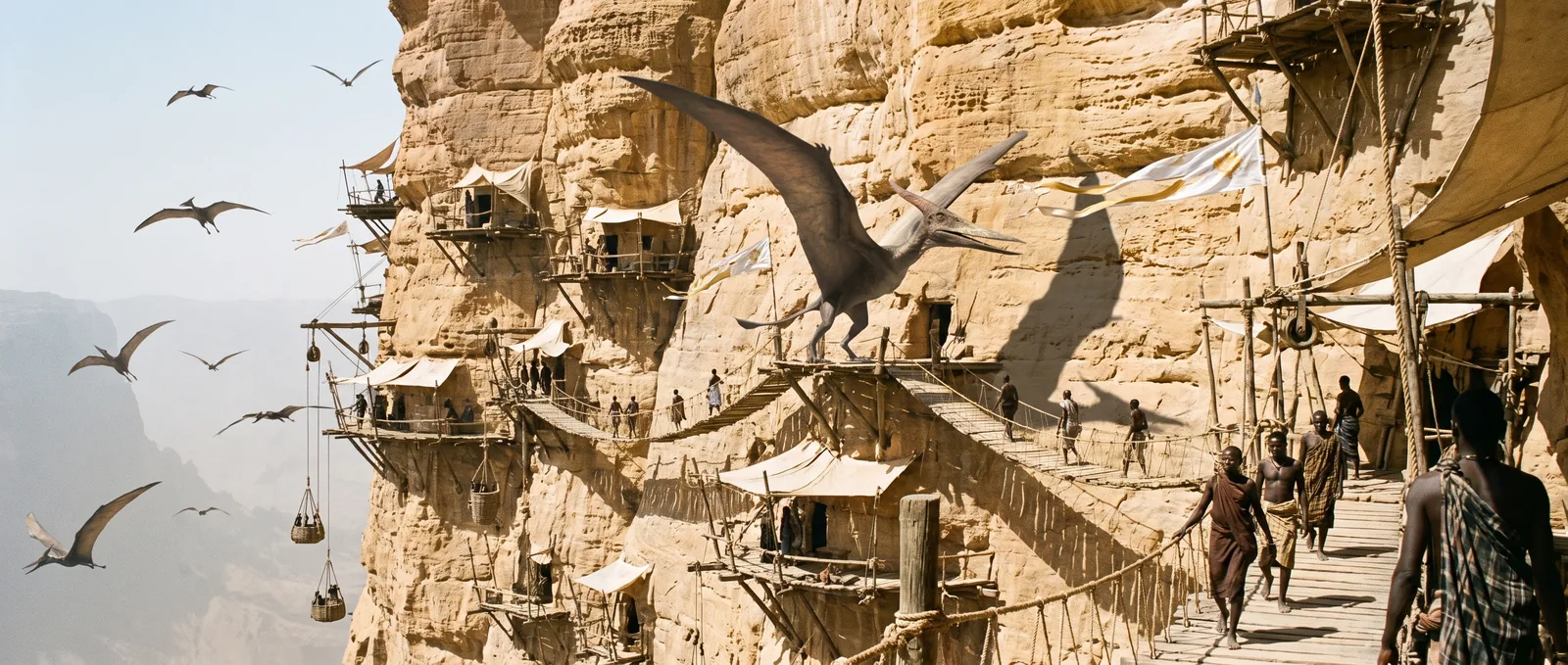
White cliffs and suspension bridges
The Hautes Îles bring together white cliffs, fibres, pterosaur nests, lookouts and the fort du Hauban. Suspension bridges and watch posts answer a relief that offers good views but demands particular access.
Nests and lookouts
Volonia uses small marine pterosaurs for signals, route scouting and spotting fish shoals, and larger individuals for relays, light transport and air interception. These animals need places to nest, land and be recovered: the Hautes Îles and the signal posts maintain part of them.
The cliff lookouts serve a fleet that acts in the sky, on the surface and under water, and that must defend itself against enemy navies and pterosaurs.
Cliff silk
The High Isles produce a silk found nowhere else. Cliff moths spin their cocoons there in the ropes of the suspension bridges and in the crevices of the white rock. Gatherers collect them by hand, hanging over the void from a rope passed round the waist, at the start of the dry season, before the pterosaurs return to nest. A silkworm nursery at the foot of the cliffs also raises caterpillars on trays to complete the harvest.
The cocoons are stifled, reeled, spun and woven on the spot by a silk company established at the foot of the white cliffs. High Isles thread is finer and more irregular than that of Séloris; fashion workshops seek it out for ceremonial veils and light fabrics that catch the light. Part of the harvest leaves raw for Séloris, where the dyers give it the blue and gold of the parades.
Ropes, fibres and salted vines
The fibres of the High Isles serve the islands themselves first. The ropes of the suspension bridges, the winches and the pterosaur recovery nets are braided there, and the ropemakers sell the surplus to the shipyards. A suspension bridge is remade piece by piece every season, like a sail being mended: the ropemakers replace worn strands before they give way, and the old bridges can be recognized by their colour, a mixture of new and old rope.
On the slopes exposed to the spray, a wine-growing house cultivates vines on narrow terraces held up by low walls of white stone. Its wine, slightly salted by the sea wind, is the table wine of the League, served at the official banquets of Port Volon; the same house gathers fleur de sel on the flat rocks of the shore. Visitors say a High Islander can be recognized by his hands, hardened by rope, and by his wine, which he always judges better than anyone else’s.
The fort of the Hauban
The fort of the Hauban guards the main approach to the archipelago. It takes its name from the great fibre cable that links it to the neighbouring island, stretched over an arm of the sea like the shroud of a mast: in fair weather, baskets travel along it, hauled by hand on pulleys. The fort also commands the only cut stairway climbing from the harbour to the plateaus; anyone who wants to reach the nests, the silk works or the vineyards passes beneath its walls.
Its contract garrison includes crossbowmen, net-throwing teams and a few ballistae covering sea and sky. Its lookouts are linked by signals to the towers of the Silver Wind and to the Semaphore. Above all, the fort protects what the islands hold most precious: the pterosaur colonies, whose animals Volonian houses hire or buy for their ships, and which thieves from the Broken Isles sometimes try to approach by way of the cliffs.
Living up high
The people of the High Isles live above the sea rather than beside it. Their houses of stone and wood cling to the plateaus, with cisterns that collect rainwater; loads come up from the harbour in baskets hoisted by winches, and suspension bridges link the islets together. Children there learn the rope as lagoon children learn to swim, and families count their goods in baskets hauled up rather than in boats.
The Wing-Bearers find their best recruits there. Relay pterosaurs are bred and trained on the islands, and the foam riders of the northern routes keep mooring basins at the foot of the cliffs, where their scouting ichthyosaurs rest between two dispatches.