

Families and social ties
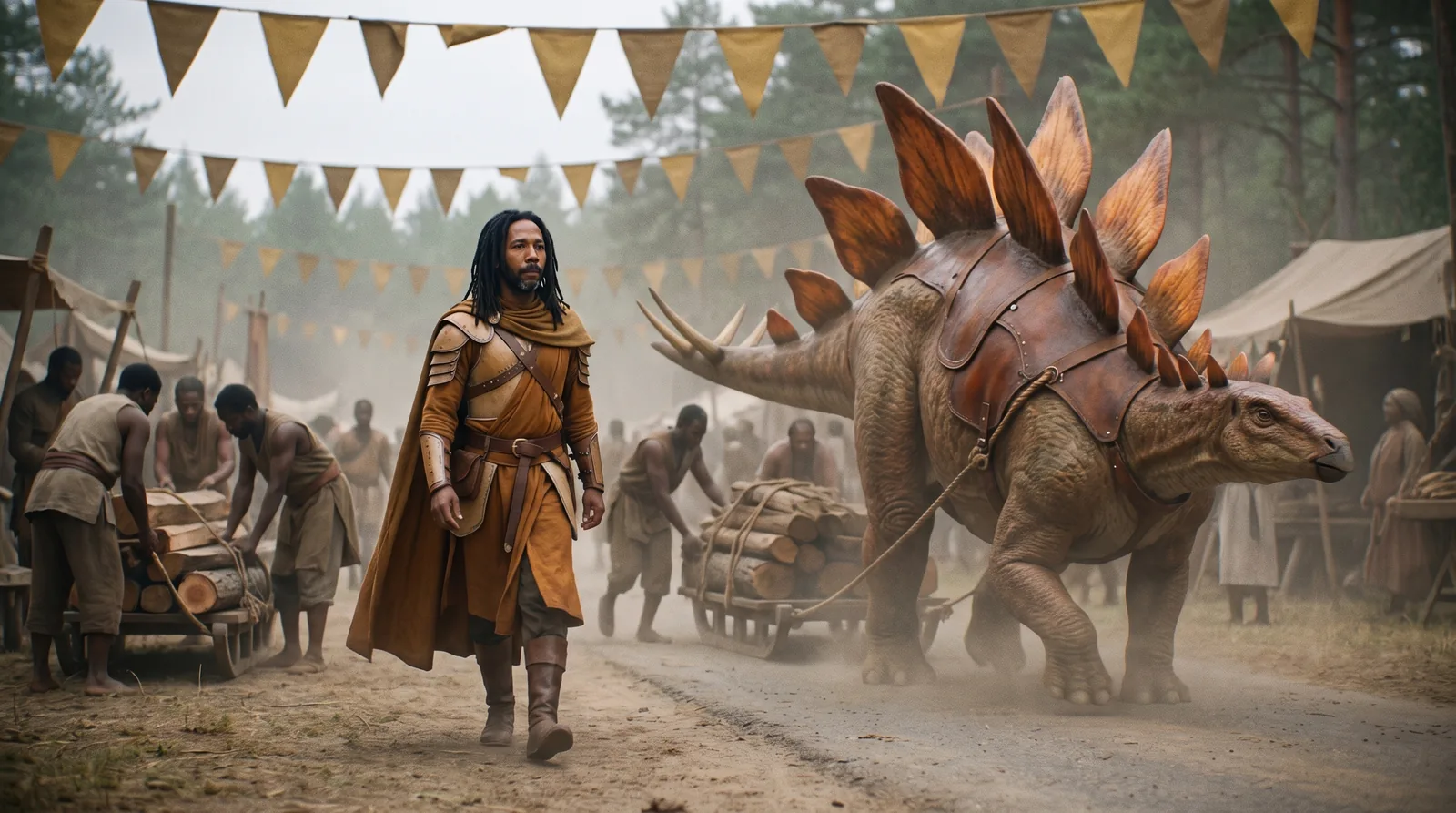
House Voranis
The ducal House of Orlantis, the forest duchy of the west: noble timber, resins, ropes and ports facing Volonia.
The forest duchy and its duke
House Voranis holds Orlantis, the forest duchy of the west: noble timber, resins, ropes, relays and ports. The Duke of Orlantis is a man. The stegosaur is the emblem of the duchy; it is harnessed to sledges of resin and noble timber, while the resin lambeosaur remains a secondary transport animal. The imperial stegosaurids, Stegosaurus, Dacentrurus and Kentrosaurus, are exclusively Orlantine.
Yet the House does not hold the animal of its emblem. The breeding, training, harnessing and logging work of the stegosaurids fall to the Lomvar Line, a family distinct from the ducal House. In Orlantis, government, ownership and trade are followed separately.
A port House born of the forest
Its history goes back about three thousand nine hundred years. The Voranis are a port House born of control over the forests, the resins and the inland sea routes, and bound to Volonia by marriages. Orlantis is one of the former Crowns absorbed by the unification that set out from Calaron; in the Empire’s long history, defeated kings became dukes.
The name Voranis belongs to the duchy’s proto-Volonian layer, where M, B, L, V and R meet: Lomvar, Mirvane, Marlen and Berlan share it. This kinship of sound has a history. Volonia descends from the ancients of the Broken Isles, who themselves came from Orlantis: the Volonians are Orlantines who went to sea. An old stereotype calls the Orlantines liars; Volonia turned it into the declared and insured lie.
This position makes the Voranis a hinge between Urnok, Volonia and the Broken Isles. Their cargoes of timber and resin reach the Volonian ports and sustain a diplomacy of the House’s own; it also exposes them to contracts and to divided loyalties.
Eleven Lines, from tree to port
Below the House, seven High Lines hold the timber chain, from tree to port. Berlan holds felling and floating, Lomvar the stegosaurids and logging, Mirvane carpentry and construction, Tolmen fine joinery and turning, Aversin the resins, Culorn hunting and the exploration of the high forest, the Marlen of Orlantis downstream floating and the ports. Four Lines then hold the intermediate products: Corvel the glues, Nalen the ropes, Ombrin lampblack and pigments, the Tanoris of Orlantis bark tannins.
The duchy’s towns read from upstream to downstream, because the material goes down and the water flows the right way: the Berlan log yards, the floating basins, the drying sheds and steam rooms, the Tolmen quarter, the Mirvane quarter, the Aversin resin cooking downwind and outside the walls, the Marlen port. The Lomvar enclosures hold an outer belt: a stegosaurid goes around a town, it does not cross it.
What the forest supplies to the Empire
The products of Orlantis leave the duchy in forms no one recognises any more. Tanoris bark becomes the tannin of Velmor’s black harnesses; Ombrin lampblack becomes the ink of the imperial registers; Nalen ropes serve hauling, rigging and Velmor’s anti-air nets. No duchy wages war alone: an army of Velmor also marches on the leather, ink and ropes of Orlantis.
Expedition credit
Orlantis is not only a timber duchy: it is also a centre of credit. House Voranis owns its own bank, the Voranis Expedition Bank, which lends to shipowners, finances timber convoys to the coast and advances the money for sea expeditions. It is also credited with a shadowy side: it has fitted out privateers and financed trade wars the House has never acknowledged. In Urnok, people speak of it as the hidden credit of Orlantis.
Beside it, the Larn Lines Fund serves as the bank of the craft families. It lends on future fellings: a felling letter is a right to a tree the Berlan will fell in ten, twenty or thirty years. These letters are sold, pledged and inherited; an Orlantis family can thus own a share of a forest that will be cut only by its grandchildren.
A duchy facing the sea
Orlantis timber travels down to the coast by the floating rivers and ends in the estuary yards held by the Marlen Line of Orlantis. There they build floating rafts, barges, coasters and above all single-piece masts, cut from the ancestral wood of the Larn forests and sold to Volonia, whose arsenals, it is said, grew out of Orlantis traditions.
The estuary has its own animals: small ichthyosaurs, trained to drive shoals of fish towards the nets and to tow light boats, and small coastal pterosaurs that fish on the wing and serve as signals between the quays. These animals never leave the coast; they give the ports of Orlantis an air found in no other duchy of the Empire.
Marriages and branches
The House has woven itself into Volonia through marriages, generation after generation. Volonian wives and husbands have entered the ducal family; Voranis younger sons and daughters have gone to live in the republic’s ports. A cadet branch, the Voranis-Brisé, keeps the House’s ties with the Broken Isles, from which the Volonians’ ancestors descend; its best-known member, Orren Voranis-Brisé, the duke’s cousin and a charter captain, acts as go-between with the island families.
These ties are the House’s strength and its weakness. They open a private diplomacy the Crown does not fully control, and give it kin on both sides of every negotiation. They also expose the duke to the charge of serving two masters, which the other Houses level at him whenever an Orlantis cargo puts to sea at the wrong moment.