

Places and landscapes
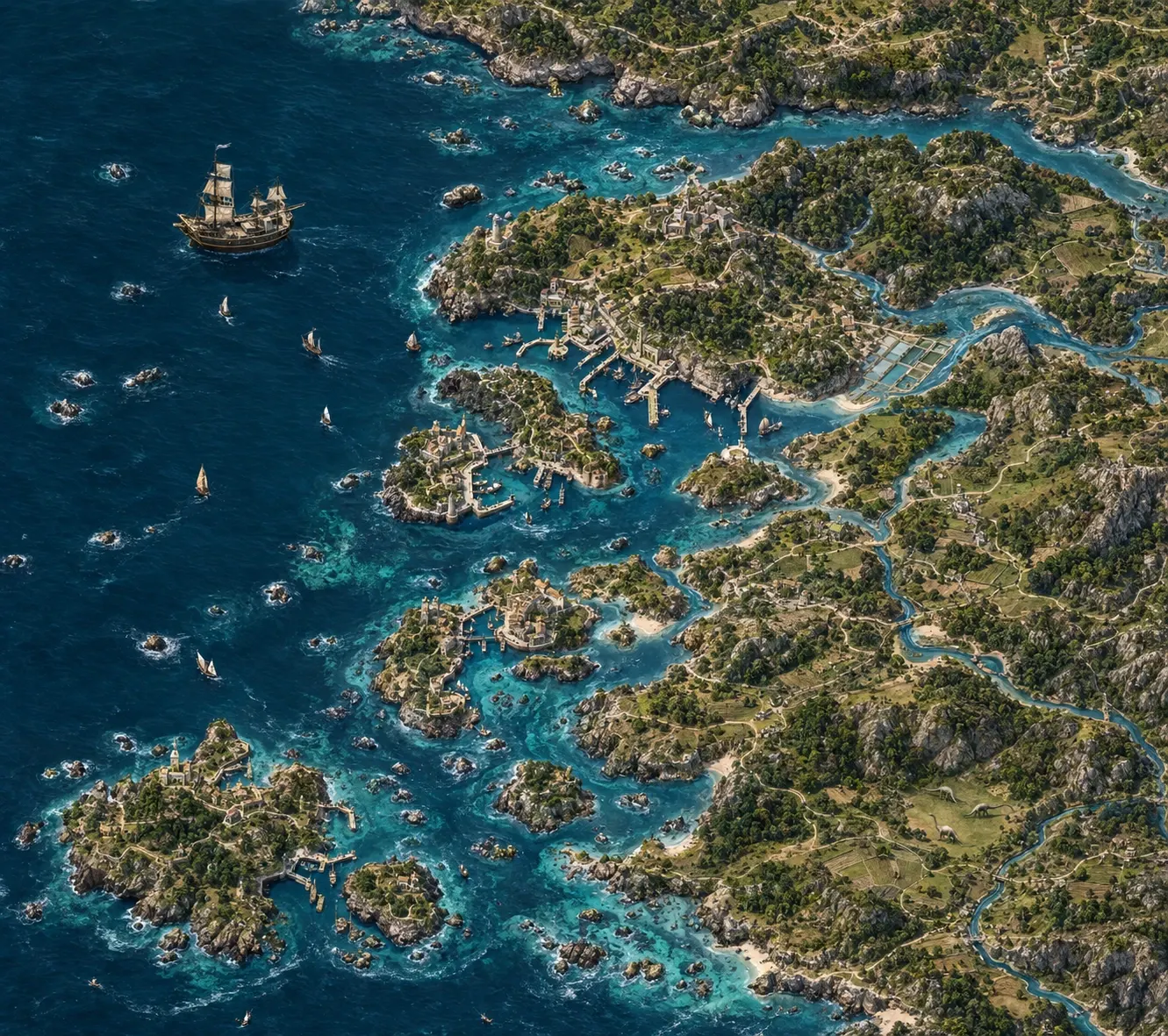
The Archipel du Vent d’Argent
Volonia’s northern relay: high islands, towers and perches that watch the weather and relay signals on the routes to Urnok and Arkhan.
The northern relay
The Archipel du Vent d’Argent serves as a relay in the north, on Volonia’s routes to Urnok and to Arkhan. Its high islands, towers and perches support weather watching and the passing of signals.
Preparing the route
Volonian routes change with season, current, cargo and draught animal. A route is a course to be prepared, with relays able to pass on such changes; pilots, observers and messengers link the archipelago to the other places on the route.
Small marine pterosaurs carry signals and scout the routes. They need perch-masts, platforms and landing places; towers and high islands provide part of them.
High islands and araucarias
The Archipelago of the Silver Wind stretches across the north of the republic, between the arsenal of Velasar and the coasts of Séloris. Its islands are high and wooded: upland meadows, open woods, araucaria forests and wind-beaten hills, with cliffs where the great pterosaurs nest. Its name is said to come from the north wind which, in certain seasons, covers the sea with pale foam and turns the needles of the trees, whose light undersides make the slopes shine.
The araucarias make up part of the archipelago’s wealth. A cooperative of resin-tappers bleeds their trunks and draws from them the marine varnish used to coat hulls, as well as the varnished panels that decorate the salons of the capital and of Séloris. Archipelago timber is also felled there for small craft, and fishermen find cold, rich waters. The inhabitants live in close-packed villages at the head of sheltered coves, below the towers and perches that crown the heights.
The Aviary of Currents and Skies
The archipelago houses part of the perch towers and workshops of the Aviary of Currents and Skies, the port university where navigation is learned on the sea and above it. The cliffs of the Silver Wind lend themselves to it: young pterosaurs learn there to return to a perch, to carry a case and to fly in strong wind, and students learn to care for them, release them and take them back in the recovery nets.
The Aviary trains Current Readers, Wing-Bearers and Damage Gaugers. The first read the sea, the second handle and tend relay pterosaurs, the third estimate what an injured beast or cargo is worth. Its masters also teach the insurance of living things on the move: a contract must provide for the case where the mount dies, panics or is injured. One rule of the Aviary is known to every sailor in the north: when a bay “smells” of predator, nobody sails.
The Festivals of the Silver Wind
The archipelago is also known for its festivals. The house of Corsani-Verdian, a house of spectacles whose members, artists and financiers alike, appear in public behind red lacquered masks, organizes the Festivals of the Silver Wind there every year. For several days the cove villages host flèche-mer races in the channels, plays performed on barges, singing contests and long nights of feasting under the araucarias.
Visitors come from all over the republic, and the red masks, sold in every port, are worn in the capital’s maritime theatres too. For the archipelago the festival is an income as much as a tradition: inns, boatmen, room-letters and resin-tappers often earn in a few days what fishing brings them in a season.
On the northern route
Convoys heading north towards Urnok and Arkhan put in at the archipelago before the long legs. They take on water, timber and news there; their pilots consult the watchmen, who observe from the heights the approach of squalls and storms coming down from the north. A convoy waiting at the Silver Wind is almost always waiting for a window: the signal a tower will raise when the sea becomes passable on the next stretch of the route.
The archipelago’s towers also watch the northern fogs, out of which come the raiders of the Northern Pirates — low in the water, fast and built for boarding. Lookout pterosaurs report any sail without a flag, and escorts leave the Silver Wind to join the most exposed convoys. That is why captains sailing north say they “go by the silver”: before the fogs, it is the last place where they can learn what awaits them.