

Power and institutions
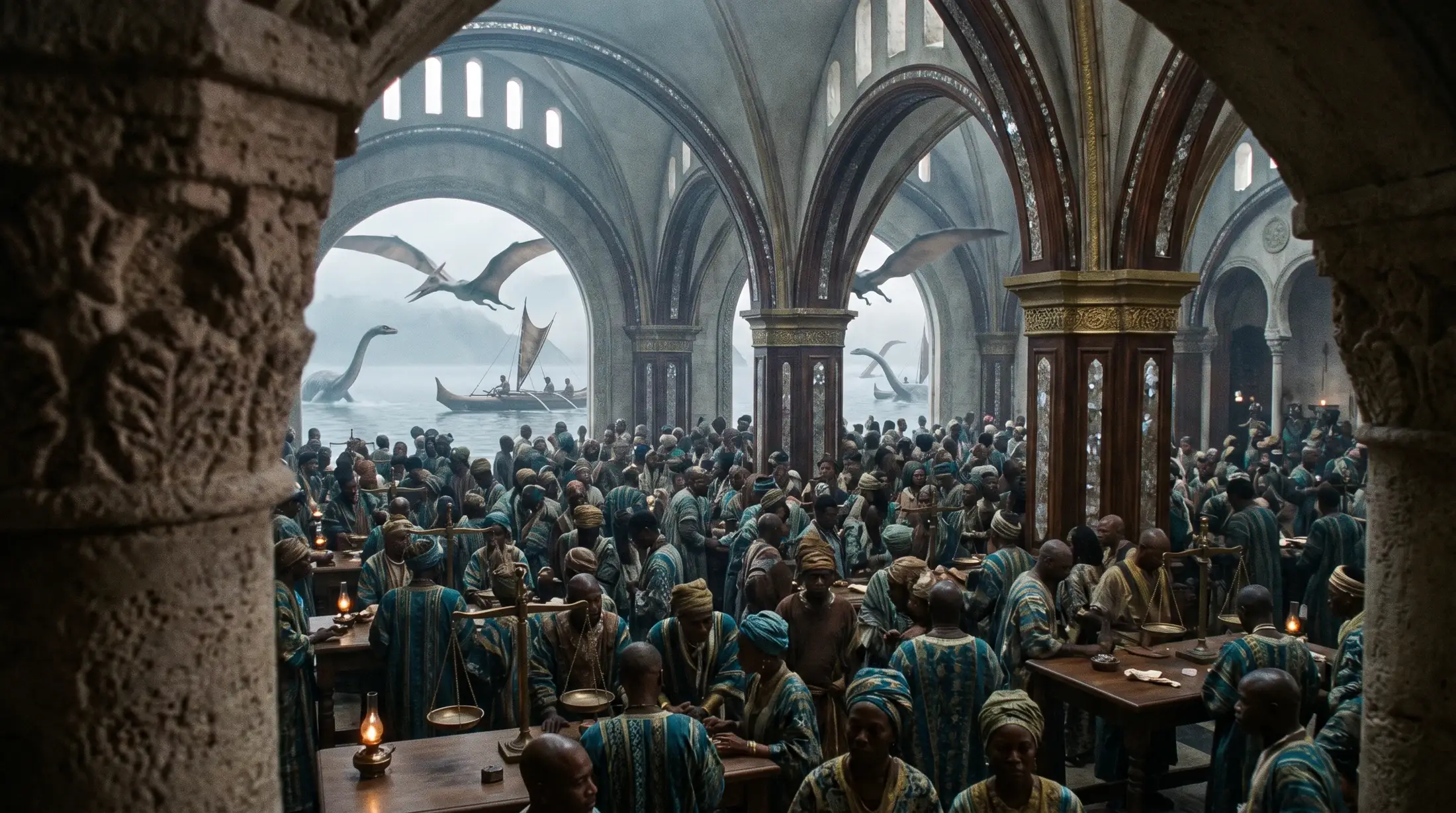
The Council of the Five Families
Volonia’s executive summit is collegial: with no individual sovereign, it sits at the Palais des Gouvernants and must work with houses, guilds and coalitions.
A summit without a sovereign
The Council of the Five Families is Volonia’s executive summit. The republic has no individual sovereign: the Council leads it collectively, and its visible leadership sits at the Palais des Gouvernants in Port Volon. No family, shipowner or banker governs alone there.
Governing by compromise
Houses have their own interests and their own means. The government must work with guilds, unions, artisans and the middle classes, whose activities keep the ports and routes alive and who can form coalitions. Power is divided between the Council, the houses, these coalitions and specialised institutions: the Grand Comptoir settles financial exchanges, the Cour des Marchands handles disputes, the Stake Chambers receive the money committed in votes.
Governing therefore requires gathering means and support able to make a decision enforceable.
Deciding war, entrusting the fleet
The political summit decides on mobilisation; the Admiralty of the United Fleets then conducts operations within the powers entrusted to it. The Council and the great shipowners do not intervene in every manoeuvre of a battle: once a major war is recognised by the Meeting of Flags, houses keep ownership of their fleets, but naval expertise commands.
A networked republic
The Council leads a republic of some ten million inhabitants, bound together by the Ligue des Mers et des Comptoirs: ports, routes, treaties and a common fleet. Port Volon, a networked capital, places the sites of government, finance, justice and spectacle beside the quays, lagoons and floating districts.
The Palace of the Governors
The Palace of the Governors stands in Port Volon, between the quays, the lagoons and the places of finance. One enters by water as much as by gangway: a parade basin lets delegations arrive by barge, and signal pterosaurs land on roof perches. The great hall has no throne. Five seats are arranged in an arc facing a long table, where clerks lay out the deeds to be signed and the returns from the Chambers.
Around this hall work secretaries, jurists, readers of Quay Notation and couriers. Sessions open and close with a bell, as at the Great Counting House, and decisions are read aloud before they are sealed. The Palace does not resemble a court: people come with files and leave with seals.
Five seats, not five dynasties
The Council’s name goes back to the age of the Pact, when the founding houses of Port-Volon gave themselves a common leadership. Yet the families sitting there have changed several times since. The five seats are held by houses, but none belongs to one bloodline forever: a house keeps its seat as long as it carries its share of the common burdens, the League fleet, the contribution to the quarantine, the guarantee of treaties.
When a house can no longer carry that share, its seat may pass to another, after a vote in the Chambers of Stakes. The mechanism explains how the Council has been able to change its face over the centuries without changing its name. Each house appoints a person to fill its seat, often the head of the house, sometimes a jurist or a former admiral. The Council decides in common, and none of its members governs alone.
What the Council signs
The Council is an executive: it proposes, signs and enforces. It calls the great votes in the Chambers of Stakes and sets what is to be decided there; it signs, in the name of the League of Seas and Counting Houses, the treaties of route, call and exchange; it appoints envoys to the other powers. In a major war it is the Council that puts the decision to mobilise before the houses, before the Gathering of the Flags places the fleets under the Admiralty.
It does not raise taxes: the Fifteenth is collected by Vaesh. It does not judge: the Merchants’ Court settles disputes. It does not command battles: the Admiralty fights them. Its power lies in its position at the crossroads of these institutions. A Council deed with no funds in the Chambers remains an intention; funds with no Council deed remain a stake. The republic moves forward when the two meet.
A diplomacy of passes and ports of call
The foreign policy the Council conducts rests on an old principle: preventing a power already dominant on land from also gaining complete freedom at sea. Urnok, the first power of the known world by population, great living beasts and administration, is the power this doctrine targets first. Relations with Arkhan are excellent, fed by trade, credit and a shared hostility to Urnok’s hegemony, without Volonia seeking an absolute victory for Arkhan.
The weapons of this diplomacy are rarely ships. They are rights of access, of call, of pilotage, of repair and of finance, granted, delayed or refused. With Orlantis, whose timber and resins keep the shipyards alive, the republic maintains a tense dependence and treaties inherited from the War of the Grey Quays, still in force. With N’Goro, it buys knowledge it does not master and filters it at the Vaesh threshold.
What the ports say
Few Volonians know the faces of the Council; all of them know its seals. In the taverns they say the Palace governs with the Chambers’ permission and to the rhythm of the tides. Sailors judge it by simple things: a dredged pass, an escort granted, a quarantine held without ruining the port.
Visitors from Urnok are astonished that a republic without a sovereign can hold together. Volonians reply that no single man could carry what five seats already struggle to carry together, and that the day one name governed Volonia, someone would still have to find it an insurer.