
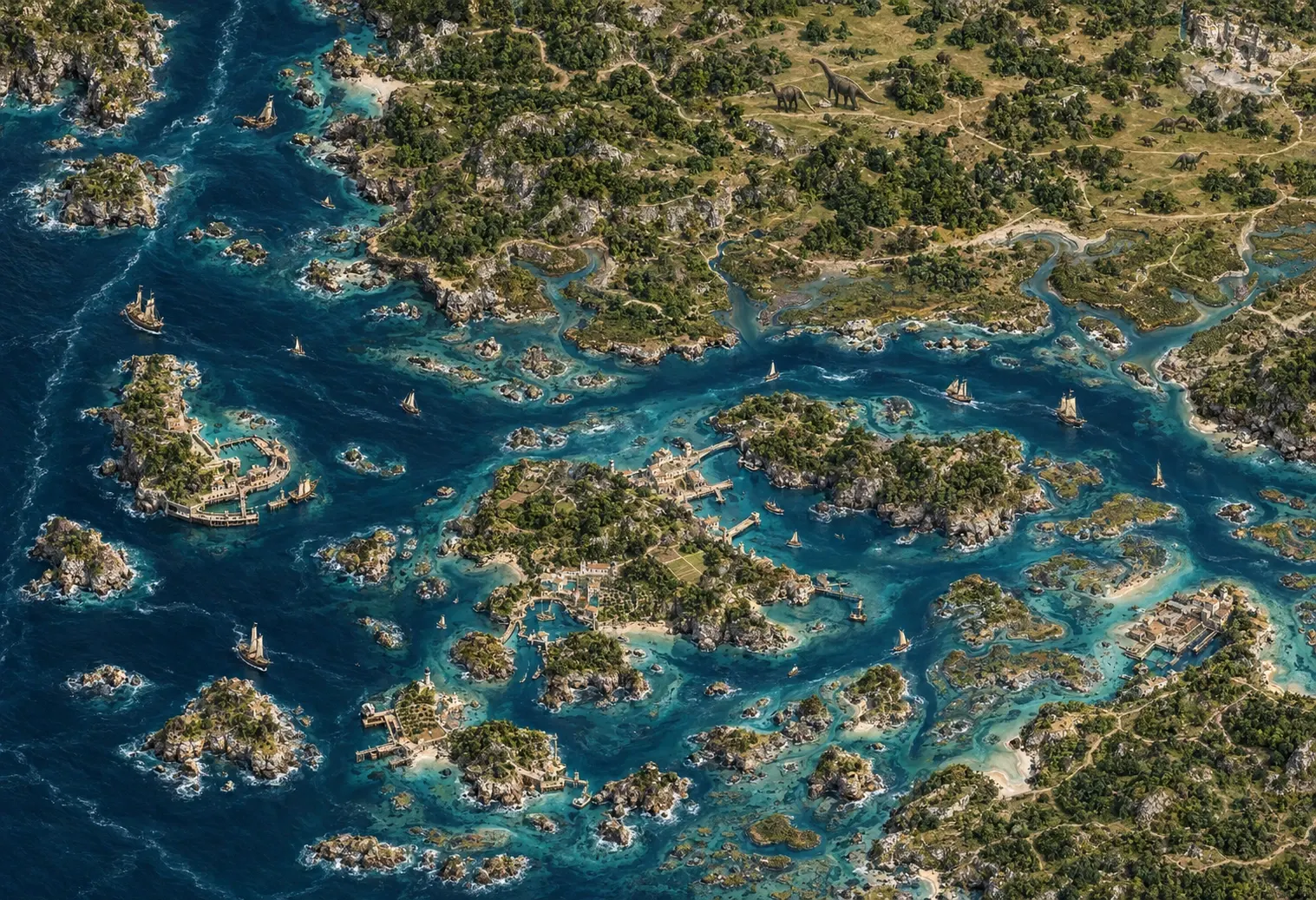
The Républiques des Îles Brisées
An archipelago of small coasting and privateering republics between Orlantis and Volonia. Cradle of the sailors from whom Volonia descends, it has become its marginalised rival.
Republics of coasting and privateering
The Îles Brisées form an archipelago of small island republics between Orlantis and Volonia. They live by coasting and privateering. They are no mere districts of Volonia: of Volonian culture, they remain one of the free powers of the known world, outside the republic. The register of Urnok’s duchies even gives Orlantis the Côtes Brisées and maritime republics as neighbours to the west, and Volonia names one of its sectors the Îles Brisées du Nord.
The stock of high-sea sailors
Volonia descends from the ancient peoples of the Îles Brisées, who themselves came from Orlantis. Its heritage of high-sea sailors comes from these islands. The kinship can still be heard in names: Orlantis’s proto-Volonian stratum, that of the Maison Voranis, shares Volonia’s sounds.
A marginalised rival
The islands shelter the heirs of ancient island powers that competed with Volonia. For centuries the republic has tormented and marginalised them: they were defeated fiscally and commercially. The rivalry is over the harbours, ports of call, shipyards and passages that make it possible to sail without depending on Volonian circuits.
For the islands, an independent route is worth more than a trading profit. A chain of refuges, pilots and supply points could divert convoys from the Volonian trading posts; Volonia’s power, on the contrary, grows when its services become indispensable.
A buffer between Orlantis and Volonia
Between the forest duchy and the republic, the islands serve as a buffer. Orlantis’s timber, resins and ropes reach Volonia under a tacit agreement, and the resin route reaches the Îles Brisées, where its particular risk is maritime smuggling. The Maison Voranis, which holds Orlantis, is the hinge between Urnok, Volonia and the islands. Marévant also sells its catch there under contract.
Island councils
Each island, or each group of neighbouring islands, forms a small republic governed by a council. Seats are held by virtue of old family franchises, rights the first families from Orlantis granted one another and have handed down ever since: fishing rights, quay rights, the right to raise crews. Around these families revolve cadet branches, captains and craftsmen who weigh on decisions without always having a voice.
The republics do not form a state. They ally, intermarry, quarrel over fishing waters and wrecks, and truly agree only against a common enemy. Their resources are ransom, smuggling and marriage alliances as much as coasting; they take whatever pays. An island council can grant a captain a letter of marque, sign a truce with a Volonian house or open its port to sailors the republic would like to see hanged.
A name for the defeated
“Broken Isles” is a victor’s name. It is what Volonia’s registers have called the archipelago since the republic defeated, fiscally and commercially, the old island powers that competed with it. The islanders have kept for themselves an older name, the one from before the defeat, which they use among themselves, in songs and on graves, and which Volonian scribes never write down. To speak it before a stranger is a gesture of trust; to hear it from a Volonian’s mouth passes for a provocation. The defeat can be heard in nicknames too: island sailors call the republic “the Creditor” and its customs ships “the bailiffs”. When an island council wants to show that an agreement truly binds it, it seals it under the old name.
Timber, storms and songs
The islands are rocky and windswept, with little farmland and an island fauna the great mainland herds never replaced. Mounts and pack beasts there are nearly all imported, and expensive. People live off the sea: fishing, coasting, repairing hulls on small wooden slips, twisting rope. Timber comes from Orlantis, as it does for Volonia, and its route is as much one of smuggling as of trade.
Storms set the rhythm of the year. In the bad season ships stay at the quay and families gather in the halls, where they sing family songs that recite genealogies, shipwrecks and lawsuits lost against Volonia. The republic’s sailors also dread the islands’ “flying pirates”, crews who watch for convoys from the clifftops and loose pterosaurs on them; it was against them, among others, that Volonia devised its anti-pterosaur net-throwers.
A scattered family
Volonia, Orlantis and the Îles Brisées are not three blocs foreign to one another, but a scattered family. The same names recur on all three shores, the same marriage alliances are made and unmade, and a single family may count a Volonian shipowner, an island captain and a cousin in the service of the duke of Orlantis. The wars of these seas are also quarrels between cousins.
That kinship has very concrete effects. A cargo may carry two contradictory family seals, and an island charter may invoke an old Orlantine seal older than the Volonian treaties. A captain may embrace his cousin on a quay before seizing his ship in the name of an older right. In maritime lawsuits, people plead through genealogies as much as through contracts, and Volonia’s judges keep registers of marriages alongside their registers of cargoes.
The fear of unification
Volonia counts the unification of the Îles Brisées among its major risks, on a par with pirates and blockade. Divided, the republics are a nuisance: competitors nibbling at ports of call, and lairs the fleet cleans out from time to time. United, they would become a maritime power at the republic’s door, with pilots, shipyards and a chain of refuges able to divert its convoys.
That is why Volonian policy towards the islands consists in keeping their divisions alive: lending to one so that it buys up another’s debt, arbitrating their quarrels over wrecks, marrying a daughter of a house into one council rather than the other. The islanders know it. Their oldest songs repeat that the islands were defeated because they were divided, and they still are.
Part of this article covers events of season 1. Turn spoilers on in the menu to read it.