
People
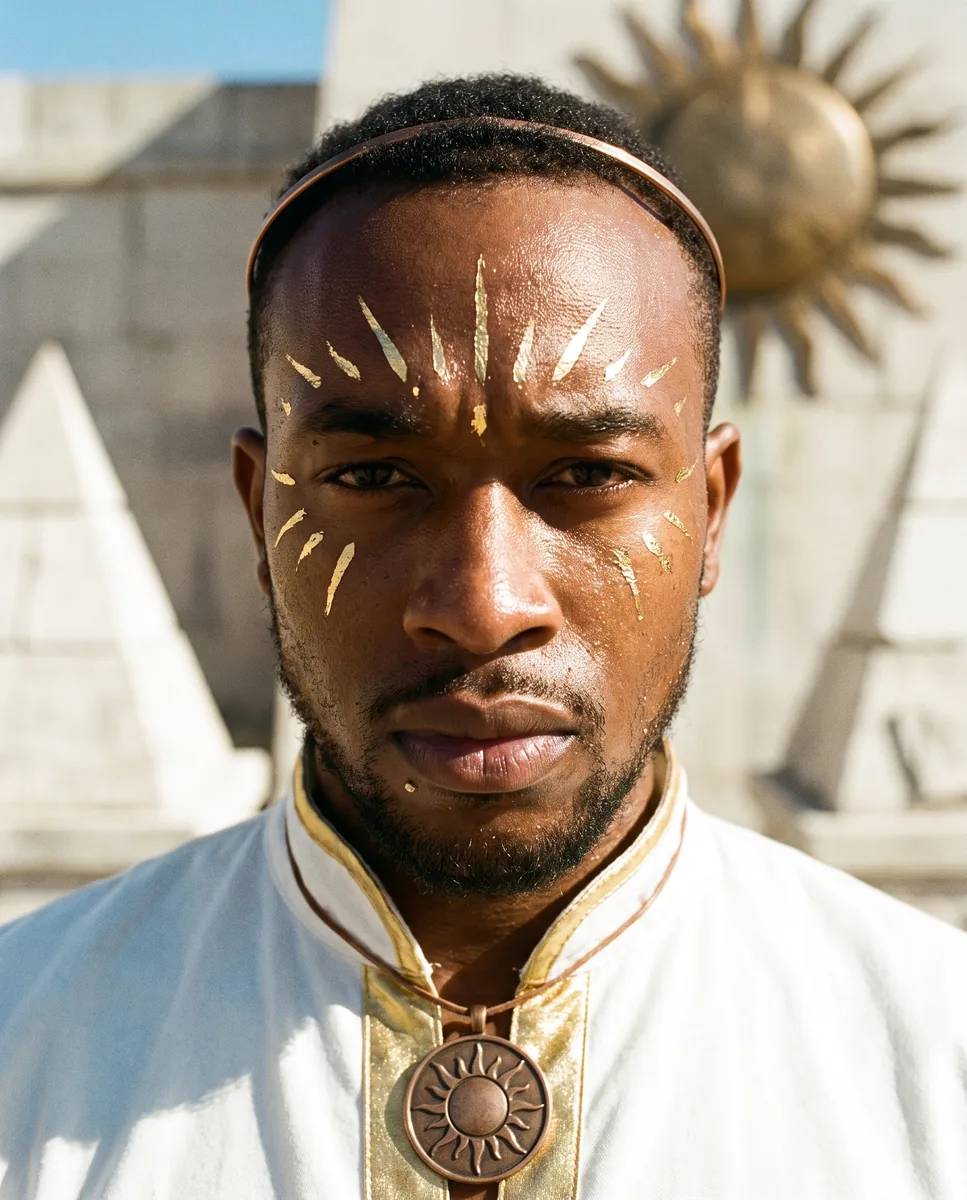
Azrûn
Silver captain of the Silver Winds and doctrinarian of the Weighing, risen from his cohort through service and certifications.
From the cohort to Silver
Azrûn grew up in a childhood cohort, Bronze like every child in Ishtir, and received his first adult rank at eighteen. His path runs through service, examinations and certifications, then through proofs of command, up to Silver. He makes visible the mobility the Weighing can grant a person without family backing. His name carries no surname: the mention of Sakar designates a training or an assignment, never a family.
Captain and doctrinarian
A Silver captain of the Silver Winds, Azrûn is also a doctrinarian of the Weighing. He interprets events in the language of doctrine: he gives moral meaning to military and civil decisions, to fear and to discipline.
Azrûn en tête de procession, parmi les porteurs d'étendards solaires.
Azrûn en tête de procession, parmi les porteurs d'étendards solaires.
His rank places him neither above the Marshal of the Zenith nor at the head of all the country’s armies: he is not the leader of Ishtir. His authority rests on his service and certifications, not on infallible genius.
A child of Troisième-Cour
Azrûn grew up at Troisième-Cour, a cohort house of six low stone tiers that from a distance could pass for a small theatre. Lodgings, kitchens and two study rooms fill the thickness of the tiers; bunks fold into the walls and the chests carry posting notches that are scratched out and cut again. Four radial passages let the children be evacuated without crossing the animal lane behind the kitchens. That is where he learned to sort the leftovers of a meal, to take his turn on the workshop’s board of rights and to avoid, without thinking, the flagstone that rings hollow on the second tier.
Like every child of Ishtir, he knew no parents and no family name there, only cohort keepers, companions and a shared memory. His first dreams were not military. As a boy he copied onto slats the distances between relays he had never seen, and happily shortened a valley when it ran off the edge. He believed then that a wish repeated often enough would end up counting as a skill; the rest of his life taught him the opposite.
From roads to the sky
His public biography begins with roads. Weighed Bronze at eighteen, Azrûn earned his first certifications in convoy driving: he led columns through hail, once cleared a road blocked by three panicked ceratopsians, and one of his earliest medals still certifies that road work. Then came the command trials, sat before arbiters who are said never to blink at the same time.
His move to the Silver Winds belongs not to a heroic tale but to a file. Relay instructors like to say that a man who can read a road can read a wind corridor: both trades require holding a line, foreseeing the breaking point and bringing everyone home. Azrûn added the sky certifications, first for relays, then for leading wings of working pterosaurs, until the Weighing that recognised him as Silver. On the ground he rides Aru-Sakar, a sacred command Triceratops with a white horn and a cloth of gold, flawless in line and anxious as soon as the tempo blurs.
“Azrûn de Sakar”
He is sometimes called Azrûn de Sakar, and foreigners hear a family name in it. It is the reverse. In Ishtir, “de Sakar” names a formation: a school, a posting or an army vow a person has passed through, like “de Venthir” or “de Keryth” for other officers. Old registers wrote “Hel-Sakar”, with the sacred prefix Hel-, reserved for consecrated names; the form survives in a few elderly mouths. Neither is passed on, and another officer may carry “de Sakar” after him.
An Ishtiri’s use-name changes with their life. Azrûn’s says where he comes from in the army, not whom he comes from. When he visits a cohort house, custom requires him to take off his Silver insignia at the door: his rank opens the high road for him, not a children’s courtyard, which one enters only by permission and for a time counted in lines of shadow on the copper groove of the wall.
What a doctrinaire preaches
As a doctrinaire of the Weighing, Azrûn is neither a temple priest nor a judge. His office is to say what decisions mean. After a review, a failed drill or a death in service, he speaks to the troops in the cadence of prayer, in short sentences that can be repeated on the march. Those who have heard him insist that he never lies: he puts each thing in its place, fear into discipline, loss into the solar order.
He keeps returning to the same ideas. Mobility is zero-sum, and whoever rises must look at whoever falls in the same hour. Proof matters more than eloquence, his own included. A Bronze who holds the line serves the solar order as much as a Gold who holds the doctrine. He readily cites his own cohort as an example, which irritates part of the Silver rank, who find such reminders of origin undignified, and delights the Bronze, who see in him living proof that the Weighing works.
That double reputation follows him everywhere. Young Bronze soldiers in the barracks come to hear him the way one goes to watch a racing champion; some Silver captains find him too close to the quarters. He sees no contradiction in it: you do not stop having grown up somewhere because you were weighed elsewhere.
A captain of the Winds
In the Silver Winds, a captain answers for a wing of working pterosaurs, its pilots, its nacelle keepers and the cliff relay where it lands. Azrûn’s day is much like his peers’: inspecting membranes and harnesses at dawn with the technicians of the Tours du Zénith, reading the wind with the observers, drills launching from the cliff and returning to the perch, and then the part pilots like least, the rolls. A captain counts his animals, his wounded, his rations of dried fish and every flyer’s hours aloft.
The trade has its rules. You do not launch a nacelle into a doubtful wind to save face, you abort a launch if a carrier grows restless, and you bring everyone home before asking whether the drill succeeded. The pilots of his wing say Azrûn counts twice and never shouts in the air, only on the ground.
Part of this article covers events of season 1. Turn spoilers on in the menu to read it.
Gallery2 images
Azrûn at the head of a procession, a stone marker on his shoulder. Azrûn, sceptre in hand, in the Court of Measures.