

Places and landscapes
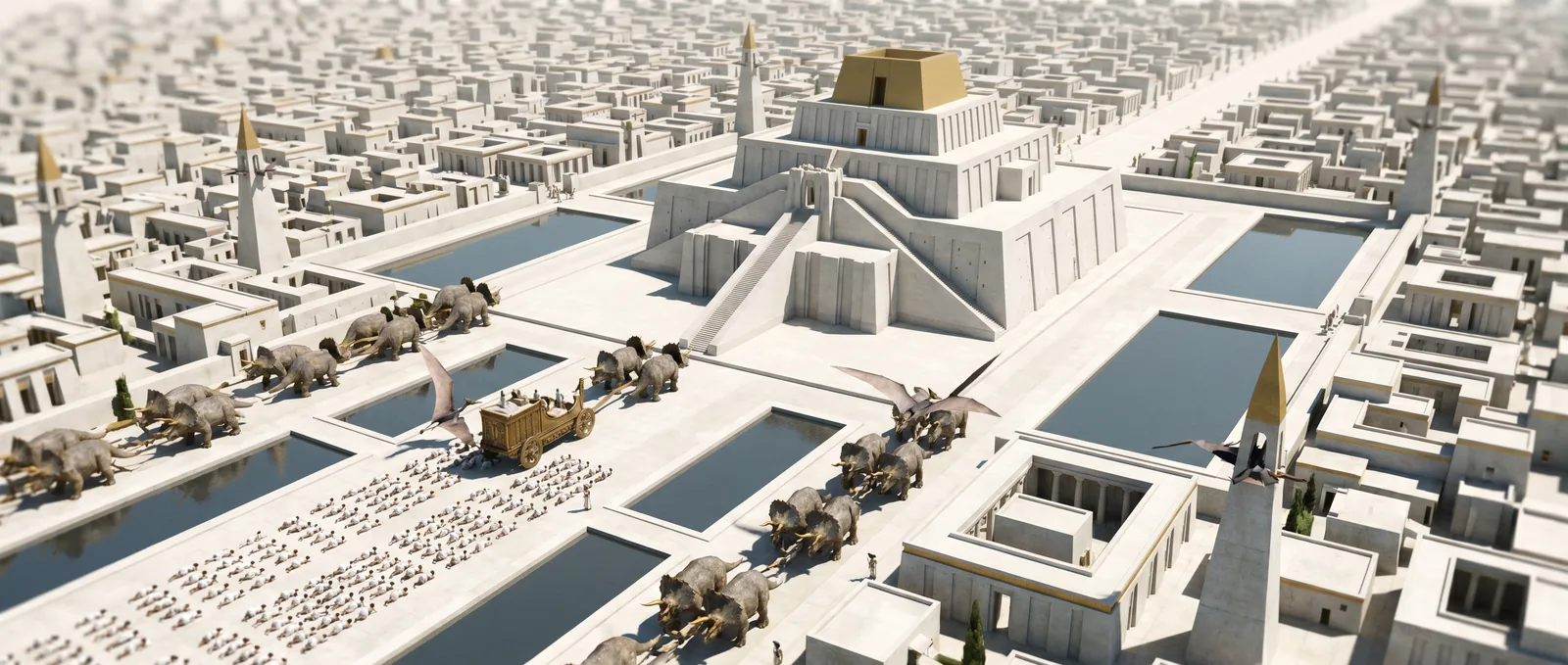
Qer-Aton: courtyards, shade and public routes
A city on the Tethys side where circulation, light and responsibilities meet.
The city on the Tethys side
Qer-Aton lies on the Tethys side. It belongs to an Ishtir combining coasts, gardens, terraces, ceratopsian plains and outer marches. This diversity gives the city its setting: access to the shore and land routes belong to the same garden-fortress as aerial relays.
Light passes through a second skin
Porticoes, low courtyards and light screens belong to Qer-Aton’s accepted architectural vocabulary. Screens combine a load-bearing wall with a perforated second skin of ceramic, horn, stone or protected bone. They filter sunlight; their shadows can also measure time in a dispensary, archive or examination space.
The human route and animal court
Ceratopsian routes require horn clearance, side courtyards and turning spaces. Processions, service movement and animal access meet in passages organised by size and function. Benches, water and rest accompany the porticoes. Circulation makes responsibilities visible while providing bypasses so daily work can continue.
The capital of Ishtir
Qer-Aton is the capital of Ishtir. A sacred city, it lies in the Jardin du Levant, the first of the nine regions, which feeds it all year round. The country’s public summit sits in Qer-Aton and in the cities of Gold: the supreme leader elected for a single twenty-five-year term, today Kheli Anor, and the Ten Golden Wings, who govern with him.
The city of the hundred and twenty
Qer-Aton is tied to air command and to the one hundred and twenty great pteranodons placed under the public responsibility of the Gold Order. All of them can be lined up there together, and fifteen great individuals stand at the centre of their array. The city gathers spaces for decision, training, specialised care and flight preparation, without being cut off from the roads, gardens and ports that supply it.
A sacred and military lock
Qer-Aton is a sacred, military and territorial lock. Passage is controlled there, and the city is at once sanctuary, fortress and place of pilgrimage. Guards, priests, workers and Silver and Gold officers live there. Pale stone, gold and ramps scaled to great animals give Ishtiri monumentality its form there.
The twelve quarters
Qer-Aton is divided into twelve quarters, which the national map shows in an inset. Several belong to the summit: the Temple of the Infinite Ray, seat of the Golden Ray; the Quarter of the Sun-Priests; the College of Stars, where astronomers and shadow measurers work; the Court of the Heliodromies, reserved for great ceremonies. Others are quarters of knowledge and record, like the Archives of Auréon, shared by the Silver Mirrors and the Greffiers du Nid. The Garden of the Thousand Rays, at the heart of the city, is at once a food garden and a promenade.
The last quarters are those of work and force: the Arsenal of Auréon, the Barracks of the Brontes, the Stables of the Ceratopsians, the Solar Forge of Hélios and the Port of Light, where the boats that serve the city by the lake and the canals come alongside. Each quarter has its gates, kitchens and basins, but none is closed to the others: the Gold cross the quarters of Silver and Bronze every day.
From the gate to the temple
A visitor entering Qer-Aton by the great lower gate first crosses the city of the ground: canals, collective kitchens, halls, reassignable dwellings, the smell of bread and fresh lime, the sound of water. Broad ramps lined with porticoes then lead him up to the level of the Weighing halls, schools, workshops and stables, where ceratops and hammers can be heard. Higher still, beyond further gates, come the temples, the Tribunal of the Measure and the perches facing the Couronne de Venthir.
This ascent is not forbidden: a Bronze may go up to the temple terraces, and many climb there at least once a season. But each level has its ways and its customs, and one changes the manner of speaking on changing height, as the Ištâr language requires.
The Solar Forge and the Stables
The Solar Forge of Hélios is the most prestigious workshop in the country. Sky iron from the Marche de Keryth and the Mines of Venthir, bronze and gold are worked there into charge lances, horn sheaths, balance parts for the Weighing and medals. The smiths burn charcoal from the forests of Qenteq in great furnaces with leather bellows, and every piece leaves marked with the workshop’s sign.
The neighbouring Stables of the Ceratopsians keep the capital’s animals: procession ceratops, mounts of the guard, lineage animals passing through. Technicians of the Silver Horns set the animals’ pace, harness and health there, and from dawn the exercise yards ring with the tread of great bodies being made to turn, stop and start again.
Feeding Ishtir’s largest city
Qer-Aton is the largest city in Ishtir, and it eats more than it produces. The Garden of the Thousand Rays and the Gardens of Dawn around the city yield solar grain, rice, dates and lotus; the rest of the grain comes up from the Côtes des Alizés, the Terrasses d’Auréon, the Couronne and the Plaines des Brontes, which also send fodder for the stables. Fish comes from the Islands and the coasts, stone from the Terraces, metal from Venthir and the ports.
These convoys arrive by the Main Solar Road and the Sacred Causeway, which link the capital to the great regions, and are received at the city’s lower gates, where granaries and halls share them out by quarter. A delay of a few days shows at once in the hall registers, and the stewards report it before it becomes a shortage.
A day in Qer-Aton
The day begins with the quarter towers, which tell the hour by the cry of signal pterosaurs released at dawn. Kitchens are lit, the water teams make their round, the children’s cohorts set off for school in noisy rows. In the morning the Weighing halls hear appeals, juries sit, workshops work; at exact noon the whole city falls silent for a moment while the crier announces the straight hour.
In the afternoon ceratops are exercised in the yards and flights are prepared on the perches. In the evening the refectories fill up, the porticoes are lit with amber lamps, and in the hot season the roof terraces are covered with sleepers. At night the city belongs to the watchkeepers: water keepers, healers on duty and tower lookouts.
“Ishtir”, a foreigner’s name
Many foreigners do not say Qer-Aton: they call the capital “Ishtir”, after the country, as if the city and the island were one. The Ishtiri rarely correct them, but never use the name among themselves. For them, Qer-Aton is one city among others, the highest and the most sacred, but subject to the same rights, the same registers and the same Measure as the smallest town of the marches.
Foreign maps often mark it with a simple solar disc, without a name. Envoys who have been received there speak above all of the whiteness of the walls, the silence of noon and the constant presence of wings above the roofs.
Part of this article covers events of season 1. Turn spoilers on in the menu to read it.