

Places and landscapes
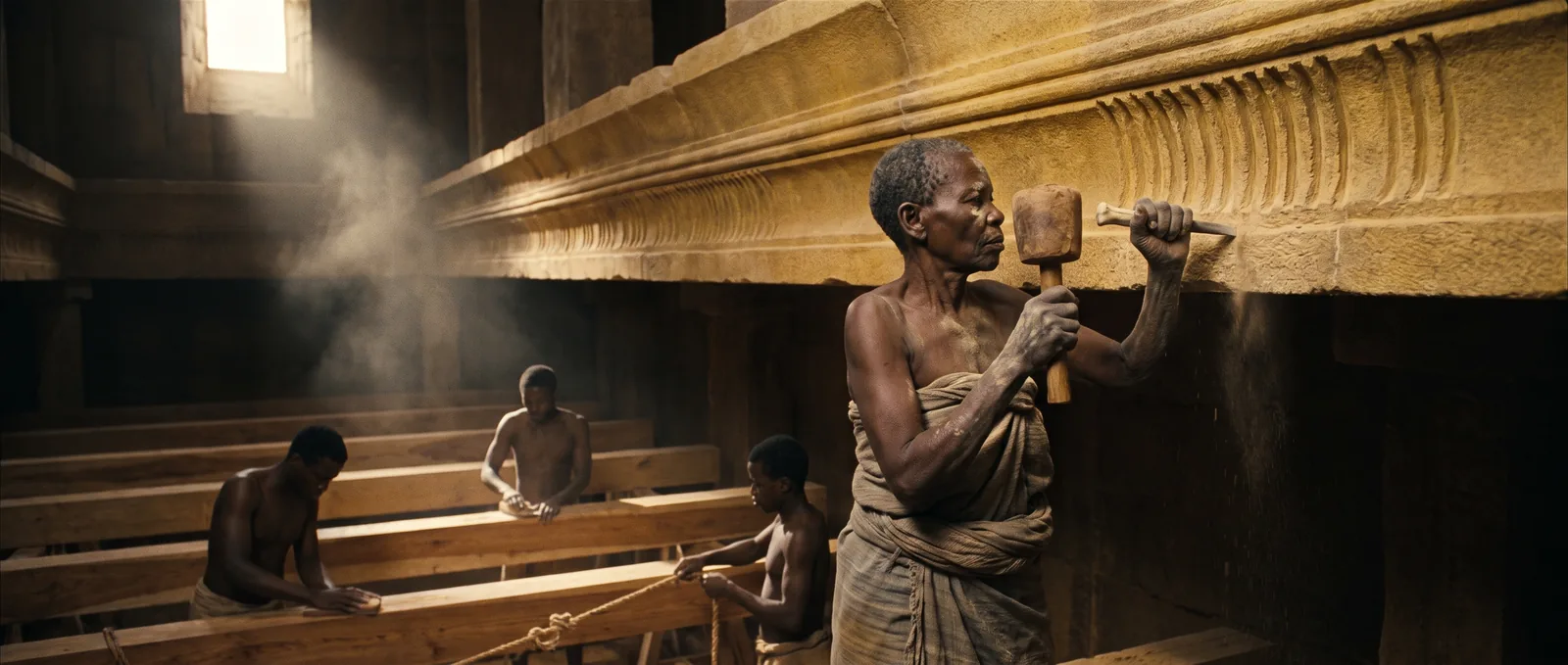
The pediment temples of Ishtir
In Ishtir, temples, ceratopsian schools, certification courts and arsenals share one pedimented form: short spans, side courts for the animals, clearance for horns and examination furniture.
Measuring, proving, assigning
The pediment temple is one of Ishtir’s great civic buildings. It may house a temple, a ceratopsian school, a certification court, an arsenal or another major ceremonial building. Its structural spans stay short, and its side animal courts keep clearance for horns. Inside, long benches, low examination tables, medal stands, measuring tablets and sanded floors serve examination and certification.
Ceratopsians belong to Ishtir’s animal sector, but the social order does not come from some supposedly honourable nature of horned beasts: it comes from the Weighing, from rights and from certifications. The building receives the animals; it serves first to measure, to prove and to assign.
A second skin for light
Temples, dispensaries, archives and courts can receive a sun screen: on a load-bearing wall of stone or terracotta, a second skin perforated in ceramic, horn, stone or protected bone filters the light. The shadows it cuts also serve to measure time. The screen remains a specialised piece: it makes neither a pierced rampart nor an ossuary.
The trial courts
An examination complex, a military school or a Silver court of proof and counter-proof can host physical trials. Markers, ropes, demountable tiers, care posts and regular exits equip it. The trial supplies a proof; it replaces neither the file, nor the appeal, nor the law. This arrangement never organises a city’s plan and never serves to set two hereditary clans against each other, which Ishtir does not have.
White monuments that change colour
Ishtir’s capital is white and gold. During the Great Breath, it turns to colour: flowers, fabrics, ribbons, plant crowns and banners cover the city, and the white monuments become supports for temporary floral decorations. The rest of the time, sun-warmed white stone, solar bells and deliberate cleanliness belong to the atmosphere of public places.
The plan of a temple
A pedimented temple is laid out around the course of the sun. Its main façade, crowned by the pediment, faces the sunrise; one enters by a broad stair and a columned vestibule. The central hall, long and high, often receives light through a single opening, placed so that at exact noon a disc of sunlight falls on a bare slab in the centre of the floor. An inner court holds a gnomon of stone or bronze, which the priests consult to set the times of the offices.
The animal courts extend along the sides, on the same level as the hall, with their troughs and wide gates. Behind, more modest buildings house the registers, the examination rooms, the lodgings of the officiants and a water reserve.
What a pediment shows
A pediment’s decoration follows the three planes of the Ištâr language. The lower register, the ground, shows work: growers, herds, water carriers. The middle register, the horn, shows ceratopsians head-on, horns forward. The upper register, the sky, shows pterosaurs and, in the centre, the solar disc surrounded by rays, often covered in matte gold.
One never sees there the face of a recognisable ruler. Ishtir has no dynasty to glorify, and sculptors depict functions, not persons: a Weigher holds a balance, a healer a jar, an officer a lance, with no individual features. Foreigners find these façades strangely anonymous; the Ishtiri, on the contrary, see in them the proof that a temple belongs to everyone.
White stone, lime and matte gold
Temples are built of golden stone for the structure and faced with white stone or a lime render, renewed before every Zenith festival. The matte gold of the discs and rays comes from the Mines of Venthir and is applied in thin leaves over a ground of fine clay; the bronze of the gnomons, doors and medal holders is partly imported. Perforated screens of ceramic, horn or stone close the side bays.
Upkeep never stops. A team of lime burners and masons of the White Hands is attached to each great temple, and the small quarter temples are redone every year by the inhabitants themselves, during a day of common work that precedes the festival.
The great temples of Ishtir
Some temples are known throughout the country. The Temple of the Infinite Ray, in Qer-Aton, houses the Golden Ray. The temple-city of Héliodrum, of the Thousand Rays, keeps the giant gnomon towards which pilgrims climb. The Temple-fortress of the Golden Throne, at Qer-Halun in the Marche de Keryth, is the seat of the Order of the Wardens; the Temple-fortress of Sol-Varak watches over the Plaines des Brontes. The Temples of the Solar Nest, in the Verger des Halcyons, receive the hatching of the sacred eggs, and the Sanctuary of Vent-Azur overlooks the eyries of the Couronne de Venthir.
Beside these great names, every quarter has its small temple, which also serves as a school, a place of examination and sometimes a court; it is there that most Ishtiri live their religion, at noon every day.