
Creatures
Aru-Sakar
Azrûn’s sacred command Triceratops: perfect in line, anxious out of cadence.
A beast that feels contradictions
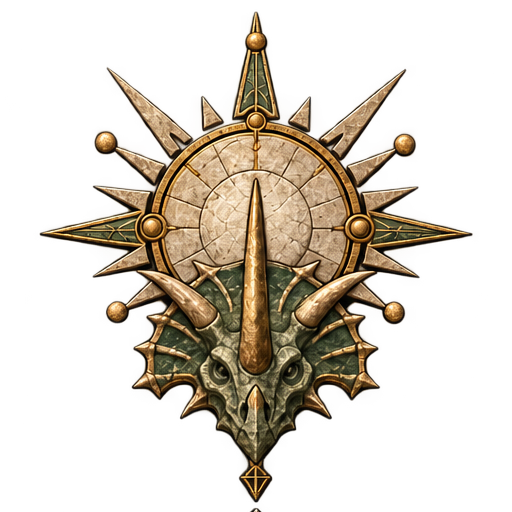
Aru-Sakar is a sacred Triceratops, of the kind Ishtir calls Sha-Qerim, trained as a command mount. It carries Azrûn, Silver captain and doctrinarian of the Weighing, linked to Sakar. Its horn is white, its cloth gold.
It is perfect in line and anxious out of cadence; it hesitates when three rhythmic orders overlap. Azrûn projects doctrine onto a beast that feels contradictions.
A command Triceratops
Aru-Sakar belongs to the Sha-Qerim line, the sacred gold-horned Triceratops that form Ishtir’s military heart. He is an animal nearly nine metres long, weighing about seven tonnes, with a solid frill and a massive brow. But he was not trained for the charge. Command mounts are chosen from among the calmest animals of the line, and their training teaches them the opposite of what shock animals learn: to hold a position, to advance at the exact pace of a line, to stop dead and never to set off on their own.
On his back, a high saddle with a backrest lets the officer see over the ranks. Behind it a bronze socket takes the cadence staff, the vertical standard whose discs, raised or lowered, set the pace of the neighbouring lines. A command mount is thus a fixed point in battle: soldiers look for it, and its very stillness tells them everything is going to plan.
The white horn and the gold cloth
His nasal horn is ivory white, whereas those of his line are usually grey or brown. His two great brow horns carry, like those of every Sha-Qerim, sheaths of matt gold applied in leaf; the nasal horn has been left bare. Ishtiri custom holds that a mark an animal is born with must not be covered, and priests take this whiteness as a fortunate sign. The carers, more down to earth, point out that a bare horn dries in the sun and has to be greased every evening.
The gold cloth is his ceremonial caparison: a great housing of white linen covering back and flanks, embroidered with rays in beaten gold thread, with a bronze border at the frill. He wears it only at reviews, processions and the great Weighings. On campaign it is replaced by a housing of unbleached linen that keeps no more gold than a thin edging.
An animal consecrated to Sakar
Aru-Sakar comes from an egg of the Enclos des Lignées d’Or, near Qer-Brontes, carried under seal to the Temples du Nid Solaire and hatched in their pits of warm sand. He grew up in the herds of the Plaines des Brontes, among the young of his season, until the two-year review, where herd chiefs and carers picked him for command. Three years of training in the riding schools of the Silver Horns followed.
His name states his consecration: the sacred prefix Aru-, followed by Sakar, the formation to which he is attached. Like every consecrated mount, he does not belong to his rider. He is registered in Sakar’s name, and it is through his posting to Sakar that Azrûn rides him; if Azrûn changes office, the animal will stay and receive another officer.
Perfect in line
Training a command mount rests on cadences. Marching drums, horn trumpets, flashes of mirrors, the tread of the infantry: every rhythm has a meaning, and the animal learns to answer it as it would a voice. Aru-Sakar has learned this language better than most. In a well-ordered line he advances at the exact pace, stops on the first beat and moves off again without being touched; officers of the Horns readily hold him up as an example.
Out of cadence he grows anxious. When three rhythmic orders overlap, he stops, sways his head and raises his frill, unable to choose which to follow. The carers do not see fear in this but hesitation: the animal has learned that every rhythm gives orders, and nobody has taught it what to do when they all give orders at once. Instructors have drawn a rule from it for exercises, a single cadence per sector, which officers do not always keep once in the field.
The doctrinaire and his mount
Azrûn is a captain of the Silver Winds, and people are sometimes surprised to see him on a Triceratops. It is the custom for officers who also command on the ground: a captain must be seen at reviews, column movements and processions, and a wing of pterosaurs is directed, once it has landed, from solid ground. Azrûn has in any case known ceratopsians since his convoy years, when he led columns through hail.
A doctrinaire of the Weighing, he speaks of his mount in the language of doctrine: Aru-Sakar “feels the order”, he “refuses what is oblique”, and his hesitations reveal the confusion of those who command badly. The animal’s carers listen politely. Among themselves they say that what he mostly feels is the drums. The two readings do not quite exclude each other, and Azrûn is the first to admit that the animal has never mistaken a rhythm.
Caring for a sacred mount
When Azrûn’s squadron is at the capital, Aru-Sakar lives in the Écuries des Cératopsiens of Qer-Aton, among the procession animals and the mounts of the guard; he follows the squadron by road when it moves. His day begins before dawn with a dust bath in the yard, then an inspection of feet and beak. He eats around two hundred and fifty kilos of fodder a day, fern, fronds and steeped cones, and drinks nearly four hundred litres of water.
His carers take one particular precaution: off duty, they keep him away from the yards where drum practice is held. A command animal that hears cadences all day that do not concern it ends up no longer listening to them. Before each ceremony, the sheaths of his brow horns are repolished with soft leather, the white horn greased one last time, and the gold cloth laid on by four people, without a crease.