

Institutions
The Réseau des Certifications
The civic system that produces the Weighing’s proofs: examinations, practice, service, duels, games and the renewal of skills, worn in public as a biography.
An architecture of proof
The Weighing does not rest on an isolated intuition: it gathers proofs. The Réseau des Certifications organises examinations, practical tests, service, games, duels, military exercises, command and the ability to pass on knowledge. Over the generations it has built schools, juries, arenas, riding centres and registers, so that proofs can be compared from one territory to another. It covers every territory of adult life.
A certification creates a precise eligibility and authorisation, never an automatic right to rise in rank. It cannot be sold, exchanged or turned into a general advantage: it is neither currency nor social score. Changing rank remains the Weighing’s decision, and a test replaces neither the file, nor appeal, nor the law.
A path in nine steps
The ceratopsian path shows how a career is built. A Bronze can certify, in turn, ceratopsian care, herd behaviour, riding, the mounted lance, collective manoeuvre, fodder, tactical strategy, command, and finally work with a sacred lineage. Each step keeps its own domain: knowing how to care for a ceratops is not competence to command. The complete file allows a genuine rise to Silver.
Biography replaces genealogy
Every adult wears a standard version of their rank, order, active certifications, grade and major medals. In a society without surnames these signs form a compulsory public biography: a foreigner sees an Ishtiri’s place before speaking to them. On the day of the Weighing, the keeper of marks engraves on sleeves what has just been decided. Some decorations are legendary; children make copies of them and dream of earning them.
Forging a certification or a strategic medal is an attack on the Weighing and can amount to treason: others entrust their safety to the competence it announces.
Sitting a certification
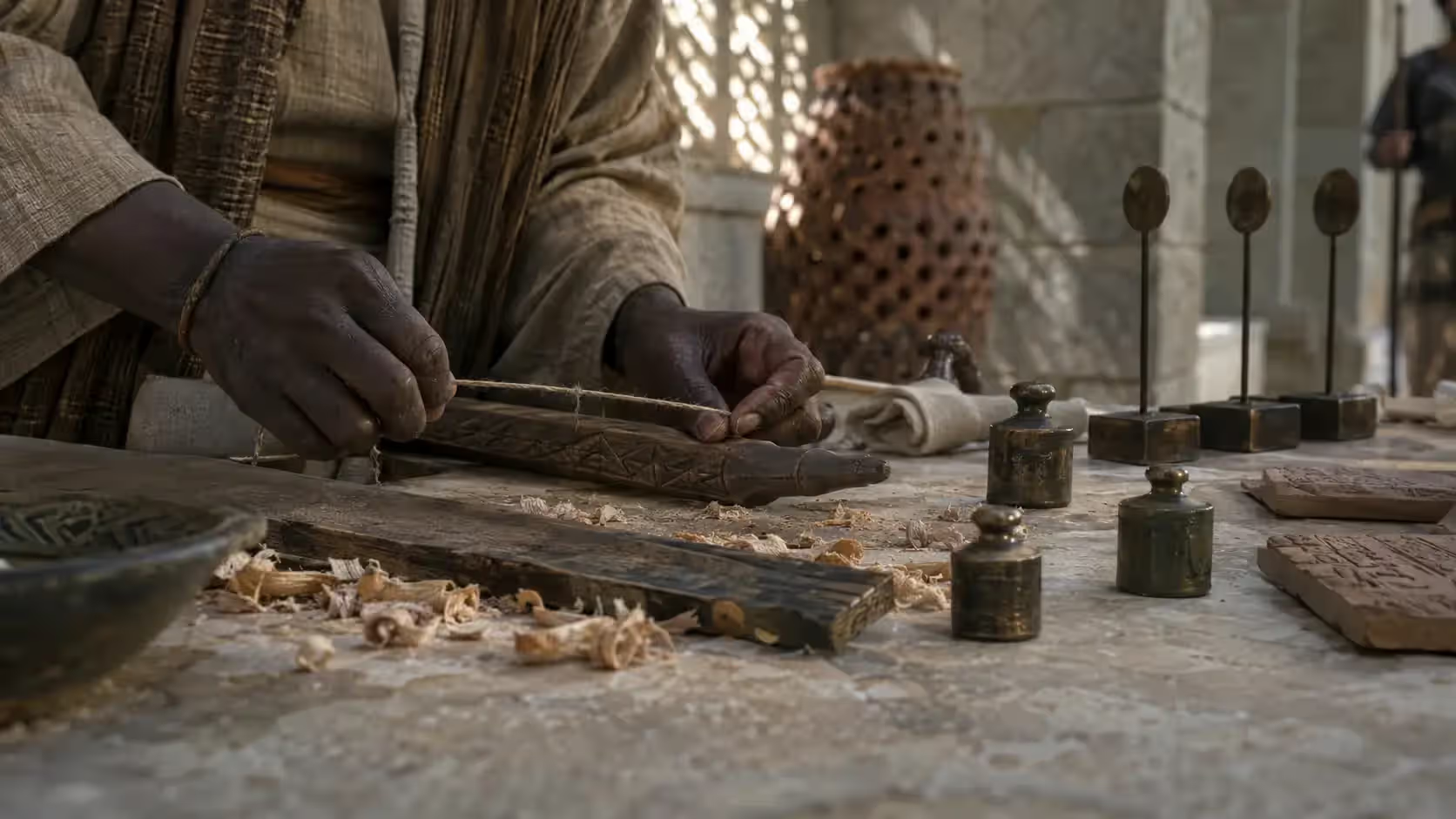
A certification is sat in three stages. The written test is taken on a tablet before a public certifier, in an examination room with a solar screen where the shadow keeps time. The practical test takes place in a proving yard, among markers, ropes and removable stands, or directly at the workplace: a basin, a pen, a relay. The pressure test, finally, puts the candidate in a situation that goes wrong, a panicking animal, a simulated flood, a contradictory order, and watches what they do.
Juries bring together practitioners of the trade and at least one outside arbiter. The result is engraved the same day, on a tablet in the register and, for active certifications, on the sleeve. A failed candidate may sit again at the next session; the failure stays in the register but never appears on the sleeve, which shows only what has been proven.
A certification lives and dies
A certification is not held for life. Active certifications must be practised and renewed: ceratopsian care, riding, wind reading or command are proven again at intervals each trade sets, and always at least once between two Weighings. One that is no longer practised moves among the old certifications: it stays in the register as part of the biography, but it is scraped from the sleeve and authorises nothing any more.
A foreigner reading an Ishtiri sleeve therefore reads what a person can do today, not what they could once do.
Citations and great medals
Sleeves distinguish several kinds of marks. Certifications say what a person is authorised to do. Citations say what they have done: a successful manoeuvre, a team rescued during a flood, a threshold held, an epidemic contained. The great medals, rare, reward acts the whole country remembers, and some have become legendary; children make terracotta copies and fight over them in the courtyards.
All these marks are standardised. Their shape, their place on the sleeve and their colour are the same from one region to another, so that an Ishtiri from the Marche de Keryth can read the sleeve of an Ishtiri from the Islands without error.
Another path: the sky
The sky path follows the same logic as the ceratopsian one. A Bronze who wants to join the wings starts with membrane care and the animals’ kitchen at the foot of the Tours du Zénith, then certifies in-flight behaviour, wind reading, signals and relay riding, and only after that war flight and nacelle handling. Each stage has its juries: a pilot does not judge a carer alone, nor a carer a pilot.
The complete file can open the way to Silver and the Silver Winds. Young signal pterosaurs that cannot fly yet often serve as the apprentices’ first pupils, and the other way round.
Games, duels and races
Games and duels count among the proofs, and Ishtir takes them seriously without making them bloody. Certification duels are fought with blunted weapons and stop at the arbiter’s first signal, which also measures the ability to stop. Ceratops races, mounted lance jousts and nacelle trials, judged on trajectory, manoeuvre and drop time, draw crowds, above all in the Marche de Keryth during Respiration.
A champion of these games earns citations. A victory alone never earns a rank.
The Bureau and its juries
The Réseau has its centre at the Bureau of Certifications in Qer-Aton, which sets the trials, keeps the models of the marks and trains the certifiers. Its juries are itinerant: they travel from region to region on a published calendar, so that the same trials are judged the same way on the Plains, on the Islands and in the March.
The Bureau also follows the cohort houses, where first files are prepared. Each region has its local offices, which keep the registers and run the routine trials, and every local office is itself inspected by a jury from elsewhere.