

Places and landscapes
Ishtir: gates, terraces and relay points
In the garden-fortress, passing a gate or climbing a terrace structures commerce as much as defence.
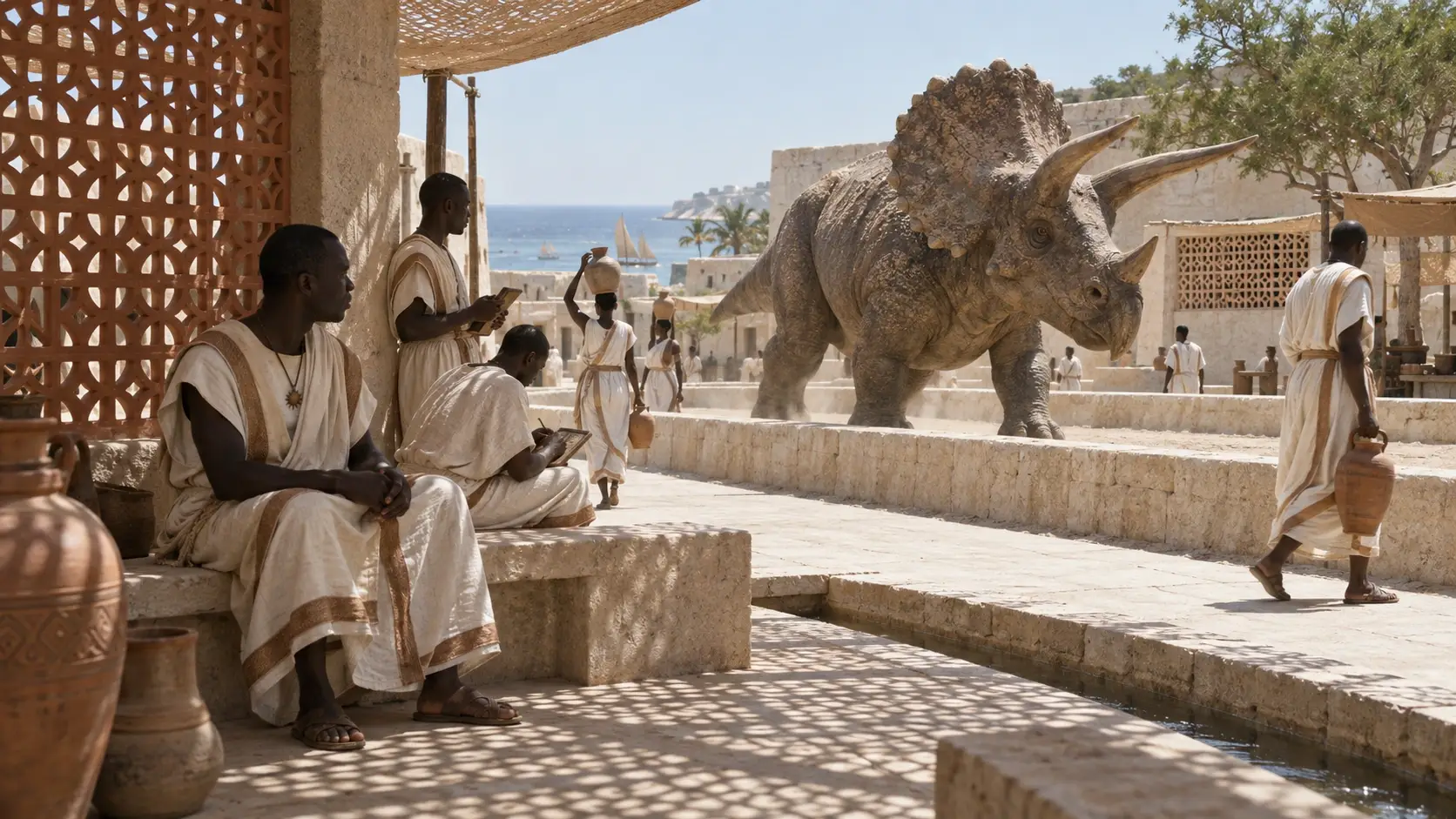
An entrance is a place of sorting
Ishtir is a garden-fortress held by marches, gates and bottlenecks. Guards, carriers, handlers and inspectors organise entry for people, animals and loads. A gate is both a defensive work and a service place: movement slows there, passage is checked, then circulation is distributed towards courts and terraces.
Terraces serve work
Terraces connect crops, stores, handling courts and human passages. Trades moving through them work with changes in level: water, baskets, tools and food are relayed from one level to another. Relay points extend these ways beyond the cultivated core, with water, shade, equipment and signals. A fast signal alerts; it does not replace a convoy or a team on site.
Three belts of thresholds
Ishtir does not defend itself with a single border but with successive belts. The first follows the sea: regulated ports, watched coves, cliffs held by lookouts. The second runs along the limits of regions and marches, where roads cross a pass, a ford or a dyke. The third surrounds the towns and their terraces. A traveller going from the coast to Qer-Aton thus passes through several gates, and each of them knows where he has come from.
There is the great gate and the small gate. The great gate, on the main roads, has two separate passages for people and for animals, a shaded waiting court, a buffer pen, troughs, a care post and a signal tower. The small gate is often no more than an arch beneath a guard post, with a bench, a water jar and a register. The elders say gates multiplied after the Excursion of the Solar Horns, the Arkhan raid that once targeted the eggs and the sanctuaries: since then, no path leads to a nest without crossing a threshold.
The Gate Wardens
The Gate Wardens hold these thresholds. Assigned to the fortified belts, they fight only where the wall opens. Their long pikes are blessed at the threshold of each gate: they are planted in front of the passage rather than carried, and a line of planted pikes is enough to stop a charging great animal. Styracosaurs of the Aru-Qerim line, with their spiked frills, serve them as a mobile guard on the flanks.
A Warden’s ordinary work is less spectacular. He counts passages, reads permits, enters herds on the way in and counts them again on the way out, sends a coughing animal to quarantine and makes a convoy wait when its tablet is badly sealed. The Order of the Wardens, one of the country’s sacred orders, consecrates new gates and blesses the old thresholds every year: a gate is not only a structure, it is a place where the Measure is exercised.
From one terrace to the next
On the slopes, every terrace is itself a threshold. People climb by narrow stairs, animals by gently sloping ramps that wind along the side, and a herd is never made to share the children’s stair. Every twenty or thirty steps a landing offers shade, a water jar and a bronze ring on which to hang a load. Heavy burdens go up in counterweighted baskets, as on the cliffs.
These stairways have a second life in wartime. In many towns the last flights of steps are made of wood and can be lifted away in moments; a ramp is closed with a barrier of logs. A terraced town can thus shut itself off level by level, and an attacker who has taken the bottom must begin the siege again at every landing.
The chain of relays
Beyond the towns, Ishtir’s roads are lined with relays, on average one every three or four leagues. An ordinary relay combines a cistern, a shade, troughs, a fodder store, a few bunks, a small perch for signal pterosaurs and a mirror platform. A Bronze team of six to twelve people holds it in rotation; during the Great Breathing part of the team stays on watch and takes its week back afterwards.
Relays carry mail and alarms. By day the mirror flashes coded signals towards the next relay; by night a fire takes its place. A packet entrusted to relay pterosaurs can cover forty to sixty leagues in a day. Yet the relay replaces neither the convoy nor the team: it announces, it waters, it shelters, and it obliges those who pass to make themselves known.
When the thresholds close
When an alarm is raised, Ishtir closes its thresholds in an established order, from the outside in. Ports send foreign ships back to the anchorage, march gates admit only troops and refugees, then the towns take the country herds into their buffer pens. The Bronze carry water and grain towards the ramparts, the Gate Wardens plant their pikes in the narrows and the relays switch to war signals.
The country was designed to be hard to conquer, but it can be wounded: a threshold holds only as long as it can be supplied and relieved. That is why every gate keeps a reserve of water and food for several days, and why, in the marches, the complete closure of a sector is rehearsed every year, from the first signal to the last bolt.