
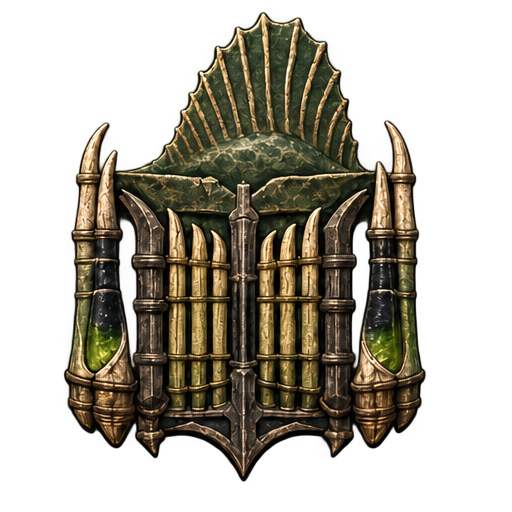
Armies
N’Goro waters, thresholds and biosecurity
Marsh mobility depends on reading waters, care and the authority to close a route.
Each basin has its rules
Water routes are not interchangeable. Their accessibility depends on season, water quality, present species and health risks. Useful mapping notes possible passages and changing limits.
Closing a route is also care
Quarantines, filters, antidotes and inspections can slow or stop circulation. This protects human and animal bodies but costs families, trade and rescue. Biosecurity is political capacity exercised by practitioners.
Signals connect care and movement
Networks of roots, vines, markers and messages convey route changes or alerts. Their value comes from maintenance and local interpretation: an isolated signal does not remove the need to test water or observe the living body concerned.
A force that drinks its road
An Urnok army counts in fodder; a N’Goro force counts in waters. Before setting out, its captain obtains the reading of every basin she intends to cross, from the posts of the Living Mirror or the keepers of coded water, and she sets her stages by those readings rather than by distances. A halt is not fixed where the force is tired, but where the water was read that same day. The Sap-Keeper who travels with each group has the last word on this: if he refuses a water, they move on, even at night.
What the force carries says as much. Each fighter wears a threshold kit suited to the waters of the route, and the force carries crystal-sponge filters in quantity, with their spare discs: in N’Goro they say an army uses up more filters than arrows. Provisions are cakes of tuber and black flour sealed under resin, the only ones that keep in the marsh; the rest comes from fishing and gathering, which the fighters know how to do on the move. A N’Goro force carries few heavy things, and almost everything that keeps it alive fits into flasks.
Who may close a water
The right to close a route does not belong to just anyone, and it operates at several scales. The Sap-Keepers’ Synod can close an entire region; the Black Quarantine, a port or a relay “by protocol”; a recognised quarantine keeper, the channel in his charge; the keeper of a water gate, her quarter. Every closure must be marked on the spot — painted stakes, coloured cords, scent beacons — and announced by drum, then confirmed by liana, so that no single voice is enough to halt traffic.
A closure is lifted the way it was made: by a new reading. Whoever wants to reopen must show that the water has changed, with proof, and it is the same authority, or a higher one, that confirms it. This right makes biosecurity a diplomatic weapon. A quarantine can act as a blockade without a declaration of war, and the neighbours know it: when a N’Goro port closes for a fever, the foreign merchants waiting on the bank never quite know whether the fever is the only reason.
Taking the marsh along
N’Goro’s great weakness is dry, open ground, and its war leaders know it. When the country must fight outside its biome, it tries to take part of its marsh with it. At the Three Waves, the thirty thousand fighters detached to Arkhan held the wing’s wet plain, made of canals and clay soils; their terrain corps opened or blocked the canals at night, changed the bearing of the soil and prepared treacherous strips of ground where heavy beasts sank. They carried their own filters, their resin-sealed provisions and their Sap-Keepers.
That war also showed the method’s limit. The contingent held its flank, pinned enemy reinforcements by opening a canal behind a levee, then refused to pursue onto the great dry slab of the centre, where neither its waters nor its beasts would have followed. It pulled back methodically towards the canals, its mission done. N’Goro’s instructors still tell their pupils about it: a N’Goro force goes as far as its water goes, and not one step further.